






















Jahia vs. CoreMedia: in-depth comparison at a glance
| Features | Jahia | CoreMedia |
|---|---|---|
| Architecture | Composable, hybrid headless. GraphQL API with visual editing | Composable, hybrid headless. GraphQL API with visual editing |
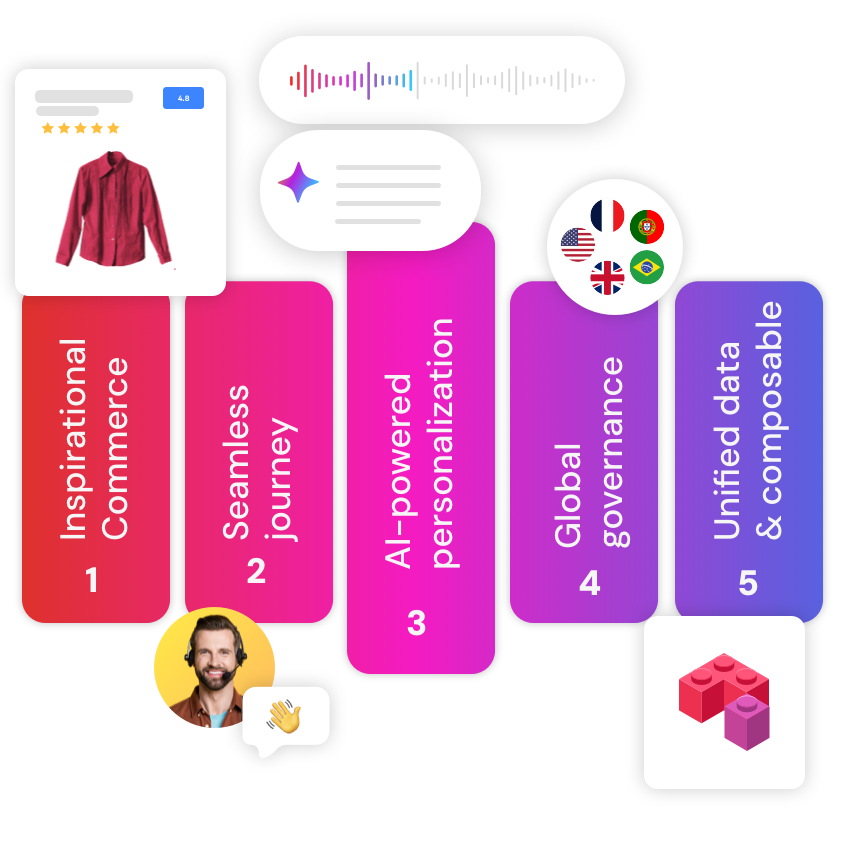
| Primary focus | Content, portals, and personalization for websites and multilingual programs | Governed, multi-language content and personalization, extended into shoppable commerce and conversion-focused human engagement |
| Real-time personalization and experimentation | Real-time segmentation and A/B testing, powered by Apache Unomi | Real-time personalization and experimentation with A/B testing and multivariate testing |
| Commerce | Connects to commerce systems through standard connectors | Native shoppable content plus Commerce Hub integration with platforms such as SAP and Salesforce Commerce Cloud |
| Customer engagement | Self-service portals and authenticated experiences | Native contact center: live chat, click-to-call, video shopping, and an AI voicebot |
| AI assistance | Embedded AI, choice of model, human approval before publishing | CoreMedia KIO, choice of model, human approval, plus live contact center support |
| Deployment | Public cloud, private cloud, or on-premises | Public cloud, private cloud, or on-premises |
| Best fit | Intranets, portals, and multilingual corporate sites | Global, multi-brand enterprises converting across digital and human channels |
Frequently Asked Questions (FAQs)
What is the main difference between Jahia and CoreMedia?
The main difference between Jahia and CoreMedia is that CoreMedia adds native shoppable commerce and a built-in contact center to a shared content, customer data, and personalization foundation. Jahia is a Java-based, hybrid headless DXP focused on content management, portals, and personalization, while CoreMedia extends that same foundation so a journey can move from content to a purchase or a live person in one platform.
Is CoreMedia a good alternative to Jahia?
CoreMedia is a strong Jahia alternative for enterprises that need commerce and human-assisted service alongside content and personalization. Both are composable, hybrid headless DXPs with a CMS, a customer data platform, and AI-assisted authoring, so the case for CoreMedia as an alternative rests on its native shoppable commerce and contact center. CoreMedia is not commerce-only: it also runs large public-sector platforms, including the German Bundestag, GTAI, and Enterprise Ireland, where governed, multilingual, accessible content matters most. If your program is content-, portal-, or intranet-led without those needs, Jahia remains a capable fit.
Is the contact center the only thing that separates CoreMedia from Jahia?
No, the contact center is not the only thing that separates CoreMedia from Jahia. The other main difference is CoreMedia's native ability to make content directly shoppable, which Jahia does not offer natively. CoreMedia's shoppable commerce and its cloud contact center both build on the same CMS and customer data platform that Jahia also offers. The difference is that CoreMedia runs all of it in one system, so a shopper can move from a shoppable article to checkout to a live agent on video or chat without leaving the platform.
How do you migrate from Jahia to CoreMedia?
Migrating from Jahia to CoreMedia is a phased process rather than a single rebuild, so your current site stays live while content, workflows, and integrations move in stages. Because CoreMedia manages content as structured, reusable objects, the migration is a chance to restructure and reduce duplication instead of copying pages across. Clear governance keeps publishing running throughout the transition.
Can CoreMedia integrate with my existing commerce and CRM stack?
Yes, CoreMedia integrates with your existing commerce and CRM stack through CoreMedia Commerce Hub and a library of pre-built integrations, so there is no rip-and-replace. It connects to commerce platforms such as SAP and Salesforce Commerce Cloud through dedicated APIs, letting you keep your current systems while adding shoppable content on top.
Do marketers need developers to manage CoreMedia?
Marketers do not need developers for day-to-day work in CoreMedia, because its hybrid headless model pairs an API-first backend with a WYSIWYG visual editor. Editors manage layouts and preview content across channels and devices without a developer, while developers use the GraphQL API to build front ends in React or other frameworks. That split keeps marketing teams self-sufficient after a switch from another DXP.
How much do Jahia and CoreMedia cost?
Jahia and CoreMedia both use custom, tiered pricing rather than a fixed public price, so you contact the vendor for a quote based on your needs. Expect the total to reflect the capabilities you need, such as advanced analytics, integrations, and support, on top of the base platform.