























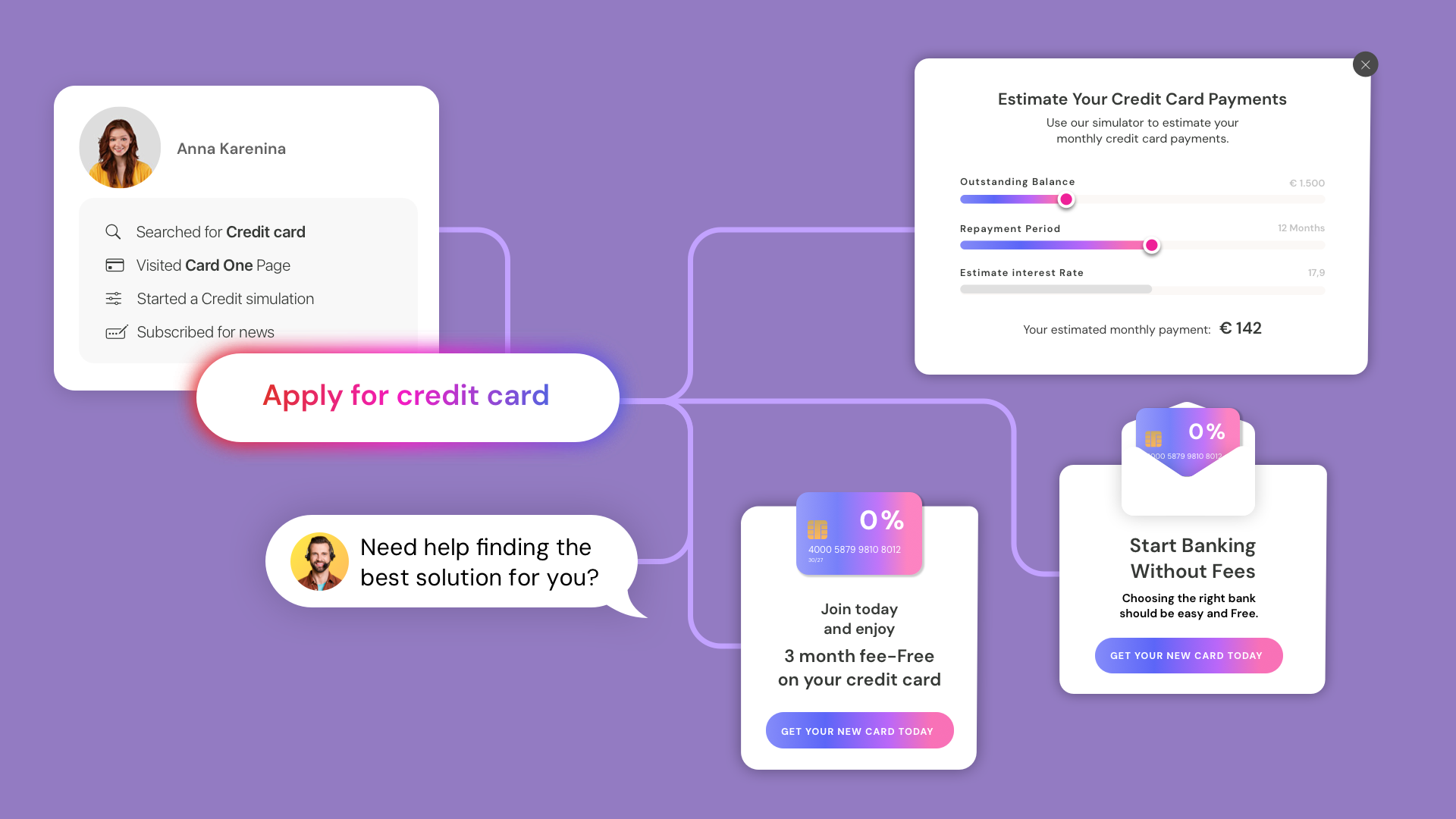
This is where modern intent based marketing evolves beyond traditional targeting. Modern intent marketing focuses on identifying customer intent through behavioral data, search intent, and real-time online behavior, adapting the digital experience immediately. Organizations respond to active intent signals that indicate real purchase intent during the buying journey.
The shift represents a broader change in intent-based marketing strategies. Rather than targeting people based on "what audience segment they belong", enterprises are responding to what they are "trying to accomplish right now". Behavioral patterns - such as repeated visits, product comparisons, and engagement with high-value content - reveal customer behavior and help identify high intent leads far more effectively than traditional segmentation. Yet many intent based marketing tools still focus primarily on collecting intent data and generating insights. Without the ability to orchestrate experiences instantly, even strong intent signals rarely translate into higher conversion rates.
With CoreMedia’s Digital Experience Platform (DXP), enterprises can transform intent based marketing from passive data analysis into real-time experience orchestration - using first party intent data and behavioral signals to deliver personalized content, contextual commerce experiences, and timely engagement that moves buyers toward conversion.
Why intent-based marketing is the new standard for ROI
Large budgets of many enterprises are still spent on broad marketing campaigns, targeted ads, and funnel-driven lead generation tools that focus primarily on lead generation rather than real-time engagement. This “spray and pray” model generates traffic but rarely produces consistent revenue outcomes. Intent based marketing shifts the focus toward prospects already showing buying signals and behavioral intent, allowing organizations to concentrate marketing efforts on high intent prospects and active accounts that are actively progressing through the buyer's journey. By prioritizing these opportunities, enterprises can improve efficiency and drive stronger ROI.

This shift is also reinforced by the growing importance of first party data as privacy regulations reshape digital marketing. As reliance on third party intent data from external third party sources declines, observing customer behavior, search behavior, and on-site engagement provides more reliable and compliant intent signals, insights that reveal real purchase intent.
Acting on these signals also helps shorten the sales process, particularly in complex B2B or luxury purchasing environments. When sales and marketing teams recognize active intent - such as repeated product research or visits to a pricing page - they can deliver timely engagement, relevant content, or targeted sales outreach, guiding prospects more efficiently toward conversion.
This evolution explains why intent based marketing is important for enterprises seeking more efficient growth.
Deconstructing intent: Signals, sources, and behavior
Not all intent signals indicate the same level of buyer readiness. Some reflect early research, while others reveal clear purchase intent.
A key distinction is between passive and active intent:
- Passive signals appear when users consume general content such as blogs or videos, reflecting early exploration.
- Active intent, however, emerges through behaviors closely tied to evaluation - such as repeated visits to product pages, comparisons, or a pricing page - which often signal stronger buying intent.
The source of the data is equally important:
- First party data from your website, apps, or CRM provides the most reliable view of customer behavior and engagement, enabling organizations to recognize real opportunities and respond with intent driven marketing.
- Zero-party data refers to information that customers intentionally share with a brand, such as preferences, product interests, or survey responses. Because it is provided directly and voluntarily, zero-party data can offer highly accurate insights into customer intent and expectations.
- Third party intent data from external third party providers can reveal broader market interest.
To operationalize this, many enterprises map signals to an intent taxonomy aligned with the buying journey:
- informational intent (research),
- commercial intent (evaluation),
- and transactional intent (ready to buy).
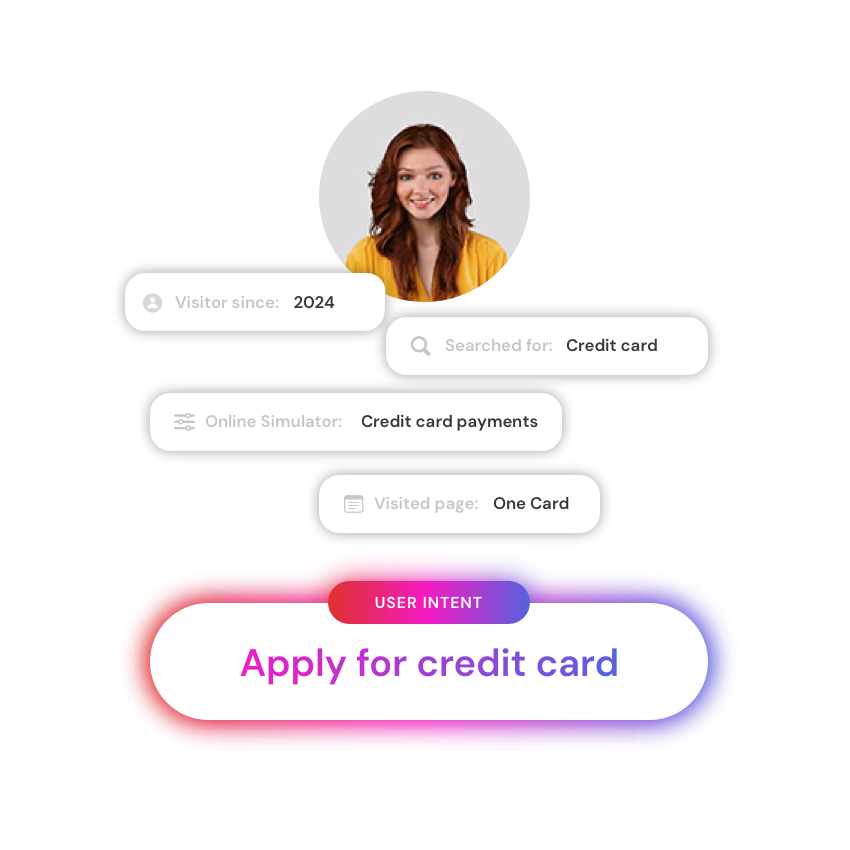
The "Missing Link": From identification to activation
Many organizations invest heavily in collecting intent data but struggle to act on it in real time. Identifying buying intent or high intent prospects means little if visitors still see generic experiences that ignore their intent signals. Windows of intent are small. If visitors don't find what they look for, they leave.
The missing link is activation through personalized content. When customer intent of target users becomes clear - such as interest in a specific product category - the digital experience should immediately adapt with targeted messages, relevant products, and contextual recommendations.
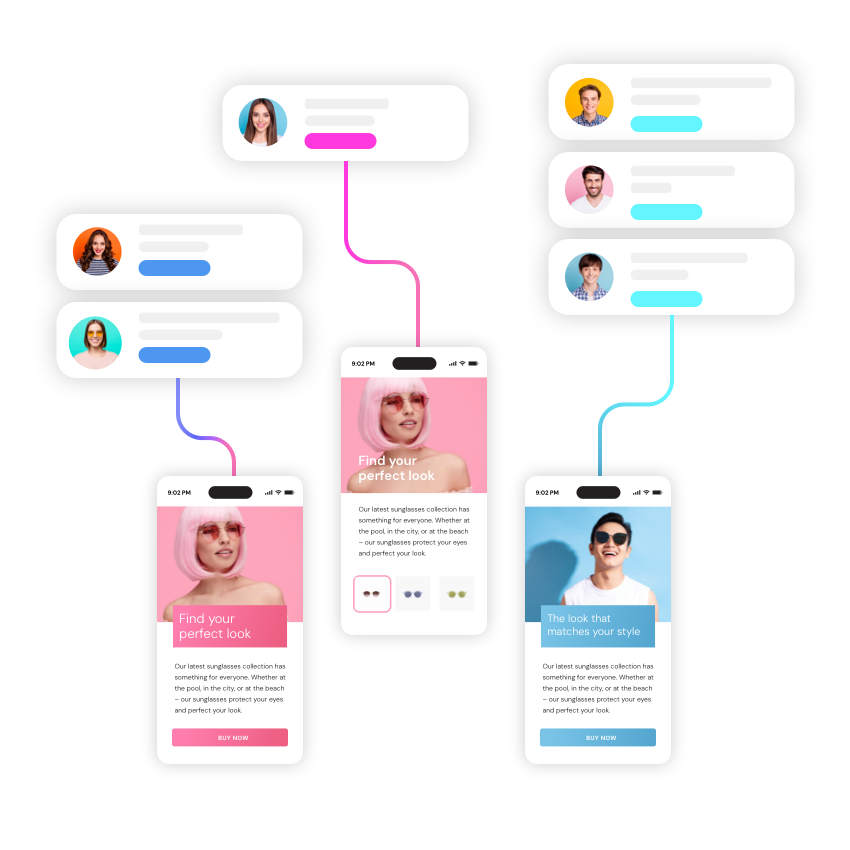
Platforms like CoreMedia’s DXP enable marketing teams to orchestrate personalized digital experiences without relying on lengthy development cycles. By combining first party intent data, behavioral insights, and flexible content orchestration, enterprises can deliver hyper-personalized experiences - adjusting layouts, product recommendations, and messaging in real time based on how customers engage.
Operationalizing intent: A 4-Step framework
Turning signals into revenue requires a clear intent based marketing strategy that connects data, content, and engagement across the buying journey.
Step 1: Capture and unify data
Enterprises must combine analytics, CRM systems containing contact data, and commerce platforms to build a unified view of behavioral data. By activating first-party data across these systems, organizations can gain reliable intent signals while maintaining a privacy-first approach and a clear understanding of how prospects move through the buyer’s journey.
Step 2: Score & segment
Using AI, analytics, and machine learning models, intent based marketing tools can analyze behavioral signals and assign intent scores that distinguish early research from real purchase intent, helping marketing and sales teams prioritize in-market buyers and identify prospects who are ready for deeper engagement.
Step 3: Orchestrate the experience
Dynamic Content: Swap images, messaging, and product highlights through the CMS based on real-time intent signals.
Activate the right interaction at the right moment. Editorial content, product pages, and campaigns adapt to user intent, while tools like live chat, SMS, or personalized follow-ups help guide customers toward the next step in their journey. Intent signals can also inform email campaigns, ensuring follow-up content reflects the user’s current interests.
Step 4: Trigger human engagement (The CoreMedia Differentiator)
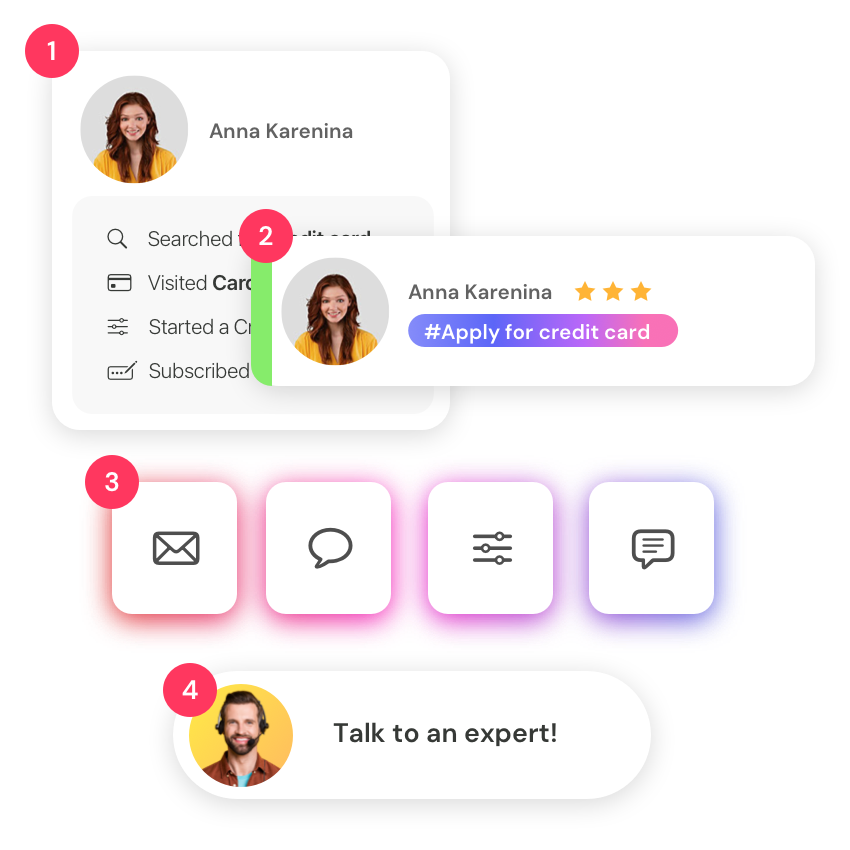
For high-value purchases, digital experiences alone may not be enough. When strong intent signals appear - such as repeated product exploration or hesitation near checkout - organizations can prompt proactive sales outreach or live engagement to guide the decision and accelerate conversion.
This is reflected in our own study: "76% of respondents confirmed the added value of personal advice from real people, especially when buying expensive products or complex services."
Bridging the gap: Combining content and contact centers
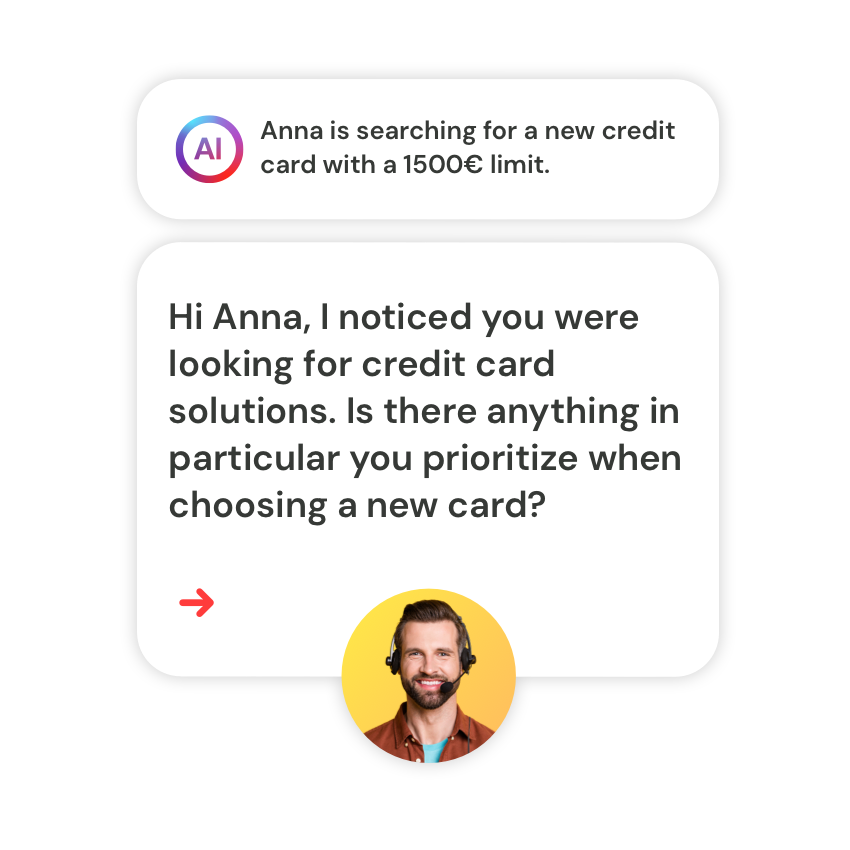
Most digital platforms stop at automated personalization. They detect intent signals and adapt content, but when customers need human guidance, the experience breaks. At the same time, many contact centers operate without visibility into the customer’s digital journey and associated contact data, forcing sales teams and support agents to start conversations without context.
This is where the “human in the loop” becomes critical. Strong intent signals - such as extended time on a product page, repeated comparisons, or deep engagement with technical content - often indicate that a prospect is close to a decision but needs reassurance. Instead of leaving the customer to navigate alone, organizations can trigger timely sales outreach or live engagement.
By connecting digital experiences with contact center capabilities, CoreMedia enables agents to see the customer’s web journey, recent customer behavior, and engagement history before interacting. This creates true omnichannel consistency, ensuring the offer and messaging a customer sees on the website aligns with what they hear from an agent via chat, phone, or video.
As an example, Spanish telecom provider MásMóvil demonstrates the impact of connecting digital journeys with human engagement. The company handles more than 7,000 customer calls per day and generates around 150 daily sales supported by CoreMedia. Today, 65% of MásMóvil’s mobile-only sales and 100% of its bundle sales are enabled through CoreMedia-powered experiences. With a 360° view of the sales process, MásMóvil can build stronger leads and make smarter investment decisions.
Real-world use cases by industry
Luxury Retail
A customer reads a “Summer Trends” blog or explores a seasonal lookbook. This behavior signals growing customer intent around specific products or styles. The experience can immediately adapt - turning the lookbook into a shoppable experience while offering a live stylist chat for VIP segments, helping convert inspiration into purchase.
B2B Manufacturing
A prospect repeatedly visits a product page for an industrial solution, such as an industrial turbine, signaling strong buying intent. The website can respond by highlighting relevant case studies or technical resources, while alerting sales teams so they can initiate timely sales outreach with context about the prospect’s research activity.
Telecommunications
A returning customer searches for information about roaming charges. Instead of forcing further navigation, the platform recognizes intent from target users signals and immediately surfaces relevant travel bundles or upgrade options in the app or dashboard, simplifying the decision and improving conversion rates.
Common pitfalls in intent marketing
Data silos: Many organizations collect valuable intent data, but it remains fragmented across marketing, sales, and support systems. Marketing teams may see web activity while sales teams lack visibility into the customer’s digital journey. A unified platform that connects marketing, sales, and service teams ensures everyone can access the same intent signals and act on account behavior across the buying journey.
Slow reaction time: Identifying intent signals is only useful if organizations respond quickly. Analyzing customer behavior in weekly reports often means the moment of active intent has already passed. Effective intent driven marketing requires real-time insight and immediate experience orchestration.
Creepiness factor: Personalization must feel helpful, not intrusive. The key is value exchange: when first party data and intent signals are used to deliver genuinely relevant content, recommendations, or support, customers perceive personalization as useful rather than invasive.
Measuring success: KPIs for intent strategies
Conversion rate (CR): The most direct measure of success. If intent signals are correctly identified and activated through personalized experiences, conversion rates should increase as more high intent prospects move toward purchase.
Time on site / Engagement score: Metrics such as time on site, repeat visits, and interaction depth help evaluate whether content aligns with customer intent. Strong engagement patterns often indicate that marketing efforts and content personalization are resonating with the target audience.
Customer acquisition cost (CAC): As intent-based marketing improves targeting and focuses resources on high intent accounts, acquisition costs should decrease while overall marketing efficiency improves.
Pipeline velocity: In B2B environments, intent insights should accelerate how quickly prospects move from early research to qualified opportunities and closed deals. Faster pipeline movement indicates that intent driven marketing is helping sales teams prioritize and engage the right accounts.
Recovered abandoned journeys: Tracks users who return to complete previously abandoned actions - such as a product simulator, shopping cart, or application form - indicating that intent-driven engagement is successfully reactivating high-intent prospects.
Conclusion: The future is composable and real-time
Intent based marketing is about agility - recognizing intent signals from search behavior, engagement patterns, and prospect data, and ultimately responding the moment customer intent becomes clear. Enterprises already collect vast amounts of first party data through analytics platforms and intent based marketing tools, but the real advantage comes from transforming that information into actionable marketing intelligence.
This is where composable, real-time customer engagement platforms become essential. CoreMedia enables organizations to act on intent data by combining dynamic content experiences with human engagement. By using compliant data and behavioral insights, enterprises can deliver targeted messages, personalized product discovery, and timely interaction that helps convert high intent prospects during active evaluation.
Ready to turn your traffic into transactions? Discover how CoreMedia's Digital Experience Platform can operationalize your intent data and transform digital signals into measurable revenue outcomes.
FAQ Section
What is the difference between Intent-Based Marketing and Account-Based Marketing (ABM)?
Intent-based marketing and account-based marketing (ABM) address different parts of the same challenge. ABM focuses on "who" to target - typically a predefined list of strategic accounts that sales and marketing teams want to win. Intent-based marketing focuses on "when and how" to engage those accounts, using behavioral signals that reveal active interest or purchase intent.
In practice, the two strategies work best together. Intent signals help organizations identify which accounts on their ABM list are currently researching solutions or showing buying behavior. Platforms like CoreMedia’s Digital Experience Platform (DXP) allow companies to act on those signals in real time by adapting content, product experiences, and engagement strategies for those high-value accounts.
How do you collect intent data without third-party cookies?
As privacy regulations and browser restrictions reduce the reliability of third-party cookies, organizations increasingly rely on first-party data and behavioral tracking within their own digital properties.
This includes signals such as:
- page visits and search behavior.
- product comparisons and content engagement.
- authenticated user sessions and account activity.
These signals provide highly reliable insights into customer intent while remaining compliant with privacy frameworks. With CoreMedia’s DXP, organizations can capture and interpret these first-party intent signals directly from their websites, apps, and commerce experiences - turning behavioral data into personalized content and engagement in real time.
What tools are needed for intent-based marketing?
Effective intent-based marketing requires a connected technology stack that can capture signals, interpret intent, and activate experiences.
Platforms such as CoreMedia’s Digital Experience Platform (DXP) play a central role by enabling organizations to orchestrate personalized content and commerce experiences based on real-time intent signals.
Most enterprises rely on three core systems:
- Digital Experience Platform (DXP): orchestrates personalized content and commerce experiences.
- Customer Data Platform (CDP) or CRM: stores customer profiles, account data, and engagement history.
- Analytics platforms: identify behavioral patterns and intent signals across digital channels.
- Marketing automation: schedules campaigns often based on pre-defined funnels.
When these systems work together, organizations can recognize intent signals, understand customer behavior, and respond with personalized experiences that guide prospects through the buying journey.
Can intent marketing work for B2B?
Yes - intent-based marketing is especially valuable in B2B environments where buying cycles are longer and involve multiple stakeholders.
In complex B2B journeys, prospects often conduct extensive research before engaging with sales teams. Intent signals - such as repeated visits to product pages, downloads of technical resources, or comparisons of solutions - help organizations identify which accounts are actively evaluating options.
With CoreMedia’s DXP, companies can respond to these signals immediately by highlighting relevant case studies, technical documentation, or tailored experiences for those in-market accounts, helping sales teams engage prospects at the right moment.
What industries benefit most from intent-based marketing?
Intent-based marketing can benefit almost any industry where customers conduct digital research before making a decision. It is particularly valuable in sectors with complex buying journeys, such as B2B manufacturing, luxury retail, telecommunications, financial services and utilities.
What role does AI play in intent-based marketing?
Artificial intelligence helps organizations analyze large volumes of behavioral data to detect patterns that indicate customer intent. AI and machine learning models can identify trends in user behavior, predict purchase intent, and help teams prioritize high-value opportunities.
These insights allow organizations to respond faster and deliver more relevant experiences. AI-driven insights can help personalize content, recommend products, and trigger engagement when intent signals suggest a prospect is actively evaluating options.
What are examples of intent signals in digital marketing?
Intent signals are behavioral indicators that suggest a prospect is actively researching or evaluating a product or solution. These signals help organizations understand where a customer is in the buying journey and whether they are moving toward a purchase decision.
Common examples of intent signals include repeated visits to product or solution pages, time spent reviewing pricing information, product comparisons, downloads of case studies or technical documentation, and searches related to specific features or solutions. Engagement with email campaigns, webinars, or in-depth content can also indicate growing purchase intent.
Platforms like CoreMedia's DXP allow organizations to capture and interpret these signals in real time. By analyzing how users interact with content, products, and digital touchpoints, companies can deliver personalized experiences that align with customer intent and guide prospects toward conversion.
How do you identify buying intent in digital marketing?
Identifying buying intent requires analyzing patterns of behavior rather than relying on a single interaction. Organizations typically combine insights from analytics platforms, CRM systems, and customer data platforms to detect when a prospect moves from general research into active evaluation.
By scoring behavioral signals—such as repeated research activity, engagement with product-focused content, or interactions across multiple touchpoints—teams can prioritize accounts that are most likely to convert.
CoreMedia’s helps operationalize this process by connecting intent signals with real-time experience orchestration. This enables marketing and sales teams to respond quickly with personalized content, product recommendations, or targeted engagement that supports the decision-making process.