





















Enterprise replatforming is one of the largest tech investments a content management strategy will carry over a decade. Comparing the cost of implementing a headless CMS vs. monolith CMS by initial setup alone misses the total cost of ownership (TCO) that actually matters: maintenance, developer dependency, campaign delays, and the cost of falling behind shifting market demands.
The industry debate framing this as a binary choice misses a third option. Hybrid headless keeps the API-first delivery of pure headless while preserving the visual editing experience marketers depend on, removing the hidden costs that bite both legacy systems and pure headless setups. It is the architecture CoreMedia has built around, and the lens this comparison will use to surface where the real money goes.
Understanding the baseline: Monolithic vs. Headless architecture
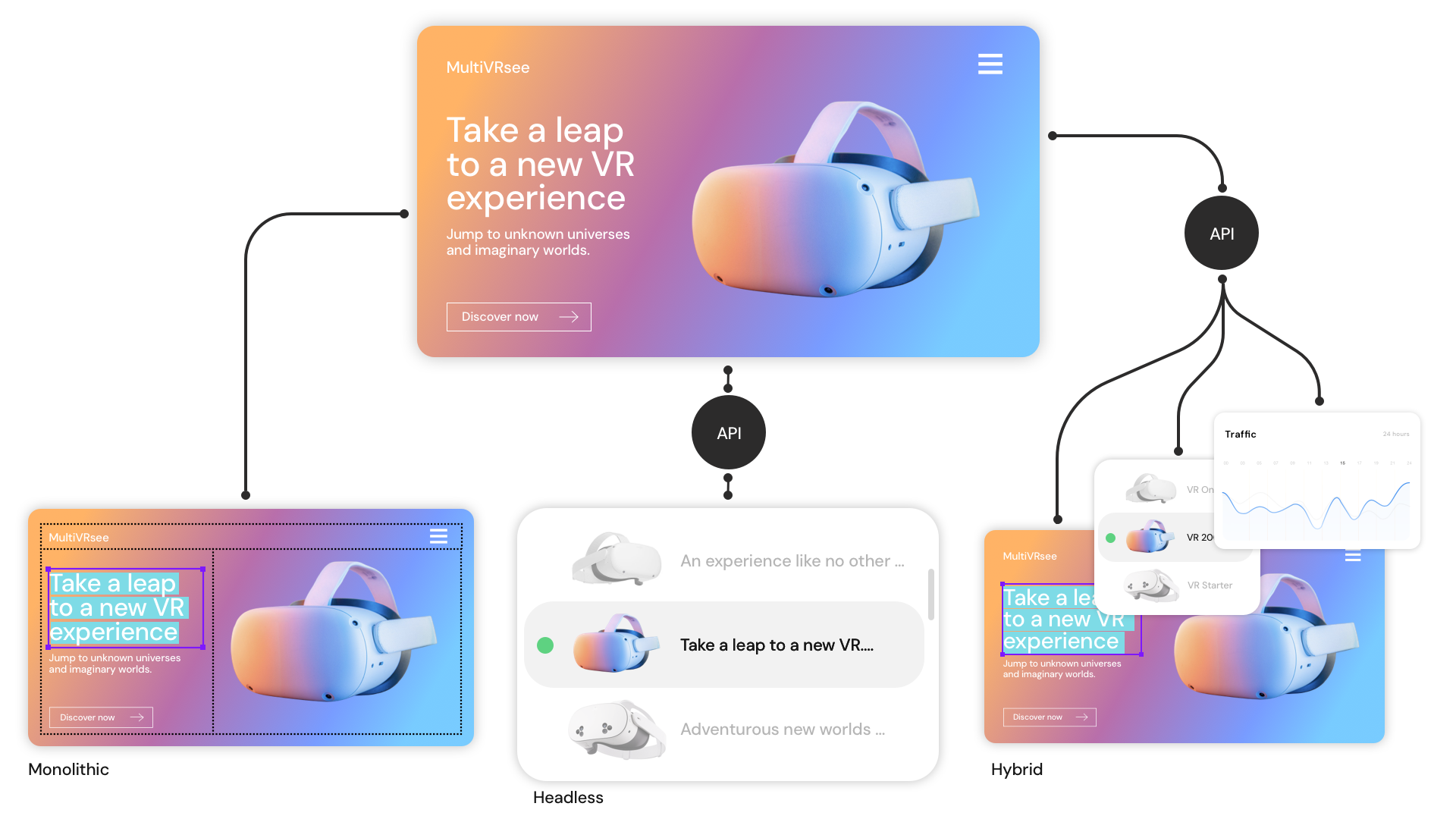
A monolithic CMS (or traditional CMS) stores, manages, and renders content from one tightly coupled platform. WordPress is the canonical example. Adobe Experience Manager and Sitecore XP were built as monolithic suites and still run that way in most enterprise installations, though both vendors have since launched headless or composable variants (AEM as a Cloud Service, Sitecore XM Cloud) in response to where the market is moving. The presentation layer ships with the system; templates, plugins, and the database all live in one stack.
A headless CMS separates the backend content repository from the presentation layer entirely. In a headless architecture, content is delivered as structured content through APIs (typically REST or GraphQL) to whatever frontend the team chooses to build: a Next.js website, a native iOS app, digital signage in a store, a voice interface. Contentful, Contentstack, and Strapi are common headless CMS platforms.
Two pressures broke the traditional CMS model for global enterprises:
- Omnichannel reality: Content now needs to reach websites, mobile apps, smart devices, digital signage, in-store screens, contact center agents, and AI systems that answer for your brand. Monolithic systems were built when "the channel" meant a single web page.
- Composable expectations: Gartner predicts that by 2026, at least 70% of organizations will be mandated to acquire composable DXP technology, as opposed to monolithic DXP suites, up from around 50% in 2023.
The fact that the legacy incumbents themselves are repositioning toward composable and headless is the clearest signal that the traditional model has reached its limits. Both architectures have real strengths and real costs.
Breaking down the costs: Monolithic CMS implementation
Initial setup costs vary dramatically between open-source and proprietary platforms. Open-source options sit on the low end: Drupal core is free, and managed offerings like WordPress VIP start from $25,000 per year, scaling with monthly unique visitors.
Proprietary enterprise suites land in a different bracket. Adobe Experience Manager annual licenses start in the six-figure range and climb significantly from there. Sitecore implementations in 2026 typically start at $150,000 to $350,000 for smaller and mid-market deployments and exceed $1 million for large multi-site enterprise programs, with licensing alone ranging from $40,000 to several hundred thousand dollars annually depending on the edition (XM, XP, or XC) and traffic tier. The newer composable variants (AEM as a Cloud Service, Sitecore XM Cloud) restructure how the cost lands but do not eliminate it. Even open-source platforms still require professional services to scale into a true enterprise content management setup.
The real cost of monolithic platforms shows up after launch, and it almost always exceeds what was planned:
- Maintenance costs and technical debt. Plugins accumulate. Custom code piles up against the core. Security patches require coordinated downtime. Database performance degrades. By year three, a growing share of the engineering budget goes to keeping the system running rather than building anything new.
- Performance drag on core web vitals. Monolithic systems tend to ship more JavaScript and rely on heavier server-side rendering. Slow page loads damage search rankings and conversion at the same time, and the fix usually means more caching layers, more CDN spend, or a partial re-architecture.
- Scaling globally is expensive. Multi-language, multi-region content programs often require duplicate instances, parallel infrastructures, and separate maintenance teams. A brand running 12 markets on a traditional CMS is usually paying for far more than 12x the complexity.
- Security costs scale with surface area. Because the editing interface and the public-facing site share a system, every public visit is potentially an attack vector. Security patches must be applied across the entire stack.
The headline price is the license. The actual total cost of ownership is the price of running the platform across markets, regions, and channels for a decade.
Pure Headless CMS implementation: what it actually costs
A pure headless architecture separates content storage from content presentation, so the same content can flow to a website, a mobile app, digital signage, a kiosk, or a third-party experience. Most modern headless platforms deliver this through a Content as a Service model: content lives in a vendor-managed cloud repository, accessed through APIs, billed on consumption. You are not buying software to install, you are buying ongoing access to a content service. The headless architecture also reduces some maintenance costs because the backend is simpler and the attack surface is smaller.
The cost shifts, though. It does not disappear.
- Consumption-based SaaS pricing. The Content as a Service model means headless CMS platforms price on API calls, bandwidth, content records, environments, and seats rather than a flat license. At enterprise scale, those line items compound quickly and overage fees on usage spikes are common. Contentstack annual contracts typically range from approximately $30,000 to over $200,000 based on actual buyer transactions, and Contentful enterprise contracts commonly land in the mid-five-figure to six-figure range. Volume tiers, overage fees, and connector pricing are easy to underestimate.
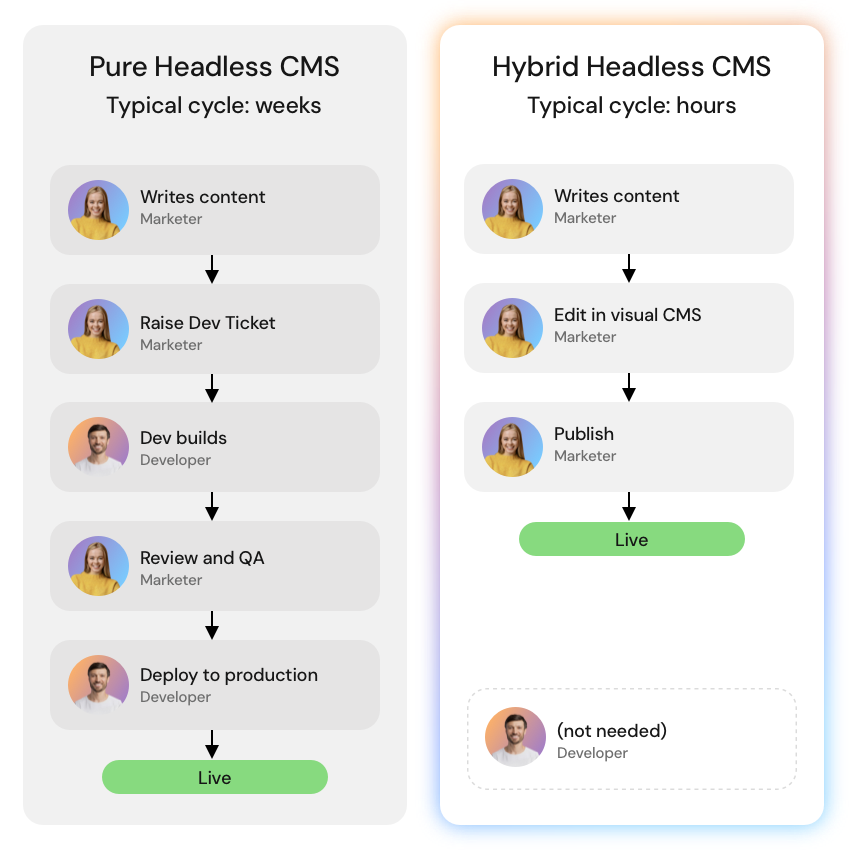
- Developer dependency becomes the bottleneck. A pure headless setup needs frontend developers (typically working in React, Next.js, or Nuxt) for almost every visible change to the experience. Building a landing page, adjusting a hero image, launching a campaign, all require engineering tickets. Development costs go up, but more importantly, time-to-market gets worse.
- Marketing teams lose visual authoring. Without WYSIWYG tools, content teams cannot see their work in context. They author in abstract content models, hand off to developers, and wait for a deployment to see whether anything actually rendered correctly. This is the single most underestimated cost in headless CMS adoption.
- The frontend is now your problem. A traditional CMS ships with a presentation layer. A pure headless CMS does not. You build it, you maintain it, you handle SSR, image optimization, edge caching, performance optimization, and accessibility. Headless CMS platforms make this faster than building from scratch, but it is still real engineering work.
Pure headless can lower long-term TCO when an organization has a strong frontend engineering culture, a single primary channel, and a marketing team comfortable working through developers. For most enterprise marketing teams managing campaigns across multiple platforms, the math is less generous than the vendor pitch suggests.
The hidden TCO (Total Cost of Ownership) factors in enterprise CMS
These are the costs that rarely show up in side-by-side pricing tables, but they decide whether a replatform actually pays off.
Time-to-market is the largest hidden cost.
Every campaign delay is a revenue delay. Forrester reports that in 2024, 90% of global technology decision-makers anticipated increasing their budgets for consumer-facing digital products and services over the next 12 months, but that investment only converts if teams can ship at the speed of the market. When marketing waits weeks for a developer to publish content, the budget is spent and the revenue is not earned.
Integration cost is where DXP programs actually break.
Gartner's 2025 Magic Quadrant for DXP highlighted that the market is shifting decisively toward composable, modular architectures, specifically because organizations are tired of paying integration tax on monolithic suites that promised an end-to-end solution and delivered another set of things to connect. Both traditional CMS platforms and pure headless systems struggle with integration for opposite reasons: traditional CMS systems assume their built-in tools will be used, pure headless assumes you will integrate everything yourself.
Global fragmentation compounds quietly.
Each brand site, e-shop, and regional property managed in isolation creates duplicate workflows, duplicate licensing, and duplicate translation work. The administrative cost is rarely line-itemed, but it is significant.
Disconnected data prevents personalization.
A CMS that does not talk to commerce, CRM, or customer data results in content that cannot adapt to who is reading it. The lost conversion is the most expensive item on the list, even though it never shows up as a CMS cost.
Lowering CMS migration costs with "Hybrid Headless"
A hybrid headless CMS is an API-first content platform that keeps the WYSIWYG interface marketers depend on. Content is structured, reusable, and deliverable to any channel through APIs, while editors work in a real-time preview environment that shows exactly how content will render before it goes live.
CoreMedia has built the enterprise version of this architecture: the API-first delivery of pure headless, the visual control of a traditional CMS, none of the scaling pain of either, and none of the developer dependency that quietly drains pure headless budgets.
Three things make hybrid headless cheaper to run at enterprise scale:
- Marketing operates without an engineering ticket. Editors create, preview, schedule, and publish content across web, mobile apps, and other channels without waiting on the frontend team. Development costs drop because developers are building product, not pushing content. Campaign cycles compress.
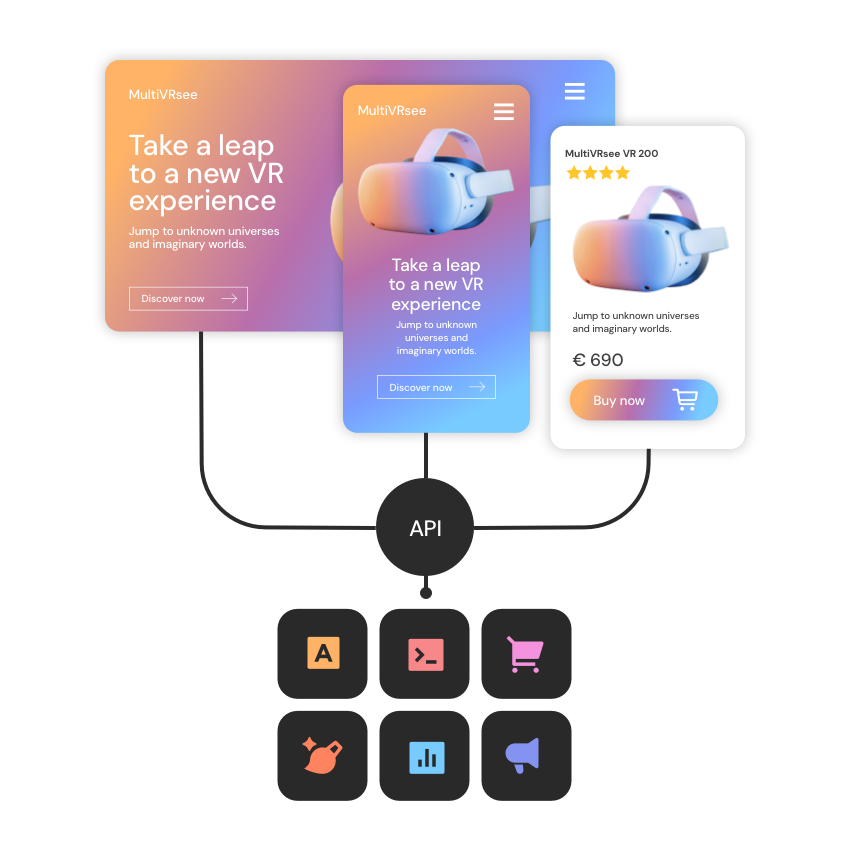
- One content model serves every channel. Structured content authored once flows to websites, mobile apps, digital signage, kiosks, contact center agents, and AI systems. There is no duplication across multiple platforms and no need to keep separate content stores in sync.
- Composable architecture means no rip-and-replace. A hybrid headless CMS plugs into the commerce, CRM, DAM, and analytics tools an enterprise already runs. Salesforce Commerce Cloud, SAP, Adobe Analytics, and similar systems integrate through pre-built connectors. The existing tech stack is protected.
Beyond standard composability, CoreMedia adds two TCO advantages most composable platforms lack:
- Native personalization and experimentation. Personalization rules, audience segmentation, and A/B testing live inside the CMS, with no separate license, integration, or editorial workflow. This removes the recurring cost and integration overhead of standalone personalization engines and experimentation platforms.
- Concurrent user licensing. Per-seat licensing penalizes large global teams. CoreMedia's concurrent user model lets enterprises scale editorial access across regions, brands, and workflows without proportional cost increases.
- Continuous upgrades, not disruptive replatforms. Composable infrastructure updates in place. There is no end-of-life cliff every five years, no expensive legacy rebuild, and no disruptive downtime. Capabilities evolve incrementally instead of stalling until the next replatform cycle.
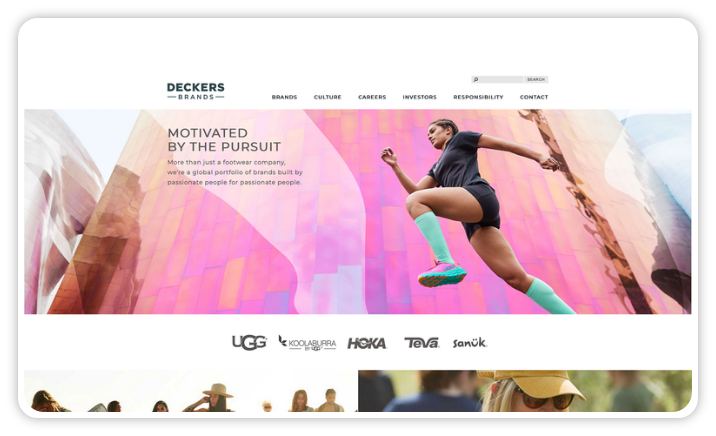
Deckers Brands runs 12 websites across 5 global lifestyle brands (UGG, Hoka, Teva, and others) and 50+ countries on a single CoreMedia Content Cloud platform, rolled out in 60 days. Content editors manage personalized shopping experiences across every brand and region from one CMS, with the same content model serving every site and every connected commerce path.
Leveraging the CoreMedia Customer Engagement Platform for maximum ROI
Most CMS conversations stop at content. They ignore the moment where a high-intent visitor stalls on a product page or a B2B prospect abandons a configuration tool. That moment is where the most expensive customers convert or leave, and a traditional CMS or pure headless setup alone cannot recover them.
CoreMedia's Customer Engagement Platform adds the layer monolithic platforms and pure headless systems both miss: customer engagement tools like live chat, AI chatbot and voicebot, click-to-call, video shopping, and a cloud contact center, all triggered by intent signals from the digital journey. When a visitor shows hesitation on a high-value page, an agent gets context (what the visitor was looking at, what they have done before, what they are signaling) and can offer a real-time interaction. This is not a generic chat widget. It is a measurable conversion path for the visits that would otherwise bounce.
For enterprise sectors where the cost of a lost customer is large (B2B, financial services, insurance, travel, luxury retail) this is the line item that flips a CMS from a cost center to a revenue driver.
Architecture comparison: TCO & ROI
Monolithic CMS at a glance:
- Initial setup: lower, especially with open-source platforms
- Ongoing maintenance costs: high once plugins, patches, and scaling layers accumulate
- Marketing agility: moderate; WYSIWYG editing helps, but it does not scale across markets and channels
- Developer dependency: moderate, mostly for templates and customizations
- Speed to market: slows at enterprise scale
- Omnichannel delivery: limited, because the model is page-centric
- Contact center integration: rare
- Composability with existing stack: limited
Pure headless CMS at a glance:
- Initial setup: higher, because the frontend has to be built from scratch
- Ongoing maintenance: moderate and more predictable, thanks to the API-focused backend
- Marketing agility: low; editors lose live preview and depend on developers for almost every visible change
- Developer dependency: high; every change touches code
- Speed to market: slow, blocked by engineering tickets
- Omnichannel delivery: strong, API-first by design
- Contact center integration: rare
- Composability: strong, but largely DIY; connectors are built in-house
CoreMedia hybrid headless at a glance:
- Initial setup: lands in the middle, faster than pure headless thanks to pre-built tooling
- Ongoing maintenance costs: moderate; managed platform, fewer moving parts
- Marketing agility: high; visual editing combines with real-time omnichannel preview, so editors ship without engineering tickets
- Developer dependency: low; developers build the foundation once, marketers iterate from there
- Speed to market: fast, because developers and marketers work in parallel
- Omnichannel delivery: strong, served by an API-first structured content model
- Contact center integration: native through CoreMedia Engagement Cloud
- Composability: strong, backed by 100+ pre-built connectors to commerce, CRM, DAM, and analytics tools
Bridging content and commerce to drive sales
The TCO conversation should not stop at saving money. The architecture decision also determines whether content makes money.
Most enterprises spend heavily on traffic acquisition (paid media, SEO, partnerships) and then deliver visitors into static content experiences that do not adapt. The hybrid headless model treats every piece of content as a potential conversion surface: a blog can carry shoppable images, a video can link directly to product detail pages at specific timestamps, a landing page can adapt to the visitor's segment in real time.
This is what CoreMedia means by inspirational commerce. The same content engine that publishes the brand story is the engine that converts the visitor. For B2B manufacturers, it converts educational content into qualified pipeline. For financial services and insurance, it ties complex product explanations directly to the quote and buy paths. For telco, it links bundle and upgrade narratives to the commerce experience. For retail and luxury brands, it collapses the gap between marketing and merchandising. A global lifestyle fashion brand uses this approach to embed inspirational imagery and video directly into product listing pages, with marketing publishing the omnichannel experience independent of technical support. The CMS stops being a cost center and starts being a measurable driver of sales.
Making the strategic choice for your enterprise
Three questions help calibrate the decision:
- How much content complexity do you actually carry? Number of brands, markets, languages, locales, integrations with existing DXP solutions, and physical channels (in-store, digital signage). The higher the complexity, the more the hybrid headless model pays back.
- Where does your marketing team get stuck today? If campaigns are waiting on developers, a pure headless CMS will make that worse, not better. If editors cannot see their work until it is live, time-to-market is the cost to cut first.
- What is the real TCO over five years? Add licensing, infrastructure, hosting, developer salaries, integration cost, and the opportunity cost of slow campaign execution. Then look at conversion: what is the value of recovering visits that currently bounce?
For most large enterprises managing complex digital ecosystems, the answer is not a traditional CMS and not pure headless. It is the architecture that gives marketers control, gives developers flexibility, and integrates the human touchpoint that turns intent into revenue.
CoreMedia helps enterprise teams move from fragmented stacks to a unified content, data, and engagement model in as little as four weeks for an initial use case.
Book a personalized demo to see how the hybrid headless approach lowers TCO and lifts conversion in your environment.
FAQ: Headless CMS TCO & architecture
What is the difference between headless CMS and monolithic CMS?
A monolithic (or traditional) CMS combines content management and frontend delivery in one tightly coupled platform. A headless CMS architecture separates the backend content repository from the presentation layer, delivering content through APIs to any channel. The trade-off is flexibility for marketers vs. flexibility for developers.
Is headless CMS more expensive than a monolithic CMS?
Initial costs are usually higher for pure headless because the frontend has to be built from scratch. Long-term, the answer depends on hidden costs. Pure headless tends to inflate developer payroll and slow campaigns because marketers lose visual authoring. A hybrid headless CMS like CoreMedia removes that bottleneck while keeping API-first flexibility, which is why TCO comparisons often shift in favor of hybrid at enterprise scale.
What is Hybrid Headless CMS?
A hybrid headless CMS provides the API-first delivery of a headless system together with a visual authoring interface for marketers. Editors preview content across channels and publish without developer involvement. CoreMedia is the enterprise example of this architecture.
How long does a headless CMS implementation take?
Enterprise implementations typically run 6 to 12 months for a full replatform, longer for global multi-brand rollouts. Platforms with pre-built connectors and a hybrid editing experience compress that significantly. CoreMedia clients regularly bring initial use cases live within weeks, with the overall timeline shaped by the number of markets, channels, and existing systems in scope. For example, Enterprise Ireland went from kick-off to live on CoreMedia in 90 days.
What are the hidden costs of a pure headless CMS?
Three main ones: developer dependency (every change needs engineering), marketer frustration (no WYSIWYG means slower campaigns), and opportunity cost from delayed time-to-market. None of these show up on the license invoice, but together they often exceed the visible spend. A hybrid headless approach like CoreMedia removes the first two and dramatically reduces the third.
How does a composable DXP reduce TCO?
A composable DXP integrates with the commerce, CRM, DAM, and analytics tools already in place rather than replacing them. There is no full migration, no parallel licensing, and modular upgrades are possible without re-implementing the whole stack. CoreMedia, for example, ships with 100+ pre-built connectors to systems like Salesforce, SAP, and major DAM and analytics tools, protecting existing technology investments.
What security risks does a monolithic CMS have?
With a traditional CMS, the editing interface and the public site share infrastructure, so every public visit potentially touches the same surface as authoring. Plugin sprawl and delayed patches widen that surface over time. A headless CMS reduces risk by separating authoring from delivery, and a hybrid headless setup keeps that separation while preserving editor usability.