





















Smooth migration in less than 90 days
Migrating from an existing CMS should not disrupt operations or stall ongoing digital initiatives. For enterprises moving from Adobe Experience Manager, the priority is continuity while transitioning to a more composable platform.
CoreMedia follows a structured, phased approach rather than a full rebuild. The project starts with a discovery phase to assess the AEM content and map it to the CoreMedia content model. Content is then extracted from AEM, transformed into CoreMedia's format, and imported through CoreMedia's ingest service, alongside metadata, assets, and users. Existing systems stay live while content, workflows, and integrations move across in stages.
With clear governance and phased execution, organizations restructure and optimize existing content instead of recreating it, which reduces risk and avoids duplication. With the right planning, migration delivers value quickly: Enterprise Ireland went live on CoreMedia within 90 days.
For organizations with EU data residency or digital sovereignty requirements, the migration can target an EU-region cloud, a private cloud, or an on-premises environment, so content and personal data stay within the required jurisdiction throughout the move and after go-live. As a European vendor certified to ISO/IEC 27001:2022, CoreMedia supports a GDPR-aligned migration in which data residency and governance are defined up front rather than retrofitted, which matters for regulated industries such as financial services, telecommunications, and the public sector.

The important questions, answered (FAQs)
What is the main difference between Adobe Experience Manager and CoreMedia?
AEM is part of Adobe Experience Cloud, an integrated suite that pairs content and asset management with Adobe's analytics, testing, commerce, and creative tools. CoreMedia is a composable digital experience platform built on a hybrid headless architecture, designed to orchestrate content, commerce, and customer engagement across channels with flexible deployment. AEM favors single-vendor integration within the Adobe ecosystem; CoreMedia favors composability and deployment choice.
When is Adobe Experience Manager the better choice?
AEM is the stronger fit when an organization is already standardized on Adobe Experience Cloud, has a large in-house Adobe and Java development practice, and runs asset-heavy creative workflows in Creative Cloud and AEM Assets. For teams that want a single accountable vendor and Adobe-managed continuous delivery, the suite model is an advantage.
When do enterprises choose CoreMedia over AEM?
Enterprises choose CoreMedia when they want composability without committing to a full suite, deployment flexibility including on-premises and private cloud, native personalization without a separate tool, and a closer connection between content, commerce, and human-assisted engagement. Cost predictability through concurrent-user pricing and lower developer dependency for marketers are also common reasons.
Can CoreMedia be used as a replacement for Adobe Experience Manager in enterprise environments?
Yes. Global enterprises use CoreMedia as an AEM alternative for content management, omnichannel delivery, native personalization, and flexible integrations at large scale. Organizations typically move when they want composability, deployment and hosting flexibility, or clearer cost transparency than a full suite provides.
What are good alternatives to Adobe Experience Manager for personalization and experimentation?
Alternatives to Adobe Experience Manager for personalization and experimentation include CoreMedia, Optimizely, and other platforms with built-in personalization or support for third-party experimentation tools. CoreMedia provides personalized content marketing, segmentation, and A/B testing natively. The right choice depends on your existing ecosystem and integration needs.
Which platform is better for global, multi-brand management?
Both platforms support multi-brand and multi-region operations. CoreMedia is built around centralized governance, content reuse, and coordinated publishing across brands, markets, and languages from one system. AEM supports the same scenarios within the Adobe suite, which works well when the wider Adobe stack is already in place.
Does CoreMedia offer native personalization, and how does it differ from traditional AEM personalization?
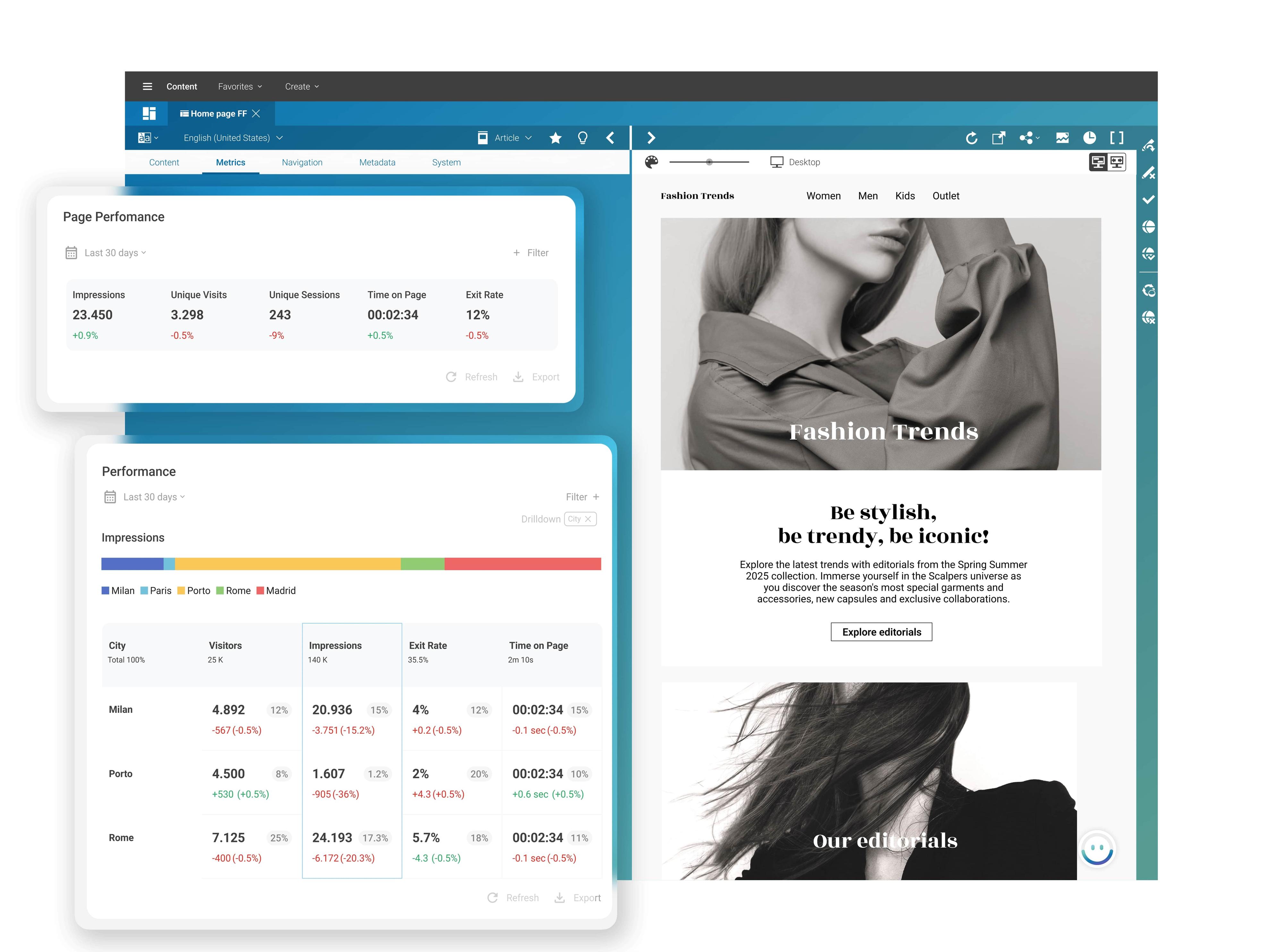
Yes. CoreMedia includes personalization, segmentation, and A/B testing natively, managed in the same interface editors use to create content, so teams adapt and test where content is authored rather than filtering it after creation. With AEM, personalization is typically delivered through Adobe Target as a separately licensed part of the suite, often applying pre-built profiles after content is created.
Can CoreMedia be deployed on-premises, and what about AEM?
Yes. CoreMedia supports cloud, private cloud, and on-premises deployment, giving enterprises control over hosting and data residency. Adobe's strategic direction for AEM is its cloud service; on-premises and Adobe Managed Services run on AEM 6.5 and are moving toward long-term-support timelines. For organizations with data sovereignty or specific compliance requirements, this difference is often decisive.
Is CoreMedia a GDPR-compliant, EU-hosted CMS, and how does it compare to AEM on digital sovereignty?
Yes. CoreMedia is a European vendor headquartered in Hamburg, Germany, certified to ISO/IEC 27001:2022, and it supports EU-based cloud hosting, private cloud, and on-premises deployment so personal data and content stay within the EU. Both platforms can support GDPR obligations, and Adobe offers EU and sovereign-region hosting for AEM through Adobe Managed Services on hyperscaler sovereign clouds. The practical difference is jurisdiction and control: CoreMedia keeps both data residency and vendor jurisdiction within the EU and lets organizations run the platform themselves on-premises or in a private cloud, which is often a requirement for regulated industries and the public sector.
How do the platforms handle content and commerce?
CoreMedia provides pre-built integrations with commerce platforms such as Salesforce Commerce Cloud, SAP, commercetools, and Elastic Path, plus shoppable content built into the editorial workflow. Connecting AEM to commerce, including Adobe Commerce, is supported but often involves more custom integration work to link content with product data and transactions.
Can CoreMedia integrate with Adobe products and third-party tools?
Yes. CoreMedia integrates with a wide range of enterprise systems, including DAM, PIM, CDP, analytics, eCommerce platforms, and marketing automation, as well as Adobe ecosystem products such as Adobe Analytics where you want to keep them after changing your CMS. Its API-first architecture is built for best-of-breed stacks.
What drives total cost of ownership on each platform?
On AEM, costs are shaped by suite and add-on licensing, named-user tiers and storage limits, and the experienced Adobe and Java developers needed to implement and extend the platform. On CoreMedia, the main factors are the capabilities adopted and the concurrent-user pricing model, which lets large teams scale usage without per-seat cost growth. Both require implementation investment; the difference is in how that cost grows as usage expands.
When should you migrate from AEM to CoreMedia, and how long does it take?
Organizations typically consider migrating when they want greater flexibility in tool choice, clearer cost transparency, or a modular architecture that fits evolving business needs. With a phased approach, a migration can be completed in around 90 days: CoreMedia transitions content, workflows, and integrations incrementally while existing systems stay live. Enterprise Ireland went live within that timeframe.
How do AEM and CoreMedia compare on AI?
Both platforms ship embedded AI. CoreMedia KIO is an embedded copilot for content creation, metadata, and SEO and GEO optimization, with editor approval required at every step. Because CoreMedia manages content from a single source of truth — structured content objects rather than page-based templates — AI-generated content inherits consistent metadata, taxonomy, and governance rules across every channel automatically. This matters for GEO: structured, consistently tagged content is more likely to be cited by AI search engines than content managed in fragmented or page-centric systems. Adobe provides AI across Experience Cloud, including Firefly for creative generation. The practical difference is less about whether AI exists and more about how each fits your existing stack and governance model.