






















US platforms like Sitecore and Adobe Experience Manager still hold much of the market, but large enterprises keep hitting the same three walls: bloated costs, rigid legacy frameworks, or pure headless systems that leave marketing teams unable to publish without a developer. Sovereignty now weighs on the decision alongside those trade-offs. In IDC's Worldwide Digital Sovereignty Survey 2025, the share of European organizations using sovereign cloud rose from around 30% in 2023 and 2024 to 40% in 2025, with a further 31% planning to adopt it.
This is the gap CoreMedia is built for: a European-rooted, composable digital experience platform that unifies content, data, and commerce at global scale, without forcing a choice between sovereignty and usable software.
What do European enterprises actually need from a CMS?
Buying requirements shift once an organization operates across multiple European countries and languages. Beyond content management, they require a platform that can prove it handles locale-level language variants, EU accessibility law, GDPR-aligned data handling, and data sovereignty, on top of the baseline enterprise features any large organization needs.
Baseline enterprise capability:
- Multi-site management across brands, countries, and business units under centralized governance.
- Granular roles and permissions with approval workflows, workflow support, version history, and audit trails.
- API-first delivery for headless or hybrid content distribution to web, mobile apps, kiosks, and other channels.
- High availability with multi-region deployment and a choice of infrastructure model.
European-specific requirements:
- Multilingual content with locale-level variants, such as regional versions and workflows for DE-DE, DE-AT, and CH-DE.
- Accessibility built to WCAG and EN 301 549.
- Data sovereignty and local compliance through local European-based hosting, private cloud or on-premises if required for sensitive data.
- EU AI Act compliance for any AI-assisted content and personalization, including the option to run a European LLM such as Mistral.
- GDPR-aligned data handling.
Multilingual and multimarket support in Europe
Europe's language and regulatory diversity makes multilingual support more than translation fields. Running multiple sites across 24+ EU languages, each with country-specific legal rules, is what separates the best enterprise CMS platforms from adequate ones. Capabilities to evaluate:
- Language fallback rules: if content doesn't exist in Luxembourgish, does the system fall back to French or German by configurable rule?
- Localized URL and navigation: country-path (/de/), subdomain (de.brand.com), or ccTLD (brand.de), the CMS should support all three.
- Variant management: DE-DE, DE-AT, and CH-DE may need different legal disclaimers, pricing, or regulatory notices.
- Locale-specific approvals: workflows that route content to the right national compliance team.
- TMS integration: connectors to translation-management systems and human translation providers.
Why European enterprises are moving off US vendors
Large European enterprises in finance, the public sector, and retail are actively replacing US-based CMS vendors, and the reasons are now operational and regulatory, not hypothetical. The pressures that keep coming up:
- GDPR, now in active enforcement: the European Commission’s 2024 review kept transatlantic data transfers under scrutiny, where US-headquartered vendors carry the most exposure.
- NIS2, binding since October 2024: stricter cybersecurity risk-management and supply-chain obligations for digital infrastructure providers.
- DORA, in force since January 2025: operational-resilience requirements for financial institutions and the technology suppliers they depend on.
- US legal reach: under laws such as the CLOUD Act, and in the shadow of the Schrems II ruling, data held by a US-owned vendor can be exposed regardless of where the servers sit.
- Operational concentration: leaning on a single US hyperscaler magnifies the impact of an outage and narrows incident-response options within EU jurisdictions.
- Vendor lock-in: tightly integrated US suites raise switching costs and keep long-term pricing opaque.
The shift is not niche. The European content management software market reached roughly USD 11.57 billion in 2025, led by large enterprises that need audit trails, centralized governance, and localization. Incumbents like Adobe Experience Manager, Adobe Commerce, Optimizely, Sitecore, and Contentful are still widely deployed, but data sovereignty has turned CMS procurement into a board-level governance decision.
Why Sitecore and Adobe AEM fall short for European enterprises
Sitecore and Adobe Experience Manager fall short for European enterprises in three ways: cost structure, architectural rigidity, and US corporate jurisdiction over the data they hold.
- Adobe Experience Manager (AEM) delivers most of its value inside the Adobe suite (Analytics, Commerce), runs on Adobe's managed cloud, and is priced at a premium.
- Sitecore has moved to a composable, SaaS model led by XM Cloud, a headless CMS with the Sitecore Pages visual editor, while personalization, its CDP, and commerce are licensed as separate products.
The marketing bottleneck
Sitecore and Adobe Experience Manager began as monolithic platforms, where content management and delivery are tightly coupled in a more traditional CMS model. Pure headless tools took the opposite approach. Both leave marketing teams with a version of the same problem:
- Monolithic suites: editors keep visual editing, but global rollouts are slow and most changes need custom development.
- Pure headless: developers move fast, but editors lose visual editing and live preview, so routine updates turn into developer tickets, and the model requires strong developer support for updates and frontend maintenance.
Plugin-based platforms like WordPress VIP hit the same wall, since enterprise governance and multi-site control lean on custom development. CoreMedia customers describe the opposite: at Henkel, the technical setup is no longer the limit, and teams publish across markets in near real time instead of waiting on developers.
Total cost of ownership in enterprise CMS platforms
The license line understates the real cost, as total cost of ownership also includes implementation, training, and maintenance over time. What surfaces later:
- Separately licensed modules: personalization, testing, CDP, and commerce are priced individually, so each add-on raises the bill and deepens lock-in.
- Consumption pricing: fees tied to API calls scale with your traffic and make budgets unpredictable.
- Developer maintenance: pure headless pushes upkeep onto developers, since layout and preview live in frontend code, and sustaining it often demands more technical expertise.
- Implementation and training: the specialist work to deploy and run these suites rarely shows on the quote.
- Compliance workarounds: meeting EU hosting and audit rules on a US-first platform adds tooling and legal review.
Over three to five years these become exit costs too: the more modules and US-cloud dependencies you add, the harder it is to leave. A European, EU-hosted platform with native capabilities keeps both the cost and the exit in your hands.
The integration dilemma
Ripping out a legacy platform disrupts the business, so a composable approach usually beats a full replacement. CoreMedia connects to your existing commerce, e-commerce platforms and PIM/ERP systems, including SAP Commerce Cloud and Salesforce Commerce Cloud, through dedicated hubs. That gives you both:
- Developer control: API-first delivery to any channel, without hand-coding every layout change.
- Marketer autonomy: visual editing and live preview, without a ticket for routine updates.
CoreMedia's hybrid headless model keeps the API-first delivery without the marketer bottleneck.
| CoreMedia | Sitecore | Adobe Experience Manager | |
| Headquarters/jurisdiction | Germany (EU) | United States | United States |
| Architecture | Hybrid headless: server-side rendering plus a GraphQL API | SaaS headless (XM Cloud) with the Sitecore Pages visual editor | Full-stack and headless within Adobe Experience Cloud (AEM as a Cloud Service) |
| Visual editing for marketers | Native WYSIWYG with omnichannel preview | Sitecore Pages (XM Cloud) | AEM authoring, inside the Adobe suite |
| Deployment | Managed cloud in EU regions, private cloud, on-premise, or hybrid | SaaS on vendor cloud | Adobe-managed cloud |
| Personalization and commerce | Native personalization and A/B testing; integrates SAP and Salesforce Commerce | Licensed as separate products (Sitecore Personalize, CDP, OrderCloud) | Via the Adobe suite (Adobe Target, Adobe Commerce) |
| Native human engagement | Live chat, click-to-call, video, and cloud contact center built in | Not native | Not native |
Digital sovereignty, data compliance, and EU governance
For European enterprises, digital sovereignty comes down to four things: what it means, how compliance is proven, who owns the data, and where it can legally live.
What digital sovereignty means for enterprise content
Digital sovereignty means keeping your content and customer data under the legal jurisdiction and operational control of the region where you operate, rather than exposed to foreign law through a foreign-headquartered vendor. For enterprise content it covers where data is stored, which government can compel access to it, and who controls the infrastructure that processes it.
Compliance and certifications under GDPR and the EU AI Act
CoreMedia meets the EU compliance baseline that regulated industries have to document. It is GDPR-ready and holds ISO/IEC 27001:2022, which gives auditors ground to stand on. GDPR sets the baseline for how data is handled, and the EU AI Act extends the same scrutiny to how customer data feeds automated and AI-driven systems. An EU-headquartered vendor whose AI operates under EU rules keeps that exposure inside European jurisdiction rather than adding a US legal layer on top.
Data ownership and deployment control
Data ownership comes down to whether you can move your content and data out and choose where they live, without renegotiating the entire stack. Deployment is where that becomes concrete: CoreMedia can run on managed cloud in EU regions, on private cloud, on-premises, or as a hybrid, so you decide where content and customer data physically sit instead of accepting a single vendor cloud as the only option. European alternatives tend to prioritize customer ownership of data and flexible governance over proprietary US cloud lock-in.
Why data residency matters for regulated industries
Relying on overseas data centers is a live compliance risk for regulated industries such as financial services, insurance, government, and telco. Data stored in an EU region can still fall under US jurisdiction when the vendor is US-headquartered, because of laws such as the US CLOUD Act, so legal exposure, not server location alone, is what these buyers examine. European regimes carry real teeth: GDPR fines can reach €20 million or 4% of global annual turnover, whichever is higher.
European CMS alternatives compared: CoreMedia, TYPO3, Storyblok, and Magnolia
Several enterprise CMS vendors are headquartered in Europe, but they are not equivalent swaps.
- TYPO3 (Düsseldorf, Germany): an open-source CMS with strong multilingual support, widely used across German-speaking markets. It runs at enterprise scale but leans heavily on in-house or partner developers, and it is a CMS rather than a full DXP with native personalization and engagement.
- Storyblok (Linz, Austria): an API-first headless CMS with one of the strongest visual editing experiences in its category. It fits mid-market to enterprise teams moving to headless, but it is SaaS-only with no on-premises option, and it has no native customer engagement or contact center.
- Magnolia (Basel, Switzerland): a Java-based hybrid DXP for enterprise multisite and multilingual needs, available in cloud or on-premises. The jurisdiction nuance is that Switzerland sits outside the EU, though under a GDPR adequacy decision, and implementation is Java-heavy.
- CoreMedia (Hamburg, Germany): an enterprise DXP that combines hybrid headless architecture with native personalization and customer engagement, deployable on EU-region cloud, private cloud, or on-premises. For an enterprise replacing Adobe AEM or Sitecore, it is a seamless European option, matching the enterprise feature set while keeping both the data and the entity governing it inside the EU.
CoreMedia: European enterprise CMS alternative to Sitecore and Adobe AEM
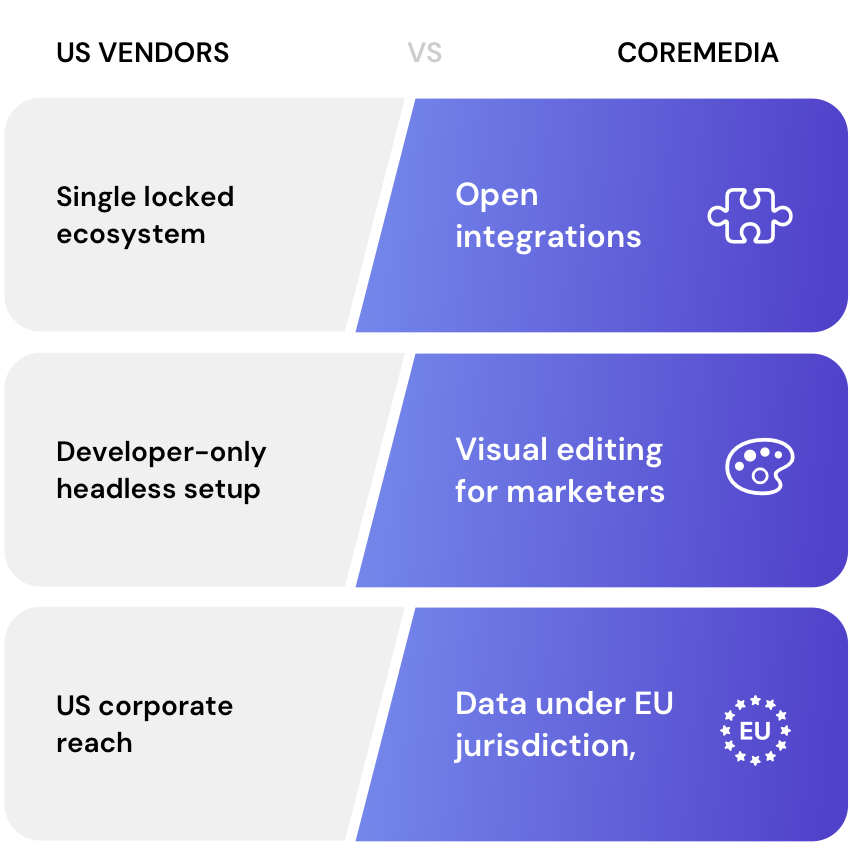
CoreMedia is a European, composable digital experience platform that unifies content management, personalization, marketing automation, and customer engagement, deployable as a whole or pillar by pillar and hosted in EU regions, private cloud, or on-premises. Built for enterprises running many brands and markets, it closes the three gaps the US options leave open:
- Open integrations, instead of a single locked ecosystem.
- Visual editing for marketers, instead of a developer-only headless setup.
- Data under EU jurisdiction, instead of US corporate reach.
Delivery and support run through European-based implementation partners who know your market, languages, and compliance rules, which is one of the things enterprises should weigh when planning a deployment. From there, one content operation runs every region, language, and brand, with CoreMedia reporting customers publishing to the web up to 75% faster.
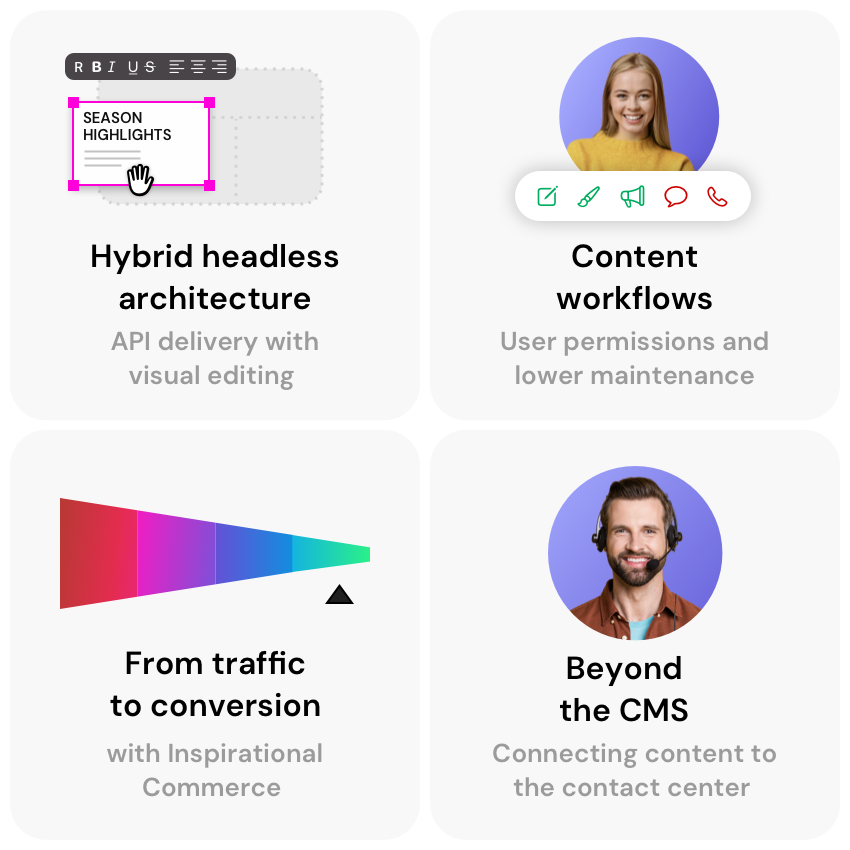
Hybrid headless architecture: API delivery with visual editing
A hybrid headless architecture serves developers and marketers from one content repository:
- Developers get API-first delivery plus server-side rendering, through a GraphQL headless service to any frontend, mobile app, or channel.
- Marketers get visual editing: WYSIWYG with omnichannel preview, no code for layout changes.
- Both get CoreMedia KIO, the embedded AI copilot, running on the LLM of your choice, including a European model like Mistral, so AI processing stays in your jurisdiction.
Finnish broadcaster MTV runs over a million articles and 100+ journalists on CoreMedia's headless API, publishing at newsroom speed.
Content workflows, user permissions and lower maintenance
Simpler workflows and lower maintenance come from letting non-technical teams run the daily work while governance controls who can do what:
- Drag-and-drop authoring: content teams build and edit pages without developer involvement, lowering the load on both.
- Role-based permissions and approval workflows: role-based user permissions, role-based access, encryption, and approval processes control who can create, edit, and publish, so a large author base across brands and markets moves quickly without losing editorial control.
- Localization and translation workflows: keep multilingual content consistent across every market.
- Composable integration: connects to existing PIM, ERP, and commerce systems rather than duplicating them, which reduces long-term maintenance.
B2B manufacturers feel this most, since they manage constant change across many products and markets. Emerson, the industrial technology manufacturer, consolidated five separate platforms and over 500K products onto CoreMedia and brought hundreds of content authors down to roughly fifty working day to day to create, manage, and translate content.
From traffic to conversion with Inspirational Commerce
High traffic with low conversion usually comes from content, commerce, and marketing sites living in separate systems. CoreMedia's inspirational commerce approach turns editorial content directly shoppable, through shoppable images and videos and blended content-and-commerce navigation, so a story or product guide becomes a buying path. Connecting CMS data with CRM, analytics tools, and marketing tools then gives end-to-end visibility across every touchpoint.
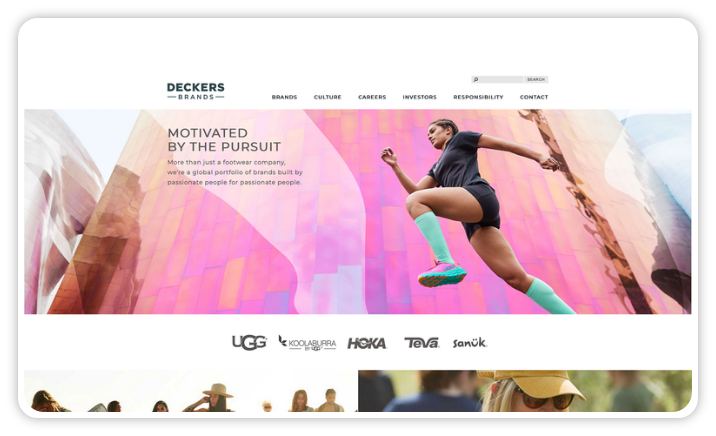
Footwear group Deckers chose CoreMedia in part for how quickly merchandisers can pull content and products from different repositories into new customer experiences, which matters to enterprise teams managing conversion across brands, without waiting on technical help.
Beyond the CMS: Connecting content to the contact center
Going beyond the CMS, CoreMedia connects digital experiences directly to human help, so a high-intent visitor is assisted in the moment instead of handed to a disconnected contact center. Four touchpoints sit inside the same journey:
- Live chat for real-time text support
- AI chatbots for routine, always-on questions
- Click-to-call to move a hesitating visitor to a live agent
- Video calls for high-value or complex sales
The cloud contact center gives agents the visitor's real-time behavior and history, so help arrives when a visitor hesitates and the agent picks up with full context. That turns human support from a cost center into a conversion lever.
TIM Ultrafibra, the Brazilian broadband provider, unified live chat, click-to-call, AI chatbot, and messaging on CoreMedia and recorded a 209% increase in conversions and a 53% lower cost per acquisition across close to 200 million monthly users.
Where European enterprises use a hybrid headless CMS
European enterprises run these operations on a single hybrid headless CMS:
- Multi-brand and multisite management across regions and languages from one hub
- Dealer and distributor portals for manufacturing and automotive networks
- Investor relations sites and secure client portals in financial services
- Citizen and public information portals for government, in multiple languages
- Self-service and click-to-call sales journeys for telco
- Product catalogs, microsites, and campaign landing pages tied to commerce
Frequently Asked Questions (FAQs)
Why should a European enterprise choose a European CMS over a US-based one?
An enterprise chooses a European CMS to keep content and customer data under EU jurisdiction, meet stricter EU data compliance under GDPR and the EU AI Act, and reduce exposure to US vendor lock-in. A US-based CMS cannot fully guarantee this, because its parent company stays subject to US law such as the CLOUD Act even when data sits in an EU region.
Is CoreMedia a good Sitecore or Adobe Experience Manager alternative?
CoreMedia is a good Sitecore and Adobe Experience Manager alternative for enterprises that prioritize European data residency, hybrid headless flexibility, and native customer engagement. Where Sitecore licenses personalization and commerce as separate products and Adobe Experience Manager delivers most value inside the Adobe suite, CoreMedia keeps personalization and testing native and integrates with your existing commerce stack.
Can CoreMedia integrate with my existing US-based commerce platforms like Salesforce?
Yes. CoreMedia's composable architecture integrates with Salesforce Commerce Cloud through dedicated hubs, so you connect it to existing systems without a full rip-and-replace of your stack.
Which enterprise CMS is best for GDPR compliance and data sovereignty?
For GDPR compliance and data sovereignty, the best enterprise CMS is one that offers EU-region hosting, recognized certifications, and a European operating entity, so jurisdiction follows the data rather than just the server location. CoreMedia is GDPR-ready, holds ISO/IEC 27001:2022, offers EU data residency, and supports cloud, private cloud, and on-premises deployment, which makes data sovereignty a configuration choice instead of a vendor default.
Does moving from Sitecore or Adobe to a European CMS require a full replatform?
Moving from Sitecore or Adobe to a European CMS does not have to be a full replatform. A composable platform integrates with the commerce, PIM, and ERP systems you already run, so you can migrate in stages instead of ripping out everything at once. CoreMedia connects to systems like SAP Commerce Cloud and Salesforce Commerce Cloud through dedicated hubs, which keeps the move incremental rather than a single high-risk cutover.
How do I avoid vendor lock-in when choosing an enterprise CMS?
To avoid vendor lock-in, choose an enterprise CMS that is composable and API-first, so individual capabilities can be replaced without breaking the whole system, and confirm you can export your content and data and change hosting regions without renegotiating the contract. Suite models that tightly couple content management, personalization, and commerce make swapping any single component harder. CoreMedia keeps personalization and testing native while integrating best-of-breed commerce and data systems around them, so you are not locked into one ecosystem.
Is an open source CMS a good enterprise CMS choice for regulated industries?
An open source CMS can work well when you have a strong in-house engineering team to run it. But in regulated industries, a commercially supported enterprise CMS usually carries less risk, because someone is accountable for security, compliance, and uptime. Open source platforms have no license fee, yet the cost shifts elsewhere: your team owns security patching, governance, integration, and long-term maintenance, and the project itself comes with no vendor SLA, so buying commercial support adds that cost back. CoreMedia offers the same deployment control that draws enterprises to open source, on-premises or private cloud, so data stays under your jurisdiction, and pairs it with dedicated support, built-in governance, and accountable security and stability. For banks, insurers, and telcos, that mix of self-hosting control and vendor accountability is why a commercial enterprise CMS often wins over an open source one.
The decision
The European CMS decision is no longer about matching Sitecore or Adobe Experience Manager feature for feature, especially for enterprise buyers. It is about keeping data under your own jurisdiction, keeping content teams productive, evaluating integration capabilities at the same time, and then closing the gap between the traffic your content earns and the revenue it should convert. Compare the detail on our Sitecore and Adobe Experience Manager pages, or request a demo to see hybrid headless, EU hosting, and native engagement as enterprise features in action.