





















Most enterprise brands have the traffic. They run paid campaigns, rank in organic search, and generate millions of digital sessions per month. The problem is what happens next. Channels operate in isolation, regional teams cannot move fast enough, and the contact center has no visibility into what the customer was doing online thirty seconds before the call. The disappointment gap between volume and conversion is the structural failure of an engagement strategy that was built channel by channel rather than as a system.
Winning in the global market today requires moving beyond pure digital automation. The enterprises pulling ahead build a unified ecosystem that blends content, commerce, and human assistance into a single customer experience. Email automation, headless commerce, and AI chatbots are commodity capabilities. The strategic advantage now lies in how those capabilities are connected, governed, and orchestrated across a global market.
So what does an enterprise customer engagement strategy actually look like in 2026, and what does it take to execute one across multiple regions, channels, and customer segments without the fragmentation that breaks most global brands?
What makes scaling engagement complex for global brands?
Scaling customer engagement at the enterprise level is fundamentally harder than scaling it for a single-market business. The pain points compound rather than add up.
1 - Global-local tension.
A telco operating in twelve markets needs each country team to adapt messaging, pricing, and offers to local conditions. It also needs the brand to remain consistent, the legal disclosures to stay compliant, and the global campaigns to actually launch on the same day in every region. Most legacy systems force a choice: either central control with no regional flexibility, or full regional autonomy with no global consistency. Neither works.
Deutsche Telekom is one of the clearest examples of solving this at scale. Running on CoreMedia, the telecommunications group operates digital portals across multiple countries and dozens of languages, with hundreds of millions of customers. Global campaigns can launch in every market simultaneously while local teams retain control of regional adaptations, delivering a consistent brand experience. (read the client story)
2 - Operational silos.
Enterprise customer engagement is rarely owned by one team. Marketing runs the campaigns. E-commerce owns the storefront. The contact center handles inbound service. Sales operates a separate CRM with separate logic. Each team has its own systems, its own data, and its own definition of success. The customer journey moves across all of them, but the data does not. By the time a high-intent visitor calls a contact center, the agent is starting from zero.
3 - Technical friction.
Many large enterprises are still operating on monolithic platforms that were architected before mobile, before headless, and before real-time was a meaningful concept. Time-to-market for a new market launch or campaign drags from weeks into quarters. Teams build workarounds. The customer journey suffers in ways the analytics dashboards never quite capture, because the friction shows up between systems, not inside any one of them.
These three problems share a root cause: customer engagement was treated as a collection of channels rather than as an integrated business process. Solving it requires moving from siloed engagement efforts to a unified customer engagement strategy with a single architectural foundation.
5 pillars of a future-proof global customer engagement strategy
A modern and effective customer engagement strategy for global brands rests on five pillars. Each one of the following pillars solves a specific failure mode in the legacy enterprise stack.
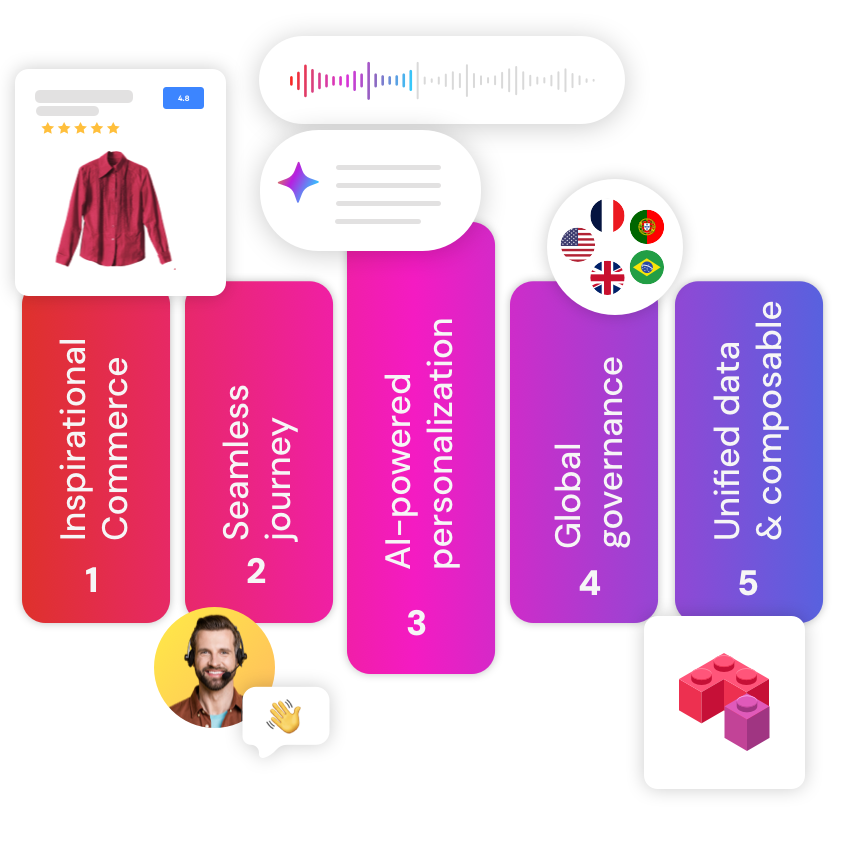
1. Inspirational commerce: Blending content and transactions
The line between brand storytelling and transactional commerce is a legacy distinction. Customer expectations have moved past it: every touchpoint should be both informative and shoppable, with the transition from inspiration to purchase invisible.
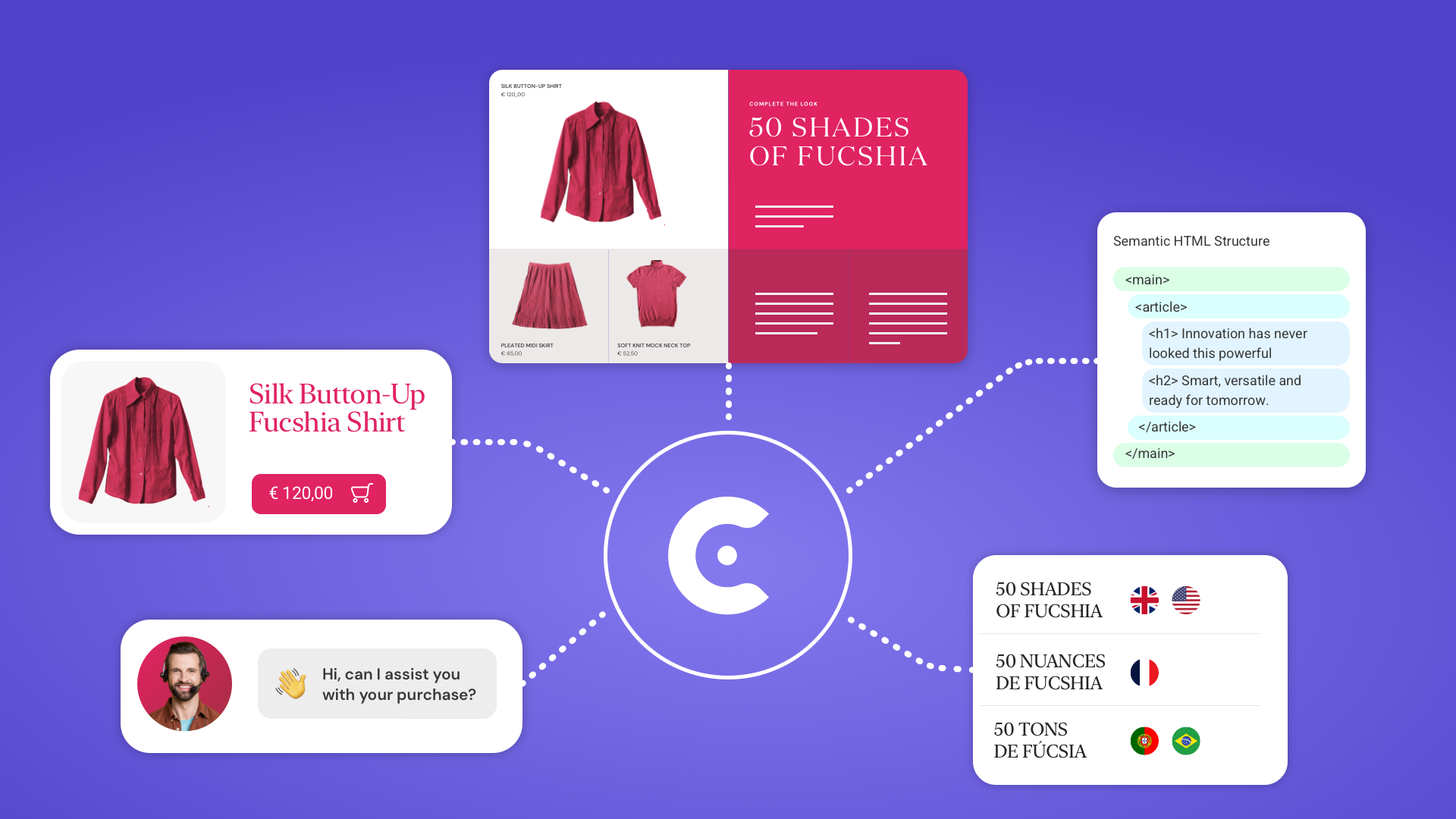
For enterprise brands, this means one system for editorial content, product pages, lookbooks, and category portals — drawing from the same content and asset repository. A campaign landing page should support direct purchase. A blog article should embed shoppable products without a developer ticket.
Web content management and digital asset management cannot live in separate tools. Marketing, merchandising, and editorial teams need one interface, with commerce and editorial flows that intersect without rebuilding the page.
2. Seamless journey between online and offline touchpoints: Connecting the DXP to the contact center
For high-value purchases like luxury goods, B2B contracts, telco upgrades, or complex insurance products, the digital journey rarely closes the deal alone. Customer needs at this stage are too complex for automated answers, and the customer needs to talk to a human.
In most enterprise stacks, the digital experience and the contact center are separate systems. A customer spends fifteen minutes comparing products, hesitates on pricing, then picks up the phone. The agent who answers has no idea any of that happened, and the customer has to repeat the entire journey.
A modern customer engagement strategy treats the contact center as an extension of the digital journey, not as a separate cost center. That requires three things:
- Behavioral signals flow to the agent in real time, so the agent sees where the customer hesitated.
- Live chat, click-to-call, video calls, and conversational bots are triggered selectively on high-intent signals, not offered to every visitor.
- Every interaction, regardless of channel, needs to be tracked in the same customer profile that informs the rest of the customer engagement strategy.
When this works, human customer interactions become a precision conversion lever and a lift to customer satisfaction.
3. AI-powered personalization and orchestration at scale
The bottleneck for most global brands is not the absence of tools for personalized experiences. It is the lag between signal and response. A customer's behavior in the first thirty seconds of a session is the most valuable data the brand will ever have about their intent. By the time a batch personalization system updates the segment overnight, the moment has passed.
A modern customer engagement strategy uses real-time data to dynamically adapt content, offers, and triggers in the moment. According to BCG's 2024 research, personalization leaders grow top-line revenue approximately 10 percentage points faster per year than laggards, and BCG projects that $2 trillion in revenue will shift to companies that get personalization right over the next five years. [BCG, Capturing the $2 Trillion Personalization Opportunity with AI, October 2024]
Personalization in one channel does not help if the same customer gets a contradictory message in another. Anticipating customer needs across channels — which message, in which channel, at which moment, for which segment — needs a single orchestration layer making those calls in real time. CoreMedia KIO, the AI copilot embedded inside CoreMedia Digital Experience Platform, is one example. It generates content variants per segments, surfaces customer behavior insights, and automates routine content operations inside the same interface editorial teams already use. Editors approve every suggestion before it goes live, so the orchestration layer accelerates work without removing human control.
4. Global governance with local agility (Hybrid Headless)
The hybrid headless approach is the architectural answer to the global-local tension.
Pure headless is fast, flexible, and channel-agnostic, but strips marketers of the ability to preview, edit, and adapt content without a developer. Unworkable at enterprise scale.
Pure traditional CMS gives marketers usability but locks the brand into rigid templates and a single model. Adding a new touchpoint becomes a multi-quarter project.
Hybrid headless combines the two. Developers get API-first content delivery for any front-end, including mobile apps, in-store displays, and AI-mediated channels. Marketers keep WYSIWYG editing, omnichannel preview, and the ability to localize content per market without re-coding. One centralized hub governs global campaigns while regional teams adapt messaging, language, and offers for their markets.
The outcome is time-to-market. CoreMedia customers moving from legacy monolithic platforms to a hybrid headless architecture have reported time-to-web reductions of up to 75% on new campaigns and market launches, freeing global teams from quarter-long release cycles.
5. Unified data and composable architecture
Rip-and-replace transformations fail. They take years, freeze decisions across the business, and trade one set of integration debt for another. Composability is the realistic path.
A composable architecture means each capability (content management, commerce, customer data, marketing automation, contact center) can be deployed, replaced, or extended independently, while sharing data and orchestration with the rest of the stack. The customer profile is unified across the layer, but the underlying tools can be best-of-breed.
Most large enterprises already have heavy investments in commerce engines (Salesforce Commerce Cloud, SAP Commerce, commercetools), CRMs (Salesforce, Microsoft Dynamics), customer databases, and analytics tools. A modern customer engagement strategy does not require replacing them. It requires connecting them through a layer that treats customer data as a unified profile and content as a single source of truth.
The architectural test is simple: can a behavioral signal captured in one system trigger a content change in another, in real time, without a custom integration project? If the answer is no, the stack is not yet composable.
Building the enterprise engagement tech stack
The tech stack required to support a global customer engagement strategy is fundamentally different from what most large enterprises run today: The architectural pattern that makes it work is a customer engagement platform like CoreMedia's: a composable layer that unifies content management, customer data, personalization, and contact center capabilities under one governed architecture.
Traditional monolithic platforms bundle everything into one system. The trade-off is integration debt: if the CMS, commerce engine, and personalization layer share one vendor, switching one component means renegotiating the whole stack. New capabilities arrive on the vendor's roadmap, not yours.
Modern composable, cloud-native architectures invert this. The platform runs on container infrastructure (Kubernetes, Docker), with horizontal scaling for delivery layers and vertical scaling for management environments. Databases are isolated per tenant or per region for data sovereignty. A CDN such as Amazon CloudFront handles global performance, and edge caching (via providers like Stellate) delivers GraphQL APIs with low-latency responses across regions. Multi-region, multi-AZ deployments handle failover and disaster recovery without the customer ever noticing.
For enterprise IT, the non-negotiables are:
- Security testing: SAST (Static Application Security Testing) and DAST integrated into the CI/CD pipeline. WAF (Web Application Firewall) included by default, with VPC isolation per environment.
- Compliance certifications: GDPR, ISO 27001, SOC 2, FedRAMP, CCPA, depending on the markets and verticals.
- Backup and recovery: Automated backups with defined RPO/RTO targets. Multi-region replication for production data.
- Performance monitoring: APM (Application Performance Management) covering both the application layer and the underlying infrastructure. Real-time alerting on latency, error rates, and throughput.
- Network and WAN reliability: For brands with physical retail or in-store digital signage, the engagement strategy depends on reliable WAN connectivity from the data center to the edge.
Choosing the right platform against these requirements is its own exercise. For a side-by-side view of the leading options, see our breakdown of the best customer engagement platforms for 2026.
The architectural decisions here are the foundation that make the customer engagement strategy executable. A perfect personalization roadmap on a brittle infrastructure will fail in production.
Measuring success: KPIs for the global engagement model
Most enterprise customer engagement programs measure the wrong things. Click-through rates, email open rates, and session duration are surface metrics. They tell you whether a campaign ran, not whether the customer engagement strategy is working.
The metrics that matter to the C-suite are the ones that connect engagement effort to business outcomes:
- Customer lifetime value (CLV): The single most important metric for any global customer engagement strategy. Customer lifetime value is the cleanest expression of whether the strategy is creating durable value or chasing one-time conversions. Small improvements in customer retention compound into large differences in customer lifetime value, which is why customer retention belongs at the center of any executive dashboard alongside acquisition cost and average order value.
- Conversion rate by intent segment: Aggregate conversion rate is misleading. The metric that matters is conversion among high-intent visitors, the segment where the customer engagement strategy is supposed to make the difference.
- Incremental lift from personalization and human interaction: Measured through controlled experiments. If the customer engagement strategy cannot produce a measurable lift versus a control group, it is not working, regardless of what the dashboard says.
- Support ticket deflection and AOV from human-assisted journeys: Two metrics that capture the contact center's contribution to both revenue and customer satisfaction. If a video call or live chat generates 30–40% higher average order value than a self-service journey (a common benchmark for high-consideration verticals), the contact center is a revenue channel, not overhead.
- Time-to-market: The lag between when a campaign or market launch is approved and when it goes live. The single best proxy for whether the underlying architecture is working with the customer engagement strategy or against it.
- External validation: rating and peer reviews: Public ratings on G2, Trustpilot, and industry-specific review platforms are real-world customer feedback channels, not just customer satisfaction signals. Pairing this external customer feedback with internal data across the customer lifecycle produces richer customer insights than either source delivers alone, and tracking the trend by region is one of the few metrics that comes from outside the brand's own measurement loop.
Full visibility from the digital click to the contact center call is what enables accurate ROI attribution. Without that visibility, every metric above remains an estimate.
Accelerating growth with CoreMedia
The strategy described in this guide is the architecture CoreMedia Digital Experience Platform was built to deliver, addressing the pain points that monolithic platforms create rather than working around them.
CoreMedia is a composable digital experience platform with four integrated capability pillars: content management, personalization and experimentation, marketing automation, and customer engagement. The Customer Engagement pillar includes a full cloud contact center with live chat, click-to-call, video shopping, AI chatbots, and AI-assisted agent support, all part of the same platform that manages the content the customer is interacting with, not a third-party integration.
The hybrid headless CMS gives developers API-first delivery and marketers a full WYSIWYG editorial interface. The unified customer data layer connects digital behavior to contact center context in real time. The composable architecture means the platform integrates with existing commerce, CRM, and analytics investments via 100+ ready-to-use connectors. CoreMedia KIO, the embedded AI copilot, automates routine content operations and surfaces customer insights inside the same interface editorial and CX teams already use.
What this looks like in practice for enterprise customers:
- TIM Ultrafibra (telco): +209% conversions, –53% cost per acquisition, 199M users per month
- EDP (utilities): +120% conversion uplift against a +100% target, 11M+ customers.
These are the outcomes of treating customer engagement as an architectural decision rather than a marketing program. The compounding gains in conversion, business growth, and lifetime value follow from there.
Request a CoreMedia demo to see how a unified, successful customer engagement strategy executes on a single platform.
Frequently Asked Questions (FAQs)
What is an enterprise customer engagement strategy?
An enterprise customer engagement strategy is a unified framework for how a global brand attracts, converts, and retains customers across every channel, region, and touchpoint. It connects content, customer needs and data, personalization, and human interaction into one operating model, so the customer experience stays consistent at every step of the customer journey, regardless of whether the customer is on the website, in an app, in a contact center call, or in a physical store.
How do you scale a customer engagement strategy across multiple regions?
Scaling across regions requires solving the global-local tension: brand consistency and compliance at the global level, with regional autonomy for messaging, language, and offers. The practical answer is a centralized content hub paired with hybrid headless architecture, like CoreMedia, so global campaigns launch simultaneously across markets while local teams adapt the execution. This is how telcos like Deutsche Telekom deliver a consistent brand experience across dozens of countries on a single platform, meeting customer expectations that the brand will feel local in every market.
What is a composable DXP and why does it matter for enterprise customer engagement?
A composable DXP is a digital experience platform built from independent, interchangeable capabilities — content management, personalization, customer data, contact center — that share a unified data layer and integrate via APIs. For enterprise customer engagement, this matters because most large brands have heavy existing investments in commerce engines, CRMs, and analytics tools. A composable DXP like CoreMedia connects to those systems rather than replacing them, which is the only realistic path for enterprises that cannot afford a multi-year rip-and-replace transformation. The architectural choice is what makes a successful customer engagement strategy executable at scale rather than locked in a multi-year roadmap.
How do you deliver personalized digital experiences at global scale?
Real-time personalization at global scale requires three foundations: a unified customer profile that connects customer behavior across channels and regions, a content architecture that supports local adaptation without breaking global governance, and a delivery layer fast enough to act on signals while the customer is still in session. Batch personalization built on overnight data refreshes does not meet this bar. By the time the segment updates, the customer's customer needs in the moment have moved on. Platforms like CoreMedia, with built-in personalized experiences powered by real-time data and AI orchestration through CoreMedia KIO, are designed to deliver the personalized experiences customers expect at global scale.