

























TL;DR - Key takeaways
- Content governance now spans more than the website. It covers localized sites, AI-generated output, and human touchpoints like chatbots and contact centers.
- Governance is what turns content volume into consistency. Without it, regional sites drift, messaging fragments, and compliance risk grows.
- In regulated industries, governance is a compliance control. Audit trails, approval gates, and localization rules keep published content within legal and brand standards.
- The CoreMedia Digital Experience Platform is one example of governance built into the tooling. It applies role-based permissions and approval workflows from the organization down to each market, so the rules are enforced automatically rather than by hand.
What is content governance?
Content governance is the control layer that keeps content accurate, consistent, and compliant at scale. An editorial calendar tells you what publishes and when. A content governance model goes further. It tells you:
- Who owns each approval.
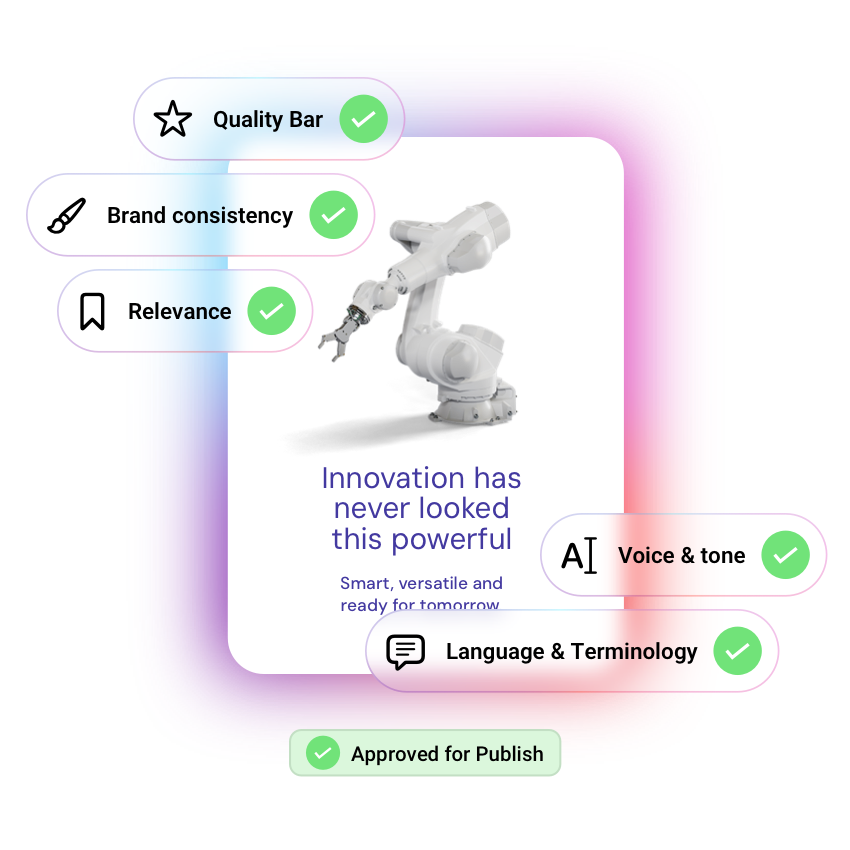
- What quality, brand, and compliance standards content has to meet before it ships.
- How content moves through review and approval.
- What happens to content after launch, from updates to archiving.
When no one owns these decisions, content volume grows faster than anyone can check it. The result shows up fast:
- Regional sites drift from brand guidelines.
- The same product gets described three different ways.
- Outdated pages stay live for months.
- Traffic arrives but doesn't convert, because it lands on off-message content.
This is content chaos, and it's where inconsistent messaging, brand dilution, and compliance risk begin.
Content strategy, content management, and content governance are often treated as the same thing. They aren't:
| Discipline | The main goal | Example |
| Content strategy | Decide which topics to prioritize, and why | A financial services firm prioritizes mortgage and lending guides because regulated products carry the longest, most compliance-heavy buying cycles. |
| Content management | Store and deliver content efficiently | The same product description is stored once in the CMS and pushed to the website, app, and email through templates. |
| Content governance | Control who can change what, when, and why | A regional marketing manager can't publish a campaign page until legal clears the compliance claim and brand signs off on the messaging. |
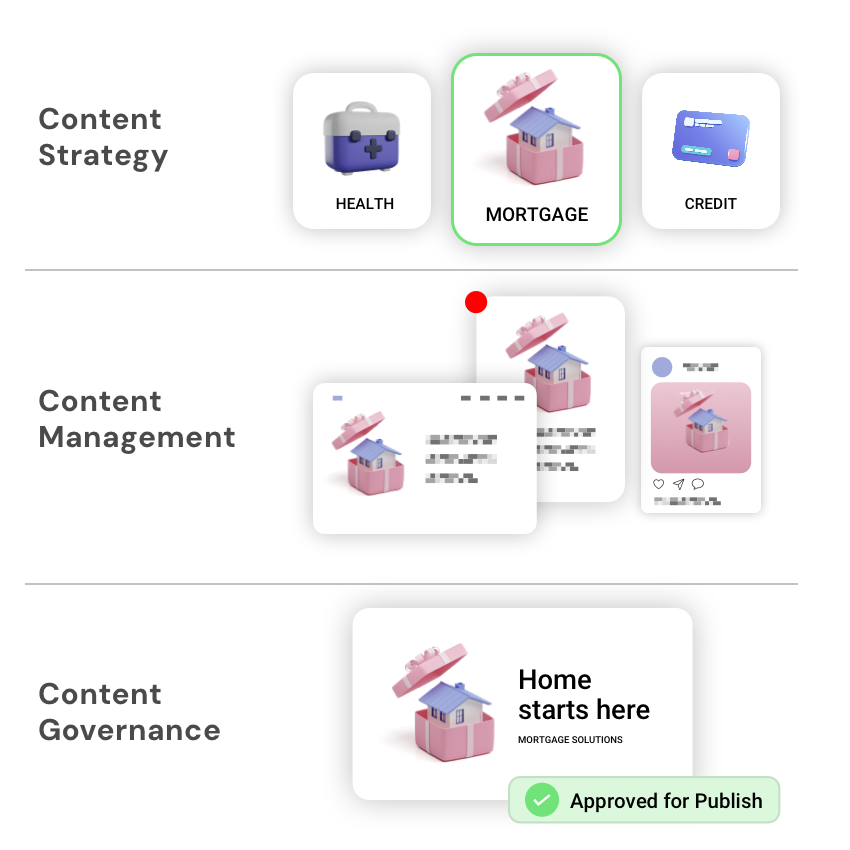
Strategy sets direction. Content management is the tooling. Content governance is the oversight that connects the two, so the strategy actually shows up in what gets published. Done well, content governance gives the organization a single source of truth: one governed content repository that every market, channel, and team works from, instead of scattered copies that drift apart.
Why content governance matters
A good content governance framework pays off in fewer errors, faster approvals, and content that stays on-brand as it scales.
Reducing risk and meeting regulatory compliance
Content governance protects the organization from legal and regulatory exposure. That matters most in regulated industries like finance, insurance, telco, and government and public services, where a published claim or a missing disclosure is a regulatory problem, not just a brand one.
A governance framework reduces that exposure across several fronts:
- Data privacy and consent. Rules for how personal data appears in content, applied before publication.
- Accessibility standards. Checks against requirements like WCAG built into the review step.
- Region-specific rules. Localized content must meet each market's regulations, and what passes in one market can breach another.
- AI-content obligations. Emerging rules on disclosing AI-generated content and automated decisions, where governed workflows are how you keep pace.
- Audit trails. A record of who changed what, when, and why, including the approval context behind each change, not just a timestamp.
Faster approvals through clear workflows
A clear approval framework pays off in three ways:
- A named role owns each approval type, so each type of content routes to the one person whose job it is to clear that specific claim.
- Routing matches the risk, so only regulated claims go to legal, and everything else clears faster without an unnecessary check.
- Approval status stays visible, tracked in the system, so nothing sits unnoticed in an inbox for days.
Maintaining quality, accuracy, and brand credibility
Content governance keeps outdated, off-brand, and inaccurate content from reaching the customer in the first place. Quality standards and editorial guidelines define what "good" looks like: format, grammar, tone, accuracy. Review and approval steps enforce them before publication.
At global scale, one governed content source is what holds brand consistency together. When every market pulls from the same source instead of its own copies, the same claim reads the same way everywhere. That consistency is what builds trust, with customers and, increasingly, with the AI systems that now decide which brands to surface.
What are the core components of a content governance framework
- People and roles. Define who owns what across marketing, IT, legal, and support. Name the creators, approvers, and the escalation path. Most bottlenecks come from unclear ownership.
- Policies and standards. Document the rules content must meet: brand guidelines, editorial guidelines, legal requirements, localization standards. A policy that lives in one person's head isn't governance.
- Processes and workflows. Map the content lifecycle from idea to publication, localization, optimization, and archive, with approval steps where risk is highest. Add measurement here too. Governance needs its own metrics, things like review turnaround, content freshness, and compliance coverage, plus regular content audits to stay useful.
- Platforms and technology. Use a composable DXP or CMS to enforce these rules automatically. Permissions, approval routing, and localization triggers scale in a way that manual checks don't.
Content governance in the age of AI
Generative AI makes content governance more relevant. The old friction was how much content a team could produce. With generative AI, the risk shifts from volume to control: unreviewed AI output can ship with hallucinated facts, off-brand tone, or non-compliant claims faster than any manual review keeps up.
The principle is garbage in, garbage out. AI output is only as reliable as the prompts and data behind it, which is why prompt governance matters. Standardize the prompts and approved data sources a tool draws on, and outputs stay consistent by design instead of corrected one draft at a time.
This is the idea behind embedded AI like CoreMedia KIO, which works from approved brand guidelines and enterprise data and routes every suggestion through editor approval before anything publishes. Governing the inputs beats policing the outputs. AI can also assist oversight, flagging off-brand language before a human reviewer sees the draft.
Governance beyond the web: omnichannel and human touchpoints
Content governance now has to cover more than pages. Content is also the script a chatbot follows, the answer a live-chat agent gives, and what a customer hears on a call. When those touchpoints fall outside governance, a customer can read one thing on the website and hear the opposite from an agent thirty seconds later.
The hard part is data visibility. When a customer moves from digital self-service to a human agent, the message often breaks, because the website's content and the agent's information live in separate systems with no shared context.
Bringing content and support into one governed system closes that gap. When the CMS and the contact center draw from the same source, agents always work from current, approved information. This is the differentiator behind CoreMedia's approach, covered below.
How to implement a scalable content governance model
- Audit and align. Map existing content silos across every region and tie them to business objectives. You can't govern what you can't see.
- Define the architecture. Choose a composable or hybrid headless CMS. Pure headless strips out visual editing, which pushes marketers toward workarounds and shadow IT that undermine governance. Hybrid headless keeps visual control for editors and still delivers to any channel through APIs.
- Automate workflows. Configure permission tiers, approval routing, and localization triggers in the platform. Rules the system enforces don't depend on anyone remembering them.
- Train and iterate. Train the people who use the system, then set up a feedback loop. The model has to evolve as the organization does.
| CMS approach | Governance implication |
| Traditional / monolithic | Strong editorial control, weak omnichannel delivery |
| Pure headless | Flexible delivery, weak marketer control, risk of shadow IT |
| Hybrid headless | Visual control for editors plus API delivery to every channel |
How CoreMedia supports enterprise content governance
Enterprises need agility without giving up control, and that trade-off is what the CoreMedia Digital Experience Platform is built to resolve.
The CoreMedia Content Management System acts as one governed source for content across every market, language, and channel:
- Create once, reuse everywhere. Localization and approval workflows keep content consistent across markets.
- Role-based permissions from the organization down to individual markets.
- Publication workflows from direct to reviewed-and-confirmed, so control matches each piece's risk.
- Built for regulated buyers. ISO 27001 certified, GDPR compliant, flexible hosting including private cloud and on-premises, and headquartered in Germany meeting the highest data sovereignty requirements.
- CoreMedia KIO, the embedded AI copilot, works from your brand guidelines and routes every suggestion through editor approval before anything publishes.
- Connected to your source systems. Integrations with systems like Salesforce and SAP pull product, pricing, and customer data straight from the source, so content reflects one authoritative record instead of copied values that drift out of sync.
Governance doesn't stop at the website. The CoreMedia Customer Engagement Platform extends the same governed content to live chat, cloud contact center, and messaging, so agents work from current, approved information and customers hear a consistent message across every touchpoint.
To see how CoreMedia unifies content, data, and AI in one governed system, explore our platform or book a demo with our team of experts.
Frequently Asked Questions
What is the difference between content management and content governance?
Content management is how content is created, stored, and delivered, usually through a CMS. Content governance is the system of roles, standards, and approval workflows that controls those activities. Management is the tooling; governance is the oversight that keeps output accurate and consistent.
What are the 4 P's of governance?
Governance frameworks are commonly organized around four pillars: people (roles and ownership), policies (standards and guidelines), processes (workflows and approvals), and platforms (the technology that enforces them). "4 P's" is a common shorthand rather than a fixed standard, so exact wording varies.
What are the 5 C's of content?
The "5 C's" is a memory aid for content quality, most often listed as clear, concise, compelling, credible, and consistent. There's no single authority behind it, so versions differ. In governance terms, consistency and credibility are the two the framework most directly protects.
What is a content governance model?
A content governance model is the documented structure that defines content roles, standards, and workflows for an organization. Effective models are written down, accessible company-wide, and reviewed regularly. The three common structures are centralized, distributed, and federated.
Why does prompt governance matter for AI content?
Prompt governance controls the instructions and data sources an AI tool uses, so it produces on-brand, accurate content by design. Governing the inputs is more reliable than reviewing every AI output after the fact.
How do enterprises balance content agility with governance requirements?
Enterprises balance agility and governance by automating the controls instead of adding manual gates. Permission tiers, approval routing, and localization triggers configured in the platform let teams publish fast while the system enforces the rules, so speed doesn't come at the cost of oversight.
What platforms provide audit trails for regulated industries' content changes?
Enterprise CMS and DXP platforms built for regulated industries provide audit trails that log who changed what, when, and why, capturing the approval context behind each change, not just timestamps. The CoreMedia Digital Experience Platform records this history alongside role-based approval workflows, which is what auditors in finance, insurance, and the public sector typically ask to see.
How can large organizations manage role-based permissions for content editors?
Large organizations manage role-based permissions by assigning editors defined roles that control what they can create, edit, approve, and publish. In the CoreMedia DXP, permissions run hierarchically from organization to brand to market, so access matches each editor's responsibility without custom development.
What are best practices for managing content governance in a multi-brand company?
Best practices for content governance in a multi-brand company center on one governed source with brand-specific rules layered on top. Set shared standards centrally, give each brand its own permissions and workflows, and use a single repository so brands stay distinct without content drifting or duplicating.
How do global brands maintain compliance while publishing in multiple languages?
Global brands maintain compliance across languages by building region-specific rules into localization workflows, not checking them after translation. Governed translation workflows keep each market's legal and accessibility requirements enforced at the approval step, so a page compliant in one market can't publish uncorrected in another.