
























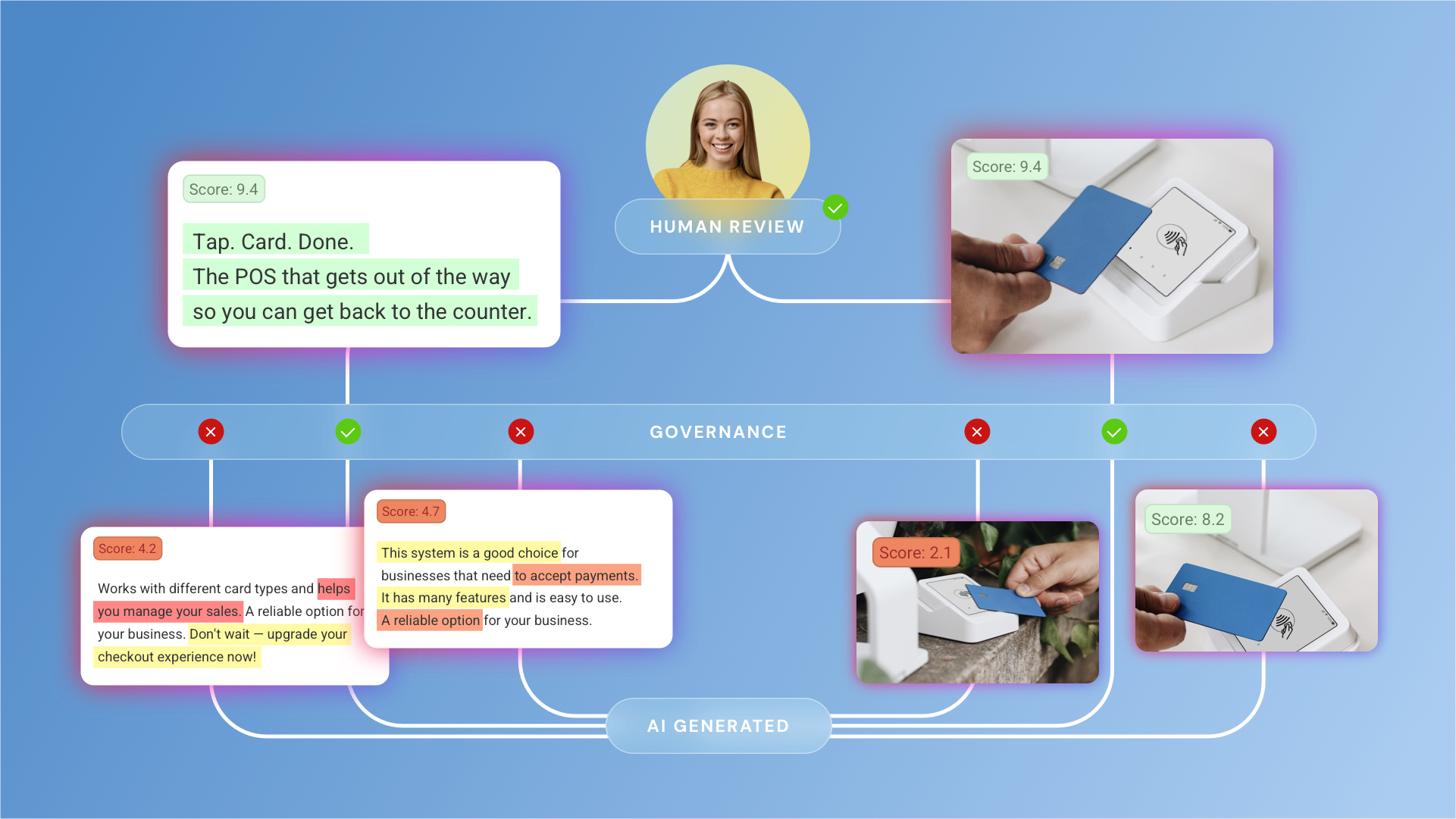
The AI governance gap: content review can't keep up with generation
For marketing teams under pressure to publish more and faster, governance has become the new bottleneck. AI now produces content faster than most review processes can check it, so the constraint has moved from generation to approval. On Gartner's February 2026 forecast, worldwide spending on AI governance platforms will reach $492 million in 2026 and surpass $1 billion by 2030, driven by fragmented regulation that will reach 75% of the world's economies by the end of the decade. The real question is whether your review process can keep up with the speed and volume of AI.
Most enterprises adopted generative AI for content faster than they built the controls to manage it. By early 2026 it was the default way marketing teams draft, localize, and repurpose content. That created a volume no review process was sized for: a handful of editors can't check every AI-drafted page, product description, and chatbot reply before it ships. The controls meant to catch inaccuracy, off-brand tone, and legal exposure didn't scale with the output. This hit regulated industries like banking, insurance, public services, and manufacturing hardest, where a wrong claim is a compliance problem, not just a bad look.
Why legacy content governance can't keep up with AI
Most programs treat AI content as a website problem, so the controls live in the CMS and stop there. But AI writes in far more places:
- Live chat, answering customer questions in real time
- Mobile apps, delivering personalized campaigns and offers directly to users
- The contact center, suggesting replies for agents
- Voicebots, email, and social, often with little or no review
- Email often governed by a separate team and a separate tool than the one running the website
Content volumes and channels are exploding. When the website and the chatbot run on different rules, the brand can promise one thing in a campaign and contradict it in a support chat an hour later. Modern governance needs to keep up with the speed of AI content generation at scale.
What is AI content governance?
AI content governance is the process, policies, and standards an organization uses to manage how AI generates, edits, and distributes content. In practice it sets three things:
- Who can use which AI models, and for what
- How output is reviewed and approved before it publishes
- What record is kept, so you can later show a piece was checked and signed off
The scope is wider than the public website. AI-generated content now shows up in product descriptions, localized campaigns, email and SMS, social messaging, knowledge base articles, chatbot answers, and the response suggestions an agent reads off-screen during a live call. Governance that only covers published web pages leaves most of that material ungoverned, which is where the reputational and legal risk actually concentrates.
What is the difference between broad AI governance and AI content governance?
Two terms get used interchangeably, and it helps to separate them: governing the AI systems, and governing the content they produce. Confuse them and you end up with an ethics policy but no working review process.
Broad AI governance manages the AI system themselves:
- The models you approve for use
- The training data those models rely on
- How you test for bias
- How you monitor the systems over time
AI content governance is narrower and more operational. It manages the output and the path around it:
- The prompt that produced the content
- The model that generated it
- The sources it drew on
- The human who reviewed it
- The record of that approval decision
An organization needs both. The practical test for whether you have content governance is simple. Can you say who approved a specific AI-generated asset, what it was checked against, where the record lives, and whether there is clear documentation of the decision-making process? If the answer is no, the content is running without governance regardless of what the policy says.

The risks of ungoverned AI content generation
Ungoverned AI content creates four distinct exposures: damaged brand credibility, legal and compliance exposure, inaccurate content at scale, and data security risk. Each one compounds in global, multi-channel organizations where content moves fast. AI search and answer engines favor content that is consistent, verifiable, and current, so material that drifts off-brand or out of date is less likely to be surfaced and cited. Governance is what keeps content in the state those engines reward.
Brand credibility and trust
AI hallucinations and off-brand tone erode trust faster than almost any other content failure. A model that invents a product specification, misstates a policy, or adopts a tone that clashes with the brand does measurable damage the moment a customer understands it; bias in AI models can also damage brand image by producing discriminatory outcomes, not just incorrect claims. The problem gets worse at scale: the same flawed prompt or unreviewed template can push an error across hundreds of pages and dozens of markets before anyone notices. For a target audience of enterprise buyers and existing customers, a single confidently wrong AI answer in a support chat can undo years of careful brand credibility.
Legal and compliance exposure
AI-generated content carries real legal risk around copyright, bias, transparency, and data protection regulations. Regulators have started to write specific rules and the exposure now spans several fronts:
- EU AI Act. Transparency obligations under Article 50, including requirements to disclose and label AI-generated or manipulated content, apply from 2 August 2026, according to the European Commission's AI Act implementation timeline.
- US state laws. With no federal AI law yet, states are moving. Texas's Responsible AI Governance Act took effect 1 January 2026, with more arriving through 2026 and 2027.
- Copyright and provenance. Unclear ownership of AI output, undisclosed bias, and missing records of how content was produced are separate exposures governance is meant to close.
Quality and accuracy at scale
Speed without a quality gate produces content that can sound correct but is wrong. Generative models are built to sound right, which is precisely why unreviewed output slips past casual reads. In a customer experience context, poor accuracy is not a cosmetic issue: an incorrect return policy in a chatbot, a mistranslated safety instruction, or an out-of-date price feeds directly into a bad experience and, often, a support ticket or a lost sale.
Data security
Ungoverned AI use exposes sensitive enterprise information to public models. When employees paste customer data, unreleased campaign details, internal documents, or other confidential information into consumer AI tools, that information can leave the organization's control and create misuse risks across prompt, training, and output layers of AI data. For regulated industries and any company handling personal data under GDPR-style rules, that is both a security failure and a compliance one tied directly to personal data protection obligations. Governance has to draw the lines the tools wont draw themselves:
- Which AI models are approved for company data
- Where data can and cannot go
- How enterprise content and customer data stay inside a controlled environment
This is one reason security-conscious buyers weigh where their content and data are actually hosted when they evaluate any AI-enabled platform. That pressure is global, with laws such as India’s Digital Personal Data Protection Act, enacted in 2023, raising the bar as well.
Key pillars of a strong AI content governance strategy
A comprehensive AI governance framework rests on three pillars: standardizing the models, prompts, and data AI draws on; keeping a human in the loop before anything publishes; and managing oversight across markets and languages. Each one is a place where good intentions break down without a concrete mechanism behind them: an ethical principle everyone agrees with, and no system to enforce it.
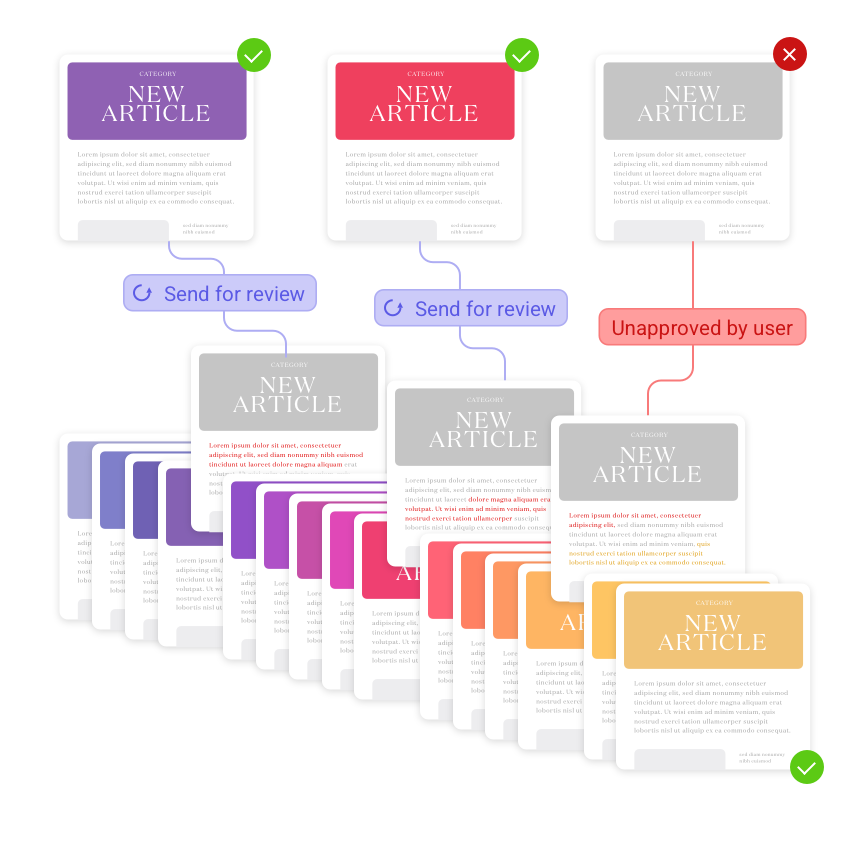
Standardizing knowledge, AI models, and prompts
Standardize the technology before you worry about the output. Three things need to be locked down:
- Approved models. Approve a defined set of AI models for enterprise use instead of letting every team pick its own, which is how shadow AI and inconsistent results take hold. It also makes security reviewable: you know what is running and where data goes.
- A shared prompt library. Prompts maintained centrally and reused across teams produce far more consistent tone and quality than dozens of people improvising. It also turns prompting into an asset the organization keeps, rather than knowledge that leaves with the person who wrote it.
- One source of truth. Point every model and prompt at a single place for product facts, brand rules, and customer data. Scattered or duplicated data is how the website and the chatbot end up saying different things.
Human-in-the-loop (HITL) quality control
AI is a co-pilot, not an autopilot. Human review before publication is the control that catches the hallucination, the off-brand phrasing, and the claim that needs legal sign-off, especially when high-risk outputs must move through a formal approval process before release. The point of human-in-the-loop is not to slow AI down but to make its speed safe to use.
The way to make that review scale is to set the guardrails upfront. When approved models, locked brand rules, and required review points are defined before anyone generates content, most output arrives already inside the lines. People then review the exceptions instead of every asset. That is how humans keep pace with AI instead of drowning in it.
Then define who reviews what. Editors own accuracy and brand voice; CX and compliance leaders own the higher-risk categories like regulated claims and customer-facing conversation flows. CoreMedia enforces this by requiring editor approval on every AI suggestion its co-pilot makes before it executes.
Global oversight and localization management
Global scale is where governance either proves itself or falls apart. Content has to ship across dozens of markets and languages, under different cultural and regulatory contexts. Ungoverned AI translation can turn a good campaign into an offensive one in a single market. The governance question is how to move fast locally while holding brand and compliance standards globally.
The pattern that works is a central hub that owns standards and pre-approved building blocks, paired with local teams that adapt within guardrails through clear operational governance in daily workflows. InSinkErator, a kitchen products manufacturer serving both B2B and B2C markets as part of Whirlpool, runs this model across 11 regional website versions in 7 languages. Reusable modules and pre-approved layouts let editors build and update pages without waiting on IT, and a change made once carries across regions, so content stays consistent. AI-powered translation, integrated with DeepL integrated translation, gets each message close to accurate on the first pass, and local teams keep full control to review and refine every one before it goes live. That mix of automation and human review is governed AI translation in practice: content stays on brand and locally relevant while global consistency holds, and launching a new regional site takes months less than building one from scratch. It is structured localization working as an operating model, not a brake.
Best practices for implementing your AI structured governance framework
These steps move from oversight to policy to people to platform.
- Establish a responsible AI governance board. Bring Marketing, IT, Legal, and CX into one cross-functional group that owns AI content decisions and oversees broader AI initiatives. Governance fails when it sits inside one function, because AI content touches brand, security, and compliance at once. Give the board a real mandate: approve models, set risk tiers, and resolve the edge cases that policies never fully anticipate.
- Enforce a company-wide AI policy. A policy people can act on names the approved models, the data that can go into them, what needs human review, the quality standards output has to meet, how it is labeled and recorded, and who signs off on high-risk work. Build it on established references like the OECD AI Principles, updated in May 2024, and revisit it as regulations evolve rather than treating it as fixed. A policy that only states principles gets ignored at the moment of the decision. One that is enforced in daily workflows changes what actually ships.
- Train employees continuously. AI tools and regulations both change quickly, so one-time training ages fast. Make it specific rather than generic: which tools are approved for which tasks, how to spot a hallucination or a compliance-sensitive claim, and what data must never go into a model. The goal is judgment, so people know when to trust AI output and when to escalate.
- Put the rules where the work happens. Governance only holds if it is enforced inside the systems people use, not written down beside them. That means:
- Set clear guardrails for AI to operate in: approved models, locked brand rules, and defined review points.
- Make your CMS enforce those rules. Rules that live in a policy document get skipped; rules the platform applies do not.
- Build workflows that keep humans in control, so AI drafts and pre-checks while a person approves before anything publishes.
A composable platform lets you add this kind of structured governance to the stack you already run, connecting to your existing commerce, data, and channel tools instead of forcing a rip-and-replace. Then keep it honest with continuous monitoring and clear key performance indicators, so you can see whether the controls are working and where output still needs attention.
Unifying AI governance across the online and offline customer experience
The pillars and steps above are only as strong as the platform that enforces them. This is where most governance programs fail: the controls guard the website, but not the chat window, the call center, or the inbox.
A composable platform has to govern AI across two very different surfaces.
- The digital touchpoints: the website, campaigns, product pages, and email, are where content governance usually starts.
- The human-assisted touchpoints: the contact center, live chat, and sales conversations, are where it usually stops.
AI now writes and suggests content in both, and the two matter equally. Governing only the digital side leaves the human side, the conversations closest to the customer, running unchecked.
Disconnected systems are what break governance in practice. When the CMS and the contact center run on separate stacks with separate content sources, the website can state a current policy while the chatbot repeats an old one, because nothing feeds them from the same approved source. Customers do not see two systems; they see one brand contradicting itself.
The fix is architectural. The CoreMedia Experience Platform is one of the few DXPs that combines content management with a full cloud contact center in a single platform, so the website a customer reads and the live chat, voicebot, or agent they speak to all draw on the same governed knowledge base. When a human agent picks up, they see the customer's digital journey, what they viewed and where they hesitated, instead of starting cold, and support and digital marketing work from one source of approved content rather than two that drift apart. That shared context is what gives governance real end-to-end visibility into what AI is saying on every channel, not just on the published page.
How CoreMedia KIO empowers scalable and responsible AI
CoreMedia KIO is the AI co-pilot embedded inside the CoreMedia Digital Experience Platform. Because it works inside the platform's hybrid headless CMS, it operates against the brand's own guidelines, live performance data, and customer data instead of generic training data, so its drafts come out sounding like your brand, instead of a generic copy someone has to rewrite to match your voice.
The governance controls are built into the architecture, which is what makes the AI safe to scale:
- Human approval by default. Every CoreMedia KIO suggestion requires editor review before it goes live, so speed never comes at the cost of an unreviewed publish.
- Roles, permissions, and workflows. Access and approval steps are configurable, so the right people sign off on the right content, with a record of who approved what.
- Playbooks. Teams capture proven instructions as reusable playbooks that CoreMedia KIO applies to a task the same way every time. It is how brand rules and tone move from a style guide people forget into prompts the co-pilot runs consistently, so output stays on-brand across writers and campaigns without starting from a blank prompt each time.
- Audit trails. The platform records what AI produced, who reviewed it, and what changed along the way, so every AI-assisted asset has a traceable history. When a regulator, a client, or your own legal team asks how a piece of content came to be, you answer with a record instead of a guess.
- Data sovereignty. The platform runs in cloud, private cloud, or on-premises, and CoreMedia KIO is model-agnostic, working with providers like OpenAI, Azure OpenAI, and Anthropic Claude, or a custom model. Enterprises decide where their data lives and which model touches it, which matters for regulated industries and for CoreMedia's customers with strict data-sovereignty requirements.
Governed AI can also use customer data safely to personalize experiences across channels, blending content, personalization, and human interaction to guide customers toward conversion. The governance point stands regardless of the number: personalization that draws on customer data is exactly the kind of AI use that needs guardrails, and building those guardrails into the same platform that runs the personalization is what keeps it compliant.
Frequently Asked Questions
What is the primary goal of AI content governance?
The goal is to balance the speed and scale of AI content creation with quality control, legal compliance, and brand safety. Governance lets an organization produce AI content at volume while keeping it accurate, on-brand, and defensible, so growth in output does not come at the cost of trust.
How does AI governance impact SEO and search visibility?
Search engines and AI answer engines both reward content that is accurate, consistent, and credible. Governance keeps AI-generated content aligned with quality and experience standards, which reduces the risk of ranking penalties for thin or inaccurate material and improves the odds of being cited by generative engines. In practice, the same review and accuracy controls that protect the brand also protect search performance.
Who is responsible for AI content governance in an enterprise?
It is a shared, cross-functional responsibility rather than one team's job. CMOs and content leaders own brand and quality, IT owns security and the approved model list, Legal and compliance own regulatory exposure, and content editors own review at the point of publication. A governance board is how those groups make decisions and enterprise content infrastructure help to enforce set rules.
Can AI governance improve customer support?
Yes. When chatbots, voicebots, and agent-assist tools are fed from the same approved, accurate knowledge base as the website, customers get consistent answers across every channel. That consistency is both a trust advantage and a governance one, because it means support and marketing are working from one controlled source rather than drifting apart over time.
Does the EU AI Act apply to AI-generated content?
The Act's transparency obligations under Article 50 require AI-generated or manipulated content to be disclosed and labeled, and they apply from 2 August 2026. Its reach is extraterritorial: it covers organizations that place AI systems on the EU market or put them into service in the EU, regardless of where the company is based. Penalties across the Act are steep, reaching up to €35 million or 7% of global annual turnover for the most serious infringements. A governed platform helps by keeping a record of what AI produced and who approved it, and CoreMedia's EU data-residency and souvereign model choice give organizations with strict requirements more control over where content and data sit.
How is AI content governance different from AI governance?
AI governance is the broad discipline of managing AI systems: which models you approve, what data trains them, how you test for bias, and how you monitor them over time. AI content governance is the narrower, operational layer that manages the output those systems produce, the prompt, the review, the approval, and the record. You need both, but confusing them is how organizations end up with a high-level ethics policy and no working control at the point where content gets published.
What are the OECD AI Principles, and are they mandatory?
The OECD AI Principles are an intergovernmental standard for trustworthy AI, first adopted in 2019 and updated in May 2024 to address generative and general-purpose AI, with a sharper focus on safety, privacy, intellectual property, and information integrity. They are endorsed by 47 adherents including the EU, but they are non-binding, so they guide policy rather than impose penalties directly. They matter because national regulations increasingly draw on them, which makes them a useful checklist for building a governance program that will age well as laws catch up.
How do I avoid AI hallucinations in content marketing?
Ground the AI in your own approved sources instead of open training data, keep a human review step before anything publishes, and point every tool at one source of truth for product facts and brand rules. Hallucinations thrive when a model fills gaps on its own. They drop sharply when it works from verified inputs and a person signs off on anything customer-facing. Governance is what makes that the default rather than the exception.
Does AI content governance slow down content production?
It doesn't have to, and done well it does the opposite. The slowdown people fear comes from governance that lives outside the tools, where approval means emailing files around and waiting. When review and approval are built into the platform where content is created, the check happens in the flow of work rather than beside it. CoreMedia builds approval workflows and the CoreMedia KIO co-pilot into the same interface editors already use, so teams move quickly while every AI suggestion still passes a human before it goes live.
How do you govern AI content in a chatbot or contact center?
The key is making sure the chatbot, voicebot, and human agents draw from the same approved content source as the rest of the brand, rather than a separate system that drifts out of sync. That means one governed knowledge base, clear rules for what AI can say unassisted, and human review of AI suggestions before an agent sends them. CoreMedia is built for this because its cloud contact center is part of the same platform as the CMS, so support and marketing share one governed source. CoreMedia KIO drafts agent responses that a person reviews rather than sends automatically.
Can AI content governance be fully automated?
No, and treating it as fully automatable is where most programs get into trouble. Automation handles the volume, checking content against rules, flagging risky claims, and routing work, but a human still has to own the decisions that carry brand, legal, and accuracy risk. The practical model is human-in-the-loop: AI drafts and pre-checks, a person approves. CoreMedia enforces this by requiring editor approval on every CoreMedia KIO suggestion before it executes, so the speed of AI never removes the human sign-off.
What platform supports AI content governance across channels?
Look for a platform that governs published content and live customer conversations in one place, rather than a CMS bolted onto a separate contact center. CoreMedia combines content management with a cloud contact center, so the website, chatbots, voicebots, and human agents draw on the same approved source, and CoreMedia KIO requires human approval before anything publishes. That shared foundation is what lets governance hold across every channel instead of stopping at the website.