





















Key Takeaways
- Securing an enterprise content platform is a governance problem as much as a network problem. Access controls, approval workflows, and audit trails matter as much as encryption and DDoS protection.
- A hybrid headless system secures content across every channel while keeping marketers productive, so strong security and fast publishing stop being a trade-off.
- Protection has to extend to human touchpoints. In the CoreMedia Digital Experience Platform, the same customer data and access controls extend from the website into live chat, calls, and the contact center.
IT locks systems down, marketing routes around the lock, and the most secure content platform is the one people do not need to work around.
The modern security challenge in enterprise content management
A standard CMS secures one website. An enterprise system secures a network of them: multiple brand sites, regions, languages, and channels, often fed from the same content. Every site, integration, and account is another point of exposure. Two structural issues make this harder than it looks:
- System silos. When brand sites, e-shops, and support systems run on separate systems, no one has a single view of who can access what. The gaps between systems are exactly where attackers look.
- Speed against safety. Marketing is measured on how fast it ships, security on how little gets through. Left unresolved, that tension pushes marketers toward shadow IT: unsanctioned tools that move fast and leave sensitive data outside any control.
AI widens both gaps: teams generate content faster than manual review can keep up with, so without governed workflows the volume outruns your controls.
Where legacy and pure headless CMS platforms fall short on security
Both fail at enterprise security for the same reason: their architecture forces users to work around the system's own controls.
- Legacy content management systems were built to run one website, not to feed many channels. Reaching apps, in-store screens, and other channels means wiring in extra integrations they were never designed for, and each add-on is a new security gap.
- Pure headless CMS is API-first but strips out the editorial tools marketers need, so every content change becomes a developer ticket. The backlog grows, blocked teams find workarounds, and workarounds rarely respect access controls.
What a secure enterprise content platform needs to offer
Evaluating enterprise CMS security means auditing vendors across three foundational pillars: access governance, infrastructure scalability, and data privacy compliance. Weigh two practical factors alongside them: total cost of ownership, and how cleanly the platform integrates with the systems you already run, such as SAP and Salesforce.
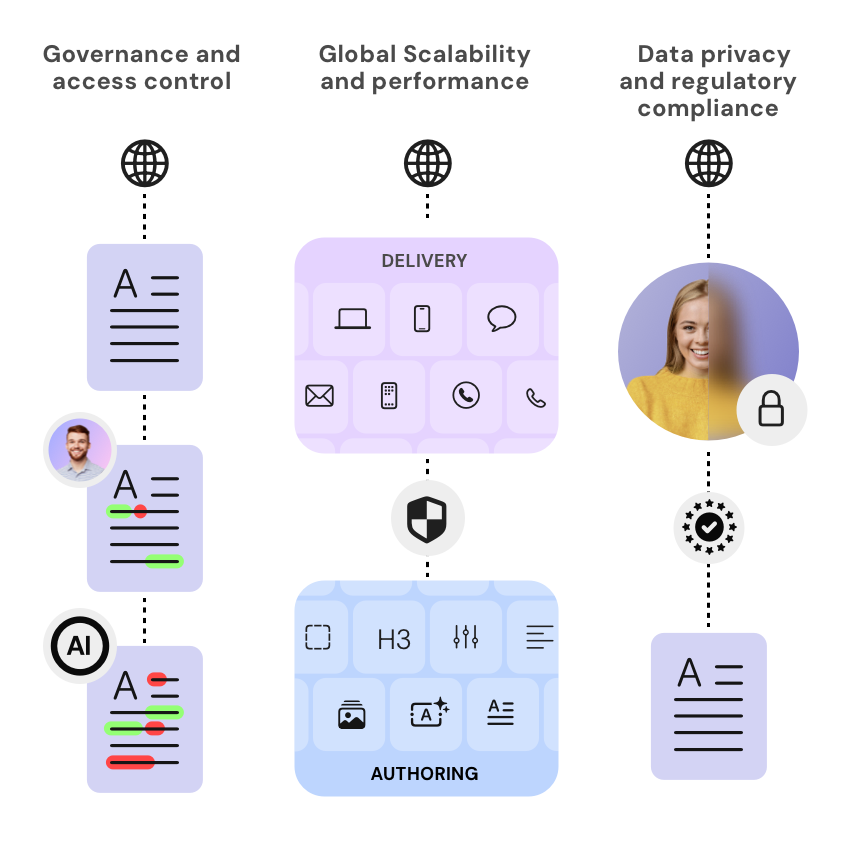
1. Governance and access control
Governance starts with control: every user has a defined role, and every action ties to a named user rather than a shared login. Four mechanisms make that real:
- Role-based access control (RBAC). Hierarchical permissions by brand, region, and market: a local editor manages single-country content, a site manager approves regional releases, and a global manager keeps oversight of every market.
- Structured approval workflows. Mandatory review paths keep off-brand or unauthorized assets from going live.
- Audit logging.Tracking of role changes, privileged access, and authentication attempts creates a paper trail that stands up to a regulatory review.
- Governed AI. CoreMedia KIO works strictly inside each user's assigned roles and permissions, so AI-assisted drafts still go through standard human approval before they publish.
2. Global scalability and performance
Under enterprise load, security and performance are the same problem: a system that buckles under a traffic spike fails when it matters most, and a DDoS attack is a spike with intent.
A secure platform separates authoring from delivery and scales behind a CDN and web application firewall, so editorial work and public traffic never compete and attacks are filtered before they reach your content. Consolidating many CMS instances into one governed environment also shrinks the attack surface.
3. Data privacy and regulatory compliance
Data privacy compliance decides whether you can legally run a global platform: customer data falls under GDPR, CCPA, and a growing list of regional rules, and a violation costs the business in fines and lost trust, not just IT hours. Four things separate platforms that can prove compliance from platforms that only claim it:
- Data residency. Choosing where content is stored, in EU-only data centers, private cloud, or on-premises, gives regulated industries the control that GDPR and similar rules demand.
- Data sovereignty. CoreMedia is headquartered in Germany and applies one of the strictest readings of GDPR, which matters for banking, insurance, and public sector buyers who need their data under EU jurisdiction.
- Certifications. Independent certifications such as ISO 27001 are the proof of a vendor's security posture that a review will check, backed by encryption of data in transit and at rest.
- Integration security. Custom API bridges and unmonitored scripts are where customer data leaks. A secure platform enforces authentication, rate-limits, and field-level permissions on every integration.
How hybrid headless architecture resolves the security vs. agility trade-off
Hybrid headless removes the security-versus-speed trade-off most systems force. It pairs the secure, API-first back end of headless with a visual editor, so content is governed once and reused across every channel from a single source of truth. When marketers publish safely inside that permissioned workspace, developers stop gatekeeping content and get their time back for security. Two CoreMedia client examples show the effect:
- Penguin Random House Verlagsgruppe cut campaign page creation from several days to under 30 minutes, with no development needed, across more than 40 publishing imprints.
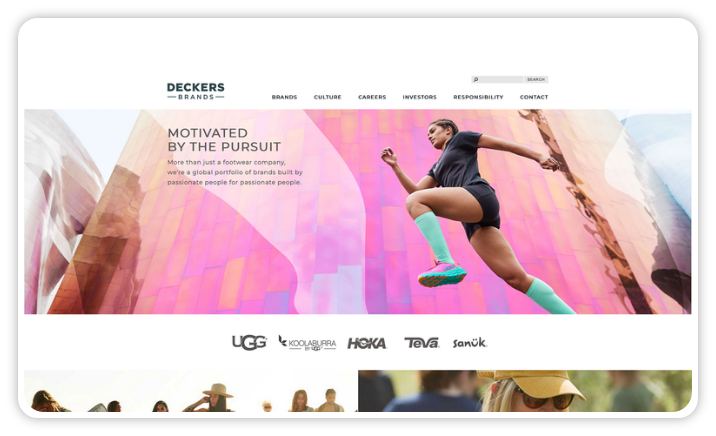
- Deckers Brands reduced time-to-market for new campaigns from several weeks to hours, so merchandisers can respond to trends without waiting on a developer queue.
When the governed path is also the fast path, people stop building workarounds, and workarounds are where breaches start.
Empowering marketing teams protects the brand
Marketers work in a permissioned visual editor, so they move fast without ever touching code or the delivery layer:
- Brand rules and approval steps are built into the editor, so off-brand content never reaches customers.
- Role and market scoping means a local editor only sees and publishes their own market's content.
- Structured content and reusable components keep every channel on-brand from a single source.
The developer's role in a secure system
Freed from routine content requests, developers spend their time on security itself:
- Hardening API endpoints and tightening the protocols behind them.
- Reviewing dependencies and automating security checks in the deployment pipeline.
- Building the front end on a modern JavaScript framework they control.
Securing the full stack across a composable DXP
Full-stack security means protecting customer data and content as they move across commerce, CRM, and contact center systems, not just inside the CMS.
Connect those systems, like Salesforce and SAP, through documented, prebuilt APIs rather than one-off custom bridges nobody owns, so every integration uses the same authentication and permission rules.
Protecting the brand across digital and human touchpoints
Security has to follow the customer past the screen into live support, where sensitive data is most exposed. Because the CoreMedia Digital Experience Platform includes a Customer Engagement Platform with a built-in cloud contact center inside the same system as the content, live chat, voice, and video calls operate under the same access controls and customer profile, so data never crosses into a separate, ungoverned tool.
Enterprise CMS security checklist for IT and marketing leaders
Use this as a scannable set of criteria when enterprises evaluate a content platform:
- Single sign-on and authentication. SAML-based SSO with providers like Azure AD, Okta, and Entrust, plus multi-factor authentication for administrative and high-risk access.
- Role-based access control and audit trails. Granular, hierarchical permissions by brand and market, with logging of role changes, privileged access, and authentication attempts.
- Approval workflows. Reviewed and confirmed publication so no content goes live without the right sign-off.
- Hybrid headless architecture. A secure, API-first back end with a visual editor, so marketers stay productive without becoming a security issue.
- Certifications. Recognized certification such as ISO 27001, with encryption of data in transit and at rest, plus GDPR and CCPA compliance.
- Data residency and sovereignty. EU-only, private cloud, or on-premises hosting, so you control where content lives and under which jurisdiction.
- Network protection and security features built in. Web application firewall, DDoS mitigation, rate limits, and per-environment isolation, ideally at no extra cost.
- Composable, governed integrations. Documented APIs and prebuilt connectors for your commerce and CRM systems, with no rip-and-replace required.
- Unified visibility across digital and human touchpoints. One governed view of customer data from web and app channels through to the contact center.
Ready to see it
Enterprise content security is won or lost in the space between what IT will allow and what marketing will actually use. A hybrid headless system closes that gap by making the governed path the productive one. See how the CoreMedia Experience Platform secures content across every brand, channel, and human touchpoint. Book a demo with our team of experts.
Frequently Asked Questions (FAQs)
What makes an enterprise CMS different from a standard CMS in terms of security?
An enterprise CMS differs from a standard CMS because it secures dozens of interconnected brands, regions, and channels at once, not a single website. That scale calls for hierarchical role-based access control, multi-tier approval workflows, immutable audit logging, and EU data residency options for regulations like GDPR, the kind of controls the CoreMedia Experience Platform is built around.
How does a hybrid headless CMS improve security?
A hybrid headless CMS improves security by decoupling the back-end authoring repository from front-end delivery channels, so the public site never exposes the authoring environment directly. Marketers get safe editorial tools and preview inside a permissioned workspace, which removes the pressure to adopt unsanctioned workarounds. Developers focus on securing APIs and infrastructure instead of reviewing every edit.
Why is governance important in a composable DXP?
Governance is important in a composable DXP because it connects several systems, and consistency and control have to hold across all of them. Role-based access, approval workflows, and audit logging keep content on-brand and compliant across every channel, including human touchpoints like the contact center. Without governance, each integration becomes another gap.
How can AI be used securely in content management?
AI can be used securely in content management by keeping humans in control and enforcing existing permissions. A well-designed copilot such as CoreMedia KIO works only within the roles and access rights of the person using it, cannot reach data that person could not already see, and routes every suggestion through review and approval before publishing.
What is the most secure enterprise CMS?
The most secure enterprise CMS combines granular role-based access control, approval workflows, full audit logging, recognized certification such as ISO 27001, and hosting that meets your data residency rules. A hybrid headless architecture adds a safe operating boundary: marketers get visual freedom without touching source code, while developers keep control of API security. The CoreMedia Experience Platform is built around these requirements, with EU and on-premises hosting for regulated industries.
How do I keep content secure across dozens of sites and hundreds of editors?
You keep content secure across dozens of sites and hundreds of editors with hierarchical role-based access control: permissions are set organization-wide first, then narrowed by brand and market, so each editor only touches what their role allows. Approval workflows gate what goes live, and logging of role changes and privileged access gives you an audit trail across every site and user.
Is open-source software the most secure and sovereign option for an enterprise CMS?
Open source is often chosen for digital sovereignty and code transparency, but it is not automatically the most secure option, because it shifts all patching, vulnerability management, and compliance work onto your own engineers and often depends on community-maintained plugins. An enterprise platform like the CoreMedia Experience Platform delivers the same sovereignty benefits, EU cloud or on-premises hosting and full GDPR compliance, without that operational burden. Open source makes sense when you have the in-house security team to own it; an enterprise CMS makes more sense when you need guaranteed patching, support, and accountability.
How do I give my marketing team more freedom without adding security risk?
Put them in a permissioned visual workspace. With hybrid headless, marketers build and publish inside guardrails set by role, brand, and market, without touching code or the delivery layer. They move fast on their own, and developers stay free to focus on securing the platform rather than reviewing every edit.
How can organizations prevent CMS supply chain attacks caused by third-party plugins?
By choosing platforms that decouple integrations from the core application, so third-party code never runs directly on the server. Unlike open-source or monolithic platforms that depend on unvetted community plugins, the CoreMedia Experience Platform isolates external services behind documented, token-authenticated REST and GraphQL APIs with persisted-query controls, so a compromised integration cannot reach the core content repository, admin workflows, or customer data.