























Key takeaways
- Content lifecycle management covers every stage of a piece of content's life, from planning and creation to publishing, maintenance, and retirement, so it stays accurate, findable, and on-brand.
- At enterprise scale, maintenance is a dependency chain: when a source document changes, every translated or reused version linked to it needs review, or your markets drift apart.
- As buyers increasingly use AI to find brands, feeding it accurate content matters more. Outdated pages left live can be cited as current.
- A platform that models content as structured, connected objects, as the CoreMedia Digital Experience Platform does, keeps the later stages manageable and makes content that AI systems can read and trust.
- To learn more about user roles and content rules, see our guide to content governance.
What is content lifecycle management?
Content lifecycle management is the practice of managing every piece of content through every stage of its existence, from planning and creation through publishing, maintenance, and eventual retirement, so it stays accurate, consistent, and easy to find for as long as it's live.
It's the operating discipline around content: the who-does-what-when for every asset, whether a landing page, a product description, a help article, or a video.
For a single team publishing a few pages a year, this happens informally. Someone just remembers what's live and what needs updating when a new product launches. At enterprise scale, with hundreds of editors, dozens of markets, and thousands of pages, no one person can keep an overview of it all, and the manual approach breaks down.
That's when content lifecycle management needs an enforced process rather than a habit: named ownership for each stage, a defined trigger for when content needs review, and a process that survives staff turnover.
The stages of content lifecycle management
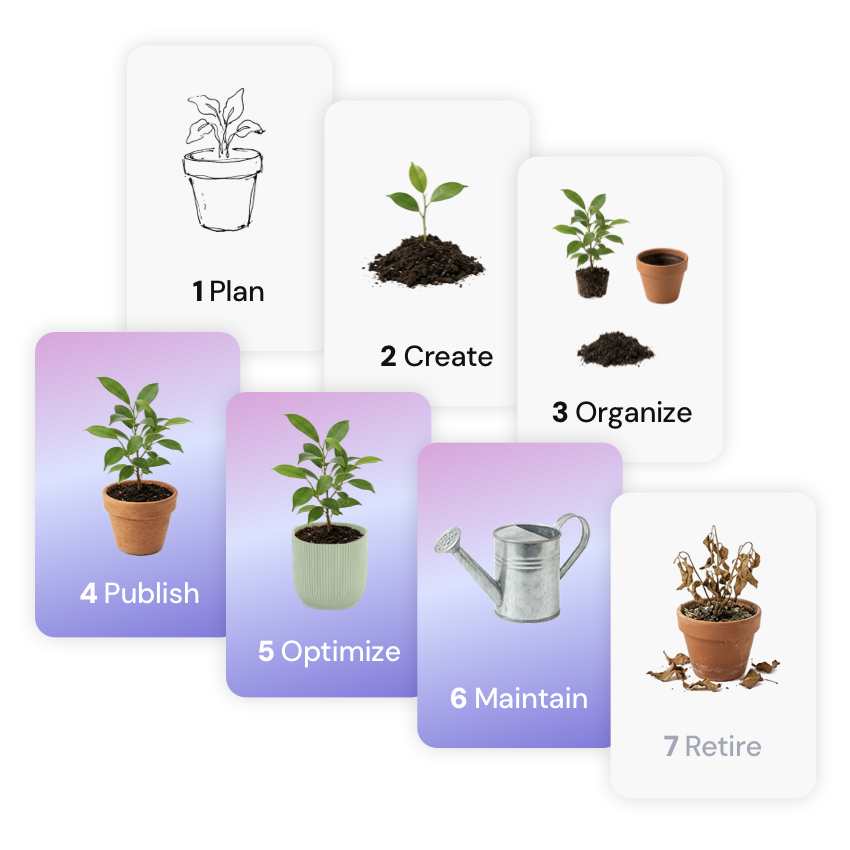
Most content lifecycle frameworks break the process into five to seven stages, from planning to retirement.
| Stage | What happens in it | What it takes to do well |
|---|---|---|
| Plan | Define goals, audience, key messages, and how success is measured | Editorial calendar, a named owner, agreed metrics |
| Create | Produce the asset to brand and accessibility standards | Brief, brand guidelines, review and approval steps |
| Organize | Tag with metadata and store centrally so content can be found and reused | Consistent taxonomy, a single source of truth, structured content model |
| Publish | Release to the right channels, on schedule, in the right formats | Scheduling, multichannel delivery, a publication workflow |
| Optimize | Update content based on performance and search behavior | Analytics, performance data, review cadence, search and AI visibility signals |
| Maintain | Keep content accurate as products, policies, and translations change | Change triggers, localization workflow, version control |
| Retire | Archive or remove content that is outdated, redundant, or no longer compliant | Archiving policy, redirects, sign-off on what stays live |
Planning and creation, get most of the tooling and most of the attention. If there is no clear and enforced lifecycle process in place, teams tend to improvise on stages that decide whether content stays trustworthy, such as organizing, maintaining, and retiring.
Those later stages deserve as much attention as creation, because a wrong page that's live does more damage than a draft that never ships, and content spends far more of its life being maintained than being made.
Why content lifecycle management matters more at enterprise scale
Content lifecycle management matters most when content volume, channel count, and market count grow. Imagine trying to manage a few hundred pages across ten localized sites, each with its own regulations and approval chain, using only your memory? Not possible.
At enterprise scale, the cost of skipping lifecycle stages compounds:
- Duplicated content competes with itself in search. When teams can't find an existing asset, they build a new one, and near-identical pages split rankings and confuse buyers.
- Outdated pages create legal exposure. A price, disclaimer, or claim that was correct at launch stays live after it stops being true, and in a regulated market that's a compliance problem.
- Teams lose hours hunting for the current version. Time spent figuring out which of five near-identical pages is actually correct is time not spent optimizing something else.
- AI answers pull from whatever is live. A page you never retired can be cited by an AI assistant as your current answer, so a skipped stage now costs you in AI search.
- Inconsistent information erodes customer trust. A price, spec, or policy that differs between channels makes customers doubt which version to believe.
- Skipping optimization leaves conversions on the table. A page that's accurate but never revisited with real performance data keeps underperforming.The larger the estate, the more each ignored stage costs.
How retiring old content affects your AI search visibility
What you retire now affects whether AI tools represent your brand accurately. Outdated pages you leave live can be picked up and cited by AI search tools as current, which turns a forgotten page into a source of misinformation about your brand.
It gets worse when an old page contradicts a newer one: faced with two versions of your answer, an AI system can stop trusting your site as a source and name a competitor instead. Retiring the outdated version isn't housekeeping, it's protecting which brand the AI cites.
The shift is measurable. In Pew Research Center's analysis of March 2025 browsing data, 58% of US users ran at least one search that produced an AI summary in a single month, and those summaries typically pulled from three or more sources. So an AI tool is increasingly the thing standing between your content and your customer, and it builds its answer from pages that are live right now.
You can't choose which source it cites but you can control whether your own content is accurate and current. That's what makes retiring and updating old pages a visibility question: a page you forgot to pull can be served up as your answer. For a regulated brand, that's not just clutter, it's a compliance and reputation risk an AI answer can amplify.
Where the content lifecycle breaks in multi-market organizations
In multi-market organizations, the lifecycle breaks where multiple teams and markets are involved. A change to a master page in one language rarely reaches every localized version on its own, so the same product can be described accurately on the German site and incorrectly on the Spanish one.
The break usually comes down to these key challenges:
- No single source of truth. Content lives across the CMS, the DAM, slide decks, and local drives, so there's no authoritative version to update, and a fix reaches some copies but not others.
- No clear ownership. Nobody is assigned to a specific market's version, so when something needs updating, no one knows whose job it is.
- Mismatched permissions. The person who spots that a page needs updating often isn’t the one who can change it, so fixes stall waiting on whoever holds access.
- No visibility into what exists. No one has a full inventory across markets, so duplicate and outdated pages pile up unseen. You can't review, update, or retire content you don't know is there.
- No fixed review cadence. Without a set schedule for checking content, pages only get noticed once someone happens to notice a problem.
- No trigger to sync changes across languages and channels. When a source page changes, nothing automatically flags the translated versions or other channels that also need updating.
- No retirement criteria. If there’s no content audit to understand when a page has served its purpose, content is almost never deliberately pulled. Old pages stay live by default and get served by AI as current.
- No enforced workflow and approval step within the CMS. Content can skip review, go live, or get pulled without following a defined sequence of steps.
These usually live in people's habits rather than in the CMS, so when people change roles, the process breaks with them. A bank publishing rate disclosures across twelve countries can't leave those questions to habit. When ownership is ambiguous, the safest-looking option, leaving old content live, is also the riskiest.
Why maintaining content is a dependency chain, not a cleanup task
Maintaining content at scale is a dependency-management problem, not periodic tidying. When a source document changes, a price, a safety notice, a legal disclaimer, every translated and repurposed version linked to it has to change too, or the versions fall out of sync.
This is the point most lifecycle guides miss. Translations aren't independent copies. They stay linked to a source, and market validity can differ on top of that, since a claim that's legal in one country may be restricted in another. Treating each localized page as a standalone asset is what lets a corrected multilingual claim reach some markets and not others.
Not every edit has to cascade, but some changes have to reach every version that depends on the source. These are the usual triggers:
| Trigger | What it puts at risk | What has to happen |
|---|---|---|
| Product spec change | Accuracy on every page and translation that describes the product | Update the source, then re-sync every linked version |
| Regulatory change | Compliance in the affected market | Review the pages valid in that market, then edit or unpublish |
| Price change | Correctness across channels and campaigns | Update the value once at the source and let it propagate to every reference |
| Rebrand | Brand consistency across the whole estate | Update shared assets and templates once, then flow the change out |
This is what a master-to-derived publishing workflow automates: a source change flags and updates its dependents, instead of a spreadsheet of edits emailed to each market and applied by hand.
Why modular, structured content makes maintenance easier
Modular, structured content is what makes the later stages work at scale. When content is stored as typed, connected objects instead of flat pages, a single update propagates to every place the object is used, and machines can read, verify, and cite it.
A product fact modeled once and referenced across a landing page, a category page, and an email changes everywhere the moment you update the object. That's the difference between maintenance that scales and maintenance that depends on someone remembering every page a fact appears on.
The same structure makes content legible to AI systems: relationships modeled explicitly, which products belong together and which claim applies in which market, give an AI answer something it can verify rather than infer, which is what wins narrow, high-intent queries. We go deeper in the structured content model guide and on how an AI-powered CMS supports it. For the lifecycle, the point is that structure is what lets maintenance, retirement, and AI-readiness scale together.
Who owns the content lifecycle: governance and human oversight
Unless someone owns each stage of the lifecycle, stages are easily skipped. Governance is the layer that assigns that ownership: who creates, who approves, who publishes, and who decides when content is retired.
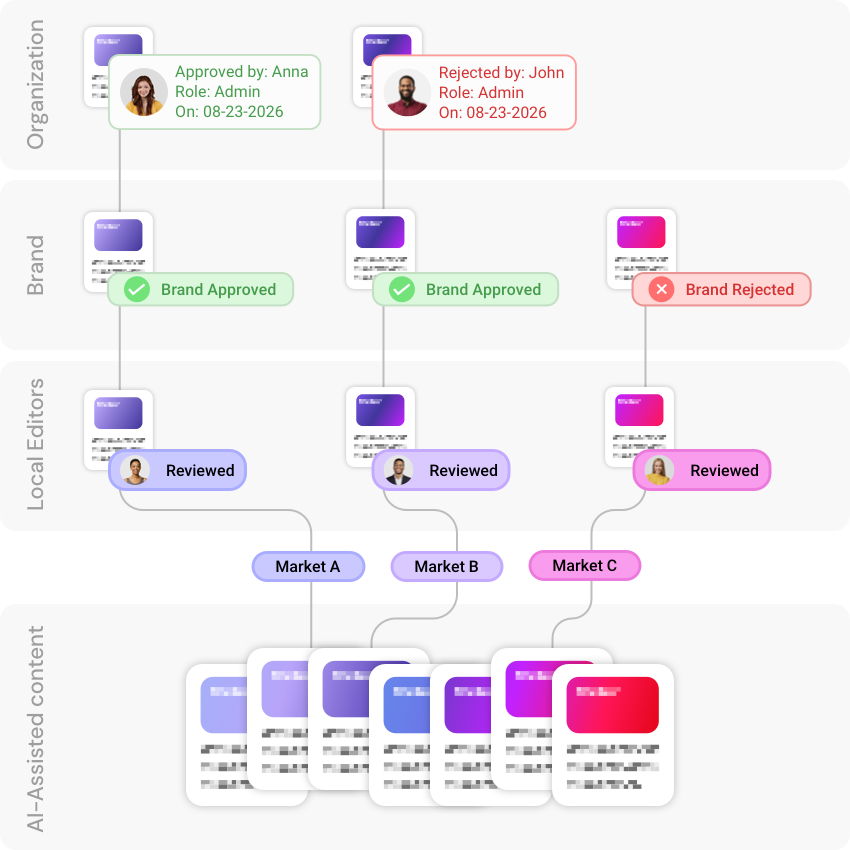
At enterprise scale, those permissions usually cascade from organization to brand to market, so a local editor can update their site while a global manager keeps oversight.
The same principle applies to AI-assisted content: keep a human in the lead, holding final publishing authority, rather than merely in the loop checking in occasionally. AI can handle more of the volume, but brand policy and approval stay with people. Lifecycle management and content governance are two halves of one system: one describes the stages, the other decides who controls them.
How CoreMedia supports the enterprise content lifecycle
The CoreMedia Digital Experience Platform models content as connected, structured objects instead of standalone pages, giving teams the framework they need to keep the later stages, maintenance, localization, and retirement, workable at enterprise scale.
Here's what that looks like at each stage:
- Scheduling built into every item: content carries valid-from and valid-to dates natively, so publishing and retirement can be set at the item level.
- A structured content model: typed, reusable objects mean a single change propagates to every page and channel that references it.
- Localization workflows: publish to a master site, route content for translation, and sync approved updates to derived sites, so markets stay aligned as the content source gets updated.
- Omnichannel preview: see how content will render across web, app, tablet, and JSON before it goes live, so errors get caught at the publish stage instead of after.
- Governance and roles: hierarchical permissions and approval workflows map ownership from global to local without custom development.
- AI with human oversight: CoreMedia KIO assists with creation, metadata, and optimization, and every suggestion needs editor approval, keeping a person in the lead.
- Composable architecture: swap in a preferred translation tool, customer data platform, or commerce system without a rip-and-replace, so you can retire or replace part of your stack without breaking the content that runs on it.
The point isn't the feature list. It's that maintenance and retirement, the stages that break at scale, become routine when the platform treats content as structured and connected from the start.
The real test of content lifecycle management isn't how you plan or publish, it's what happens to content after it goes live. Maintenance, localization, and retirement are where accuracy, compliance, and AI-search visibility are won or lost, and they're the stages generic frameworks skim past. If you're mapping your own lifecycle, start by naming an owner and a review trigger for every stage after publish, then see our guide to content governance for the roles and workflows that hold it together.
Frequently asked questions (FAQs)
What are the stages of content lifecycle management?
The stages of content lifecycle management are usually planning, creation, organization, publishing, optimization, maintenance, and retirement. Some frameworks compress these into five stages and others expand them to seven, but the sequence is the same: content is planned, produced, stored, published, improved, kept accurate, and eventually archived or removed. The later stages matter as much as the first ones.
What is the difference between content lifecycle management and content governance?
Content lifecycle management is the sequence of stages a piece of content moves through, while content governance is the system of roles, standards, and approvals that controls how it moves. Lifecycle management describes what happens to the content; governance decides who is allowed to make each change and under what rules. Enterprises need both, because stages without owners don't get done.
Why is content lifecycle management important for SEO and AI search?
Content lifecycle management is important for SEO and AI search because visibility depends on content staying accurate and current, which is exactly what the maintenance and retirement stages protect. Outdated or duplicated pages can hurt rankings and can be cited by AI tools as if they were still correct. Keeping content structured and up to date is what makes it reliably findable by both search engines and AI systems.
How do you manage the content lifecycle across multiple languages or markets?
Managing the content lifecycle across multiple markets means treating translated pages as versions linked to a source, not independent copies. When the source changes, every linked version needs review. Local review matters, as some claims may be valid in one market but restricted in another. A localization workflow that connects a master site to its derived sites keeps markets aligned as content changes.
Does content lifecycle management require a specific type of CMS?
Content lifecycle management doesn't require a specific CMS, but it's far easier with an enterprise CMS like CoreMedia that models content as structured objects and includes scheduling, workflow, and localization. Systems that store content as flat pages force teams to maintain each version by hand, which breaks down as content and markets multiply. A structured, composable platform lets a single change flow to every place the content appears.
How can CoreMedia help me improve my content lifecycle management?
CoreMedia helps you improve content lifecycle management by managing content as structured, connected objects, so the later stages stay under control at scale. A change to a source updates every page and translation that references it, valid-from and valid-to dates schedule publishing and retirement at the item level, and localization workflows keep markets aligned as sources change. Governance roles and approvals decide who controls each stage, and CoreMedia KIO assists with creation and metadata while a person keeps final publishing authority.