






















Key Takeaways:
- Consent-aware personalization builds permission into segmentation and targeting from the start, so the data a team is cleared to use and the data it acts on are the same set.
- Permissioned AI personalization keeps a human in the lead: models act only on consented, first-party, and zero-party data, while people keep approval and publishing authority.
- A few consented signals that predict intent beat a large pool of third-party data, especially when you can act on them in real time.
What is consent-aware personalization?
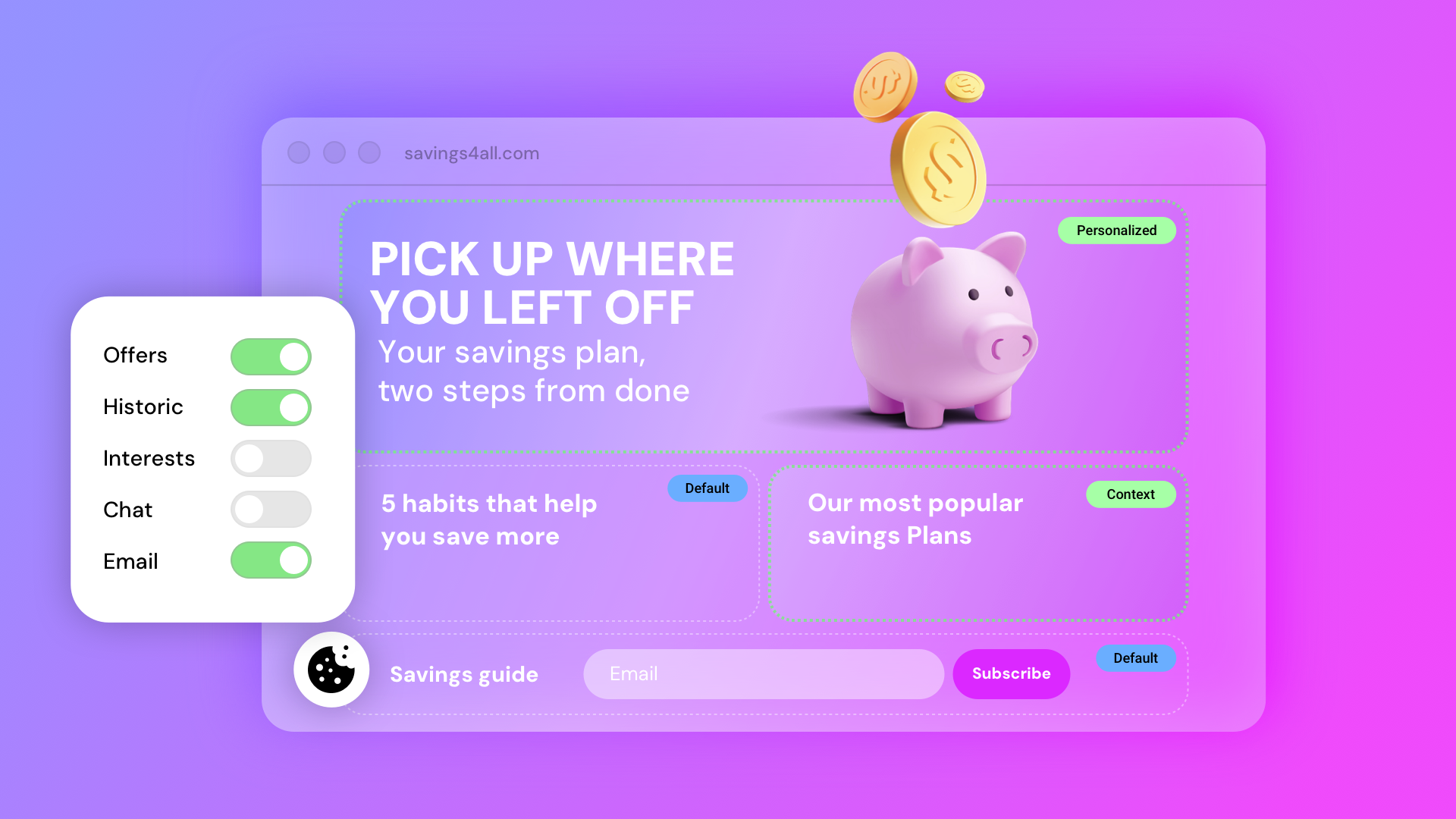
Consent-aware personalization is an approach to tailoring digital user experiences (such as website content, product recommendations, or targeted offers) based strictly on the permissions and privacy choices explicitly granted by the user. Segments are defined only from data a customer has cleared, so what a team is allowed to use and what it personalizes on are the same set.
In most setups, those two sets don't match. Consent lives in a banner and a preference center, while personalization pulls from whatever data is available in the stack. This mismatch is where compliance risk and wasted spend come from.
Why third-party data became a liability
Third-party data used to be the backbone of audience targeting. Now it works against you: the supply is drying up, and holding what you already collected creates risk without paying it back in better experiences.
Two things changed:
- Browsers cut off the supply. Safari and Firefox block third-party cookies by default, and even where cross-site tracking still technically works, it's harder to justify legally and less trusted by customers.
- The stored data turned into exposure. A bank or insurer sitting on years of third-party audience data can't safely act on most of it, and keeping it raises legal risk without improving a single customer experience.
As MarTech Series argues in its case for consent-aware personalization, the fix isn't more collection, it's building permission into segmentation before targeting runs. Our earlier take on personalization in a cookieless world covers the first-party data shift that makes this possible.
Check consent before you build a segment
Consent-aware personalization isn't campaign-led, it's behavior-led. What a customer has done and agreed to defines the segment, and the campaign is built from that, not the other way around.
The consent-aware model follows these steps:
- Confirm the legal basis. GDPR and CCPA both require consent before you collect personal data.
- Build consent into the rules. Segment logic only pulls in data a customer has actually cleared.
- Use cleared data only. Nothing gets added without confirmed permission.
- Fall back gracefully. Use page topic, device, or region if there's no consent for behavioral tracking.
- Update in real time. When consent changes mid-session, every system reading that profile updates immediately.
For a regulated insurer, that means an audience of quote-abandoners is assembled from declared, consented behavior, not from inferred cross-site activity that may not survive an audit.
This article explains publicly available regulatory information for general awareness. It is not legal advice. Organizations should confirm their specific obligations with qualified legal counsel before making compliance decisions.
How permissioned AI keeps humans in control?
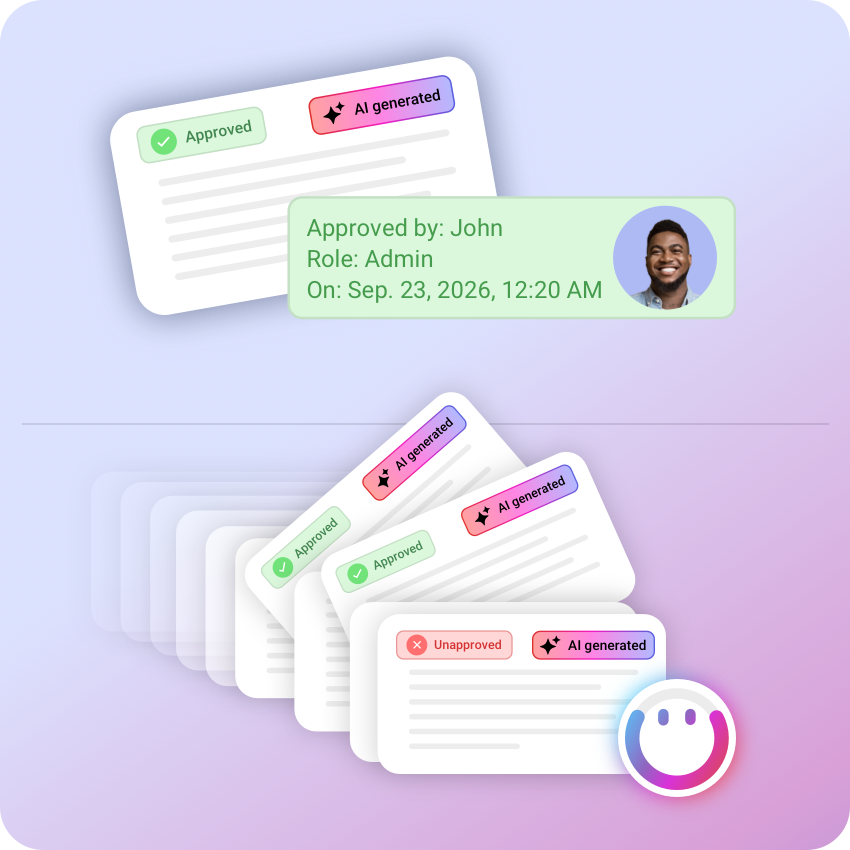
Permissioned AI personalization means the models driving targeting act only on consented, first-party, and zero-party data, with people keeping approval authority over what ships. The AI handles volume and speed; a human stays in the lead on policy and publishing.
The fear behind AI-driven personalization is loss of control: that an autonomous system will decide who sees what, using data nobody vetted, in ways the brand can't defend later. Permissioned AI done well works from a data set that's already cleared. A person keeps final say over segments and content, which is the difference between human in the loop, where someone occasionally checks in, and human in the lead, where a person retains responsibility even as AI does more of the work.
CoreMedia's approach reflects this: its AI, CoreMedia KIO, generates content and audience insight, but every suggestion requires editor approval before it goes live. That's what makes AI personalization defensible in a banking or public-sector context, where "the algorithm did it" is not an acceptable answer to a regulator.
The signals that predict intent
It's not about collecting the most signals, it's about knowing which ones matter and weighting them well. A handful of consented, real-time, first-party signals from a customer journey carries more predictive weight than a purchased profile with thousands of data points in it.
The media-buying side understood this first. MarTech Series describes the shift as adtech signal compression: the bottleneck has moved from collecting billions of ad events to identifying which few should drive a decision. The same logic applies on-site. A utility company doesn't need a thousand data points to know that a visitor comparing tariffs and reading a comparison guide is close to switching providers. Three consented signals do the work:
- Page path: which pages, in what order, showing intent.
- Time on the comparison tool: depth of active consideration.
- A declared preference: stated directly by the customer.
Stripping out the noise also sharpens the target. A model working from a few strong signals isn't pulled in a dozen directions by weak ones, so what it predicts is more precise. The payoff is being able to act on customer intent while it's there, which is where signal quality turns into conversion.
Consent-aware personalization across channels
Consent isn't one yes. A customer who opts into email hasn't agreed to SMS, and someone who accepts on-site personalization hasn't signed up for WhatsApp. Consent-aware personalization treats permission as specific to each channel, so the same profile can power a website experience while staying silent in a channel the customer never opted into.
Two things make that work:
- Permission is checked per channel. Having an email address or phone number isn't consent to market through it. Each channel carries its own opt-in, and the system honors it separately, so only eligible customers gets the follow-up.
- One customer profile feeds every channel. The same consented first-party profile drives web, app, email, and messaging, so a customer who browses on-site and later gets an email sees one consistent thread, not three disconnected campaigns that each relearn who they are. This is where a customer data platform earns its place: it holds the single view every channel reads from.
The payoff for regulated brands is that reach never outruns permission. Personalization scales across channels, but only into the ones each customer actually agreed to, delivered through personalized content that adapts to each customer in real time.
How to build consent aware personalization owned data
Building consent-aware personalization starts with first-party data (what customers do on your own site, app, and channels) and zero-party data (what they tell you directly, like preferences or interests), consent captured at the point of collection, and real-time decisioning on a trusted signal set. The infrastructure has to act on that data in the moment, not overnight, or the intent has already passed.
Three capabilities make this work in practice:
- A first-party data foundation. A customer data platform built on first-party and zero-party data rather than third-party cookies, so every profile is assembled only from data collected with permission.
- Real-time execution. Personalization that runs on live data in the same flow that delivers the experience, so there's no batch lag between a signal and the response. A visitor showing intent gets the relevant experience while they're still on the page.
- A unified, consented profile. Signals from across the customer journey consolidated into a single view of each customer, so the model works from a small, high-quality set instead of scattered, disconnected data.
How the CoreMedia DXP supports consent-aware personalization
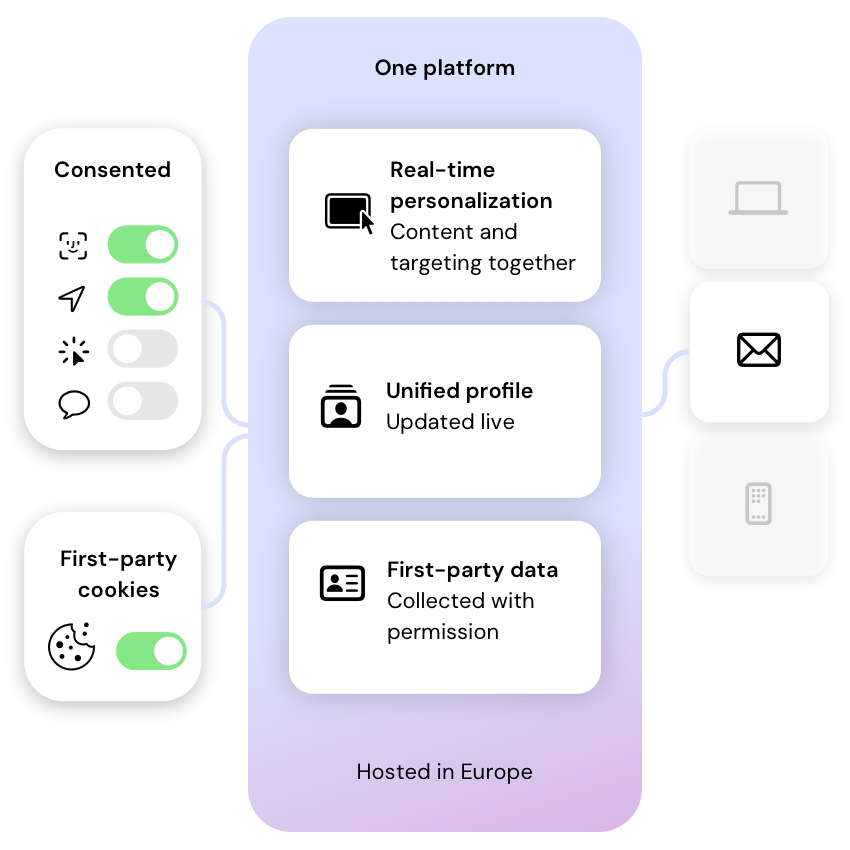
The CoreMedia Digital Experience Platform maps to all three: a first-party data foundation, real-time execution, and a unified profile.
- Its customer data platform runs on first-party data rather than third-party cookies. It builds a single customer view and collects and activates that data in real time, so targeting never leans on signals a brand can't account for.
- Personalization runs on live data inside the same system that delivers the content. Experiences adapt to behavior and intent as it happens, and editors set segments and A/B tests on the content item itself, in the same interface they publish from, rather than in a separate targeting tool.
- AI customer profiles, powered by CoreMedia KIO, pull those signals into a single 1:1 view of each customer, updated as new activity arrives, so the model always acts on current intent.
For regulated buyers, where the data lives matters as much as how it's used. CoreMedia is headquartered in Germany and offers flexible hosting, including private cloud, on-premise, and hybrid, which fits the data-sovereignty and residency requirements common in banking, insurance, and the public sector.
Conclusion
The teams that win the next phase of personalization are the ones who can act, in real time, on the data they're allowed to use, and stand behind every decision afterward. "Good data" now means permission and predictive weight, not volume. If you're rethinking personalization for a consent-first, post-cookie setup, it's worth seeing how real-time personalization works when the profile is built entirely from data customers agreed to share.
Frequently Asked Questions
What is consent-aware personalization?
It's personalization that only uses customer data the person gave permission to use, with that permission built into how segments are defined rather than checked afterward. The data a team is cleared to use and the data it targets on are the same set. That keeps targeting compliant by default.
What are the benefits of consent-aware personalization in marketing?
The main benefit is that targeting stays compliant without slowing down, because permission is resolved before a campaign runs, not in a legal review afterward. It also cuts wasted spend on data you can't act on, and it builds trust, since people are more receptive when personalization uses data they knowingly shared. The part many teams miss: a smaller set of permissioned signals often targets more accurately than a large pool of third-party data.
How does consent-aware personalization impact user engagement?
It tends to lift engagement, because personalization based on data a customer chose to share reads as relevant rather than intrusive. When people understand why they're seeing something, they're less likely to tune it out or leave. Cleaner, permissioned signals also predict intent more precisely, so what a customer sees is more likely to match what they actually want.
How is permissioned AI personalization different from regular AI personalization?
The difference is what the model is allowed to touch. Regular AI personalization tends to optimize against whatever data it can reach, including inferred or third-party signals. Permissioned AI is restricted to data the customer cleared, and a person signs off before anything goes live, which makes both the inputs and the output accountable.
Is consent-aware personalization the same as cookieless personalization?
They overlap but aren't identical. Cookieless personalization is the technical shift away from third-party cookies toward first-party data. Consent-aware personalization is the broader principle that permission decides what data you act on, cookies or not. Most cookieless setups are a subset of a consent-aware approach.