
























The key question is no longer whether companies should use AI, but how to do so in a way that strengthens customer relationships.
How do we keep people at the center when more decisions happen inside dialog-driven interfaces?
How do brands balance automation with empathy, speed with relevance, and scale with trust?
And how do organizations maintain control over the data and infrastructure that now power these experiences?
The following four interconnected trends will redefine how enterprises build resilient customer relationships in 2026.
1. Agentic Commerce and the Rise of Generative Engine Optimization (GEO)
Shoppers are no longer beginning their journey by browsing websites and comparing product pages. Artificial intelligence has become the first voice many consumers consult. According to recent research by the IAB, artificial intelligence is now the second most influential source in shopping decisions behind only search engines. surpassing retailer websites and apps, and even recommendations from friends and family. Nearly 60% of online shoppers already use AI to help with research and purchase decisions, reflecting a broader shift toward conversational, assistant-driven buying.
From browsing to asking: the journey moves into dialogue
The traditional customer journey — search, navigate a site, open product pages, proceed to checkout — is being replaced by an automated, conversational flow. AI interfaces, from advanced chatbots and AI-driven browsers to personal purchasing assistants, now answer highly specific questions that previously required multiple clicks:
“Which provider offers a 50 GB 5G plan with EU roaming and the best coverage in my neighborhood?”
“Which credit card gives me the highest cashback for travel without foreign transaction fees?”
“Which heating system offers the lowest energy consumption for a family home and qualifies for government subsidies?”
AI becomes first touchpoint and decision-maker
These interfaces are becoming the first touchpoint for discovery, comparison, and even purchase — fundamentally relocating the moment of decision. Research by the Nuremberg Institute for Market Decisions show that generative AI makes shopping faster, easier, and more confident by delivering precise, context-aware recommendations. But it also uncovers a critical risk: as AI improves, consumers tend to verify less, placing greater pressure on brands to ensure that their content is accurate, structured, and represented correctly in AI-driven results.
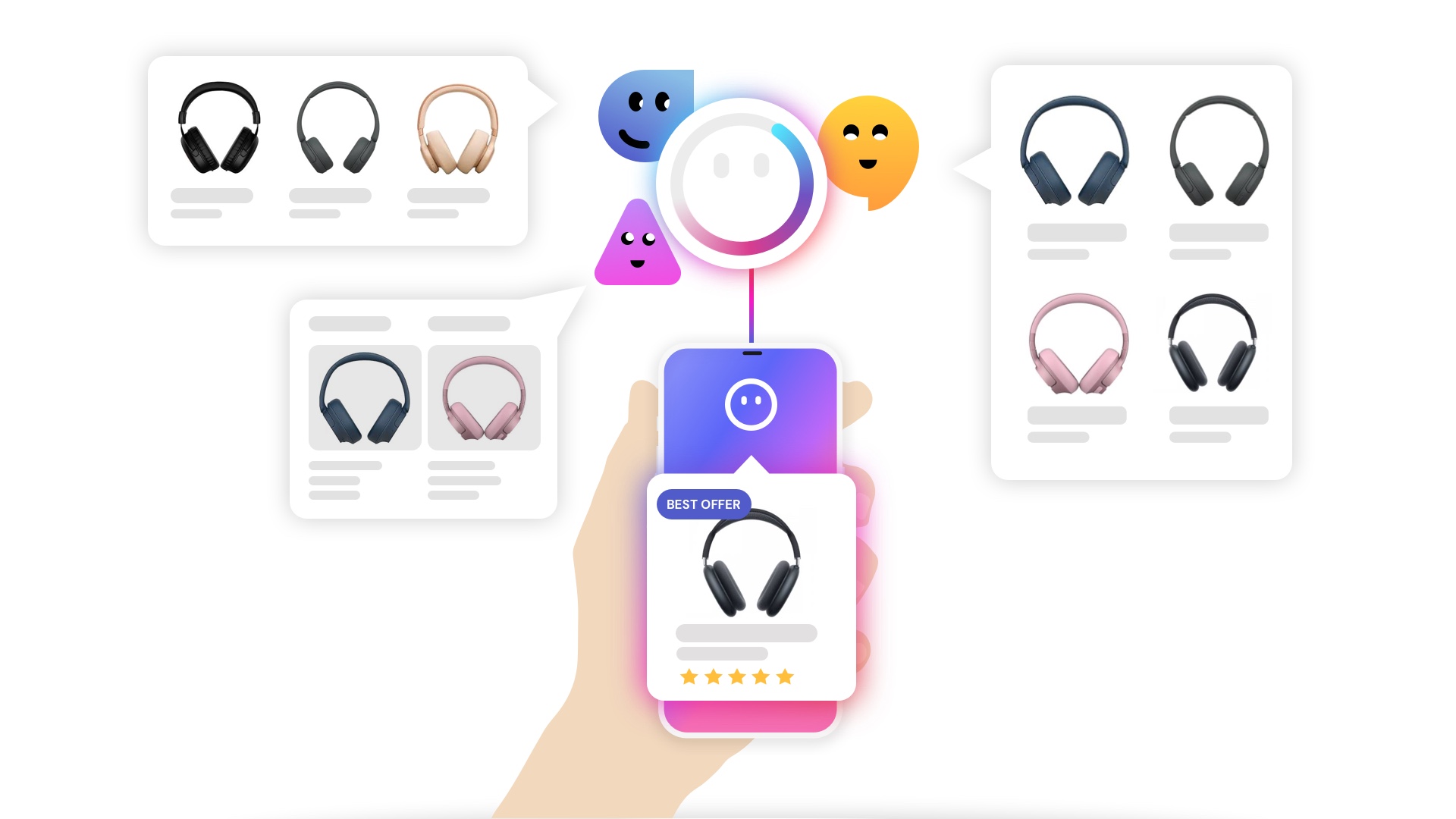
Agentic commerce
Why brands must build trust with AI agents and humans
AI agents will increasingly act on behalf of the customer. They will submit targeted, complex queries, evaluate trade-offs, and make decisions based on user-defined parameters. For enterprise brands, this creates a new strategic imperative: you must build credibility not only with human customers, but with the AI agents that represent them.
How brands remain visible in AI-driven search
Maintain consistent, accurate content from a single source of truth.
As content grows, organizations need one centralized CMS to keep product data, descriptions, and messaging up to date at global scale. This reduces content fragmentation, a common cause of outdated or inconsistent information in AI results.Make content easy for LLMs to interpret and reuse.
Structured data, clear language, enriched metadata, and complete FAQs help AI agents understand and correctly represent your products or services in their recommendations.Strengthen brand authority with trustworthy signals.
Unique content, verified customer reviews, expert opinions, and reputable third-party mentions increase the likelihood that AI models will trust. select and prioritize your brand.
Read more: content optimization for LLMs with CoreMedia.
2. Values-Driven Engagement: why the “98 Percent” can no longer be ignored
Taking AI automation seriously raises an essential question: where is the human truly irreplaceable? Not every interaction should be automated — and not every customer wants it to be. In fact, 64% of consumers would like to see more human interaction from companies online in the future.
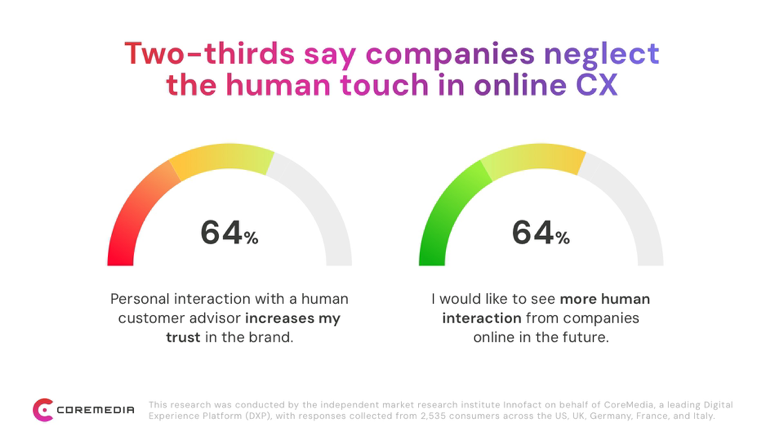
The missed opportunity: the 98% who leave unconverted
Customers don’t experience departments; they experience one continuous journey that spans marketing, sales, and service. Yet many organizations continue to pour budget into top-of-funnel acquisition even though only around 2% of visitors convert. The much larger opportunity lies in activating the other 98% — the hesitant users, drop-offs, and undecided buyers. They often disappear because they face:
too many options
too little guidance
no way to ask a timely, personalized question
Where Values-Driven Engagement becomes a true differentiator
The goal is not to add human support everywhere, but to prioritize it where it creates the greatest value. Purchasing a commodity item requires efficient automation. But evaluating a complex B2B solution, choosing a financial product, or planning a major home renovation demands nuance, empathy, and expert reassurance that a human advisor can provide. The strategic shift for 2026 is the “98 Percent Strategy.” Instead of optimizing campaigns only for the two percent who already convert, enterprises must redirect resources toward the near-conversion customers — the hesitant, uncertain, and undecided high-value leads.
Personalization that doesn't feel like it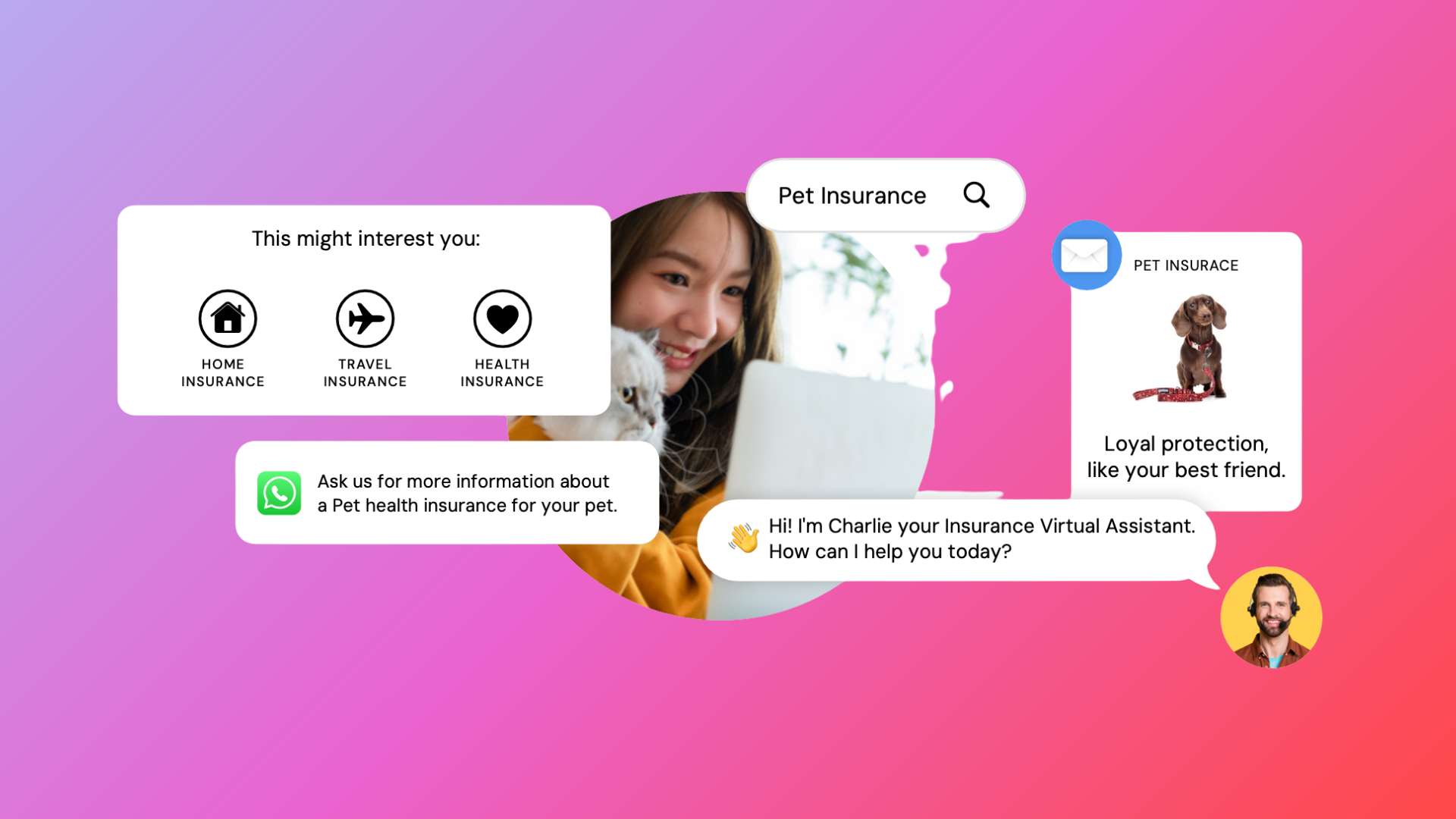
Successful CX in 2026 is built on a thoughtful partnership between AI and humans
AI’s role is to spot these high-intent risk signals — repeated product comparisons, hesitation in forms, last-minute drop-offs — understand what the customer is struggling with, and route them to the next best action. That might be a relevant product review, a guided comparison, or immediate access to human support via video, voice, or expert live chat.
AI: Filters, prioritizes, interprets signals, and executes routine tasks.
Humans: Build trust, handle exceptions, provide empathy, and guide high-stakes decisions.
3. Digital Sovereignty: the quiet prerequisite for operational CX resilience
As AI, automation, and cloud ecosystems become woven into every customer interaction, trust becomes a defining currency. Customers increasingly want to know where their data is stored, who has access to it, and how securely it is managed. This makes digital sovereignty not just a technical requirement, but a core driver of customer confidence and brand credibility.
The gap between strategic ambition and operational reality
Forrester reports that 84% of decision-makers consider digital sovereignty a critical factor in vendor selection, yet only a minority feel confident that their current technology stack fully complies with regional sovereignty requirements. This disconnect highlights a growing operational risk.
For enterprises, digital sovereignty is the foundation of operational resilience. Losing control over critical data or infrastructure directly undermines a brand’s ability to deliver consistent, reliable customer experiences. When CX systems depend on a small number of external providers — who may restrict access during outages, geopolitical tensions, or regulatory shifts — the customer relationship becomes vulnerable.
From convenience to dependency
Major cloud platforms offer convenience, but that convenience can mask strategic dependency. The core question has shifted from "Where is my data stored?" to "Who controls access — and who could deny it when circumstances change?"
For global enterprises, digital sovereignty will be a competitive advantage in 2026. It determines whether a company can govern its own data protection, performance, and scalability — or whether it risks operational and financial consequences from vendor lock-in.
The foundations of Digital Sovereignty for 2026
Composable architectures: Modular, open, and headless systems that decouple innovation from infrastructure lock-in.
Multi-cloud strategy: Distributing workloads to reduce single-provider dependency and increase resilience.
Clear exit scenarios: Prepared pathways for migrating data and applications if external conditions necessitate change.
Transparent data governance: Deliberate decisions about data flow and storage to meet regional regulatory requirements (e.g., GDPR, CCPA).
Digital sovereignty is the bedrock upon which agentic commerce, real-time orchestration, and human-centered CX can operate reliably. Without it, even the most advanced experiences remain fragile.
Read more: the hidden costs of cloud dependence.
4. Real-Time Experience Orchestration: turning data into instant customer value
With digital sovereignty as the foundation, the next competitive frontier is speed — the ability to interpret signals and respond in real time. Traditional personalization relies on historical segmentation. But in 2026, customers expect brands to recognize their intent instantly and adjust the experience on the spot.
How real-time orchestration works
Real-time orchestration means combining live behavioral data, AI decisioning, and dynamic content into one continuous system:
AI interprets what the customer is trying to do.
Content systems deliver the next best message or offer instantly.
Data flows across channels so every touchpoint tells the same story — app, web, chat, email, call center.
Static websites become the exception. Digital experiences adapt themselves: product listings reorder, content adjusts based on user struggle signals, and service journeys shift based on predicted needs
Make smarter decisions with Lead Scoring in CoreMedia Experience Platform

Make smarter decisions with Lead Scoring in CoreMedia Experience Platform
Speed becomes strategy
The brands that win in 2026 are not the ones with the most data — but the ones that can act on it the fastest.
AI accelerates the operational side: tagging content, generating variations, optimizing layouts, and testing at scale. Humans focus on strategy, creativity, and brand integrity — and critically, they define the framework in which AI is allowed to operate. Brands must stay in control of the rules, guardrails, and narrative, while AI provides the speed and scale to execute. It’s a hybrid model: automation delivers velocity; humans provide meaning and direction.
2026: the year CX becomes a unified strategy
Agentic commerce, values-driven engagement, digital sovereignty, and real-time experience orchestration are not separate initiatives; they form a unified strategic agenda for the modern enterprise.
To thrive in 2026 and beyond, organizations must simultaneously:
Communicate confidently with AI agents, treating them as influential intermediaries in discovery, comparison, and purchase decisions.
Invest in high-impact human touchpoints, where empathy and expertise drive conversion and loyalty.
Establish a sovereign, composable, and resilient digital foundation, ensuring full control over data, infrastructure, and the CX ecosystem.
Activate data with contextual intelligence in real time, enabling AI and dynamic content systems to recognize intent instantly and shape the experience across every channel.
Enterprises that achieve this integration will move beyond experimenting with AI and instead turn it into a sustained competitive advantage — delivering faster, more trustworthy, and more human digital experiences that build lasting customer relationships.