





















header-mobile-bg

Fiona CMS alternatives: how to choose the next enterprise CMS

Organizations still running CMS Fiona 6 or 7 "Classic" face a migration whichever way they turn. Moving from Fiona Classic to Fiona 8 or JustRelate Web Builder relies on JustRelate's export and import tooling. 

Once content has to be exported, remodeled and re-templated anyway, staying with the vendor becomes one option among several, and the search for a Fiona CMS alternative looks much like any other enterprise CMS selection. For a view of the wider market, the overview of the best enterprise CMS platforms is a useful starting point. The focus here is understanding what the vendor offers today, what to measure alternatives against, and which platforms fit which kind of organization. 

Key takeaways 

  • Moving from Fiona Classic to Fiona 8 or JustRelate Web Builder relies on JustRelate's export and import tooling, so it involves the same content migration work as a change of vendor. 
  • Fiona 8 is the vendor's option for private cloud and on-premises hosting, delivered as Docker images and tied to a specific Web Builder SDK version. 
  • The most useful criteria for a Fiona CMS alternative are the reasons Fiona was chosen in the first place: control over hosting, a strong editing experience and governance across many websites and languages. 
  • Public Fiona users have taken both paths: LMU Munich moved to another vendor, while LMU Klinikum moved to the vendor's cloud product Scrivito. 
API content delivery through every channel (1)
European CMS alternatives - CoreMedia as the solution

Where does CMS Fiona stand in 2026?

CMS Fiona comes from Infopark, a German vendor. It evolved from Infopark's Network Productivity System, launched in 1997, and took the Fiona name in 2004, according to CMSWire. Fiona's documentation and support knowledge base are now published under the JustRelate name. 

Most installations are in Germany. The technology tracker ful.io detects 1,006 websites on Infopark CMS Fiona, 907 of them in Germany and six in the United States (as of September 2026).

The vendor's current portfolio has three relevant product lines: 

JustRelate ends up offering two versions of the same product: 

  • Fiona 8 is the version organizations run themselves. JustRelate describes Fiona 8 as a CMS for enterprises "that can be installed and maintained in private clouds or on premise." It ships as Docker images, a standard package format that IT teams install on their own infrastructure, and it's updated less often than the cloud version. 
  • JustRelate Web Builder is the cloud version. JustRelate hosts it, stores content on Amazon Web Services and updates it daily. Web Builder sites are built with React, a widely used JavaScript framework. 
Product Comparison
Product Hosting Release model Role in the portfolio
Fiona 6/7 Classic Self-hosted Last listed release 7.0.2 (Nov 2020), service pack Aug 2021 Predecessor of Fiona 8
Fiona 8 Private cloud or on-premises, Docker images Not released daily, tied to a Web Builder SDK version Self-hosted product
JustRelate Web Builder (formerly Scrivito) Cloud, content stored on AWS Daily update cycle SaaS product

Why is moving off Fiona Classic a migration either way?
Fiona 8 shares most of its code with JustRelate Web Builder and is geared to a specific version of the Web Builder SDK. JustRelate advises against updating the SDK beyond the version a Fiona release relies on. Architecturally, Fiona 8 sits closer to Web Builder than to Fiona 7 Classic. 

The migration tooling confirms this. JustRelate's public repository provides a Classic exporter for Fiona 6 and 7 that needs access to the Fiona MySQL database, a separate exporter for Fiona 7 with the Scrivito UI, and an importer for Fiona 8 and Scrivito. Content leaves one system and enters another. 

For planning, three workstreams exist on every path: 

  • Exporting content and mapping Fiona object classes to a new content model 

  • Rebuilding templates and front-end components 

  • Re-creating workflows, user groups and permissions 

What differs between the paths is the target platform, the hosting model and the vendor relationship. That is where the comparison should focus.

lego
What should a Fiona CMS alternative be measured against?

Can the platform run on-premises or in a private cloud if security or compliance rules require it? Where is the vendor incorporated? Data location and legal access are separate questions. For public institutions in Germany and across the EU, the vendor's home country matters as much as where the data is stored, because US providers can be required to disclose data they control even when it sits in a European data center, as the US Department of Justice explains.

Editors used to in-context editing will judge a new platform by preview capabilities, page composition and how quickly a change goes live.

How does the platform handle shared content, local variants, approvals and roles across brands, markets and languages?

Fiona sets access rights down to individual content objects. Check whether the new platform can assign rights per content type, brand and market, because permission models rarely map one to one.

Can editors review and approve every AI suggestion before it's published? Since August 2, 2026, the EU AI Act has required organizations to disclose AI-generated text published to inform the public on matters of public interest, unless a person has reviewed it and holds editorial responsibility. For public institutions, an approval step in the CMS helps document that review. Which language models can the platform use, and can the AI run in the same hosting environment as the CMS?

Does the platform record who changed what and when, including changes suggested by AI? In regulated industries, that record is often part of compliance.

Can editors target audience segments and run A/B tests inside the CMS, or does that need a separate tool and an integration?

Migration path. Does the vendor or a partner offer real migration tooling? And separately: how quickly can Fiona's object classes be mapped into the new platform's content model.

SaaS platforms update continuously, so teams always work on the latest version. Self-hosted platforms let teams control, plan and test their own upgrade schedule.

Email 2

What have other Fiona users done?

Two public institutions in Munich have already moved off CMS Fiona, in opposite directions: 

LMU Munich states that it replaced Fiona with another vendor's CMS in 2021 and no longer creates new websites in Fiona.  

LMU Klinikum, the university hospital, took the other route. It states that its CMS Fiona project is no longer being developed because Scrivito has replaced the websites in Fiona, and that internet sites are now created only in Scrivito. The hospital stayed with the vendor and moved to its cloud product. 

Neither path is better in every case. The deciding factors are the criteria above, weighted by each organization's own requirements. 

Fiona CMS alternatives compared

Fiona CMS alternatives compared
Platform Deployment options (vendor documentation) Better choice for
CoreMedia EU-region cloud, private cloud, on-premises, hybrid Public institutions with multi-site setups that need hosting choice, native personalization and governed AI
Fiona 8 Private cloud or on-premises, Docker images Teams that must self-host and want vendor continuity
JustRelate Web Builder (formerly Scrivito) SaaS, content stored on AWS Teams ready for SaaS that want to stay with the vendor
Magnolia Self-hosted on-premises or in the cloud, or DX Cloud PaaS Java teams that want a choice between self-hosting and PaaS
Adobe AEM AEM 6.5 support windows are dated; check the roadmap Organizations standardized on the Adobe ecosystem
Contentful SaaS, EU data residency as a Premium add-on Developer-led, API-first teams comfortable with SaaS

CoreMedia CMS addresses a combination many Fiona teams share: several websites, markets and languages, plus compliance requirements that affect where the platform runs. CoreMedia can be hosted in an EU region, in the customer's private cloud or on-premises, with support for hybrid deployments, and the platform is ISO/IEC 27001:2022 certified. As a German vendor, CoreMedia is subject to EU law, which matters for teams that weigh vendor jurisdiction alongside data location. 

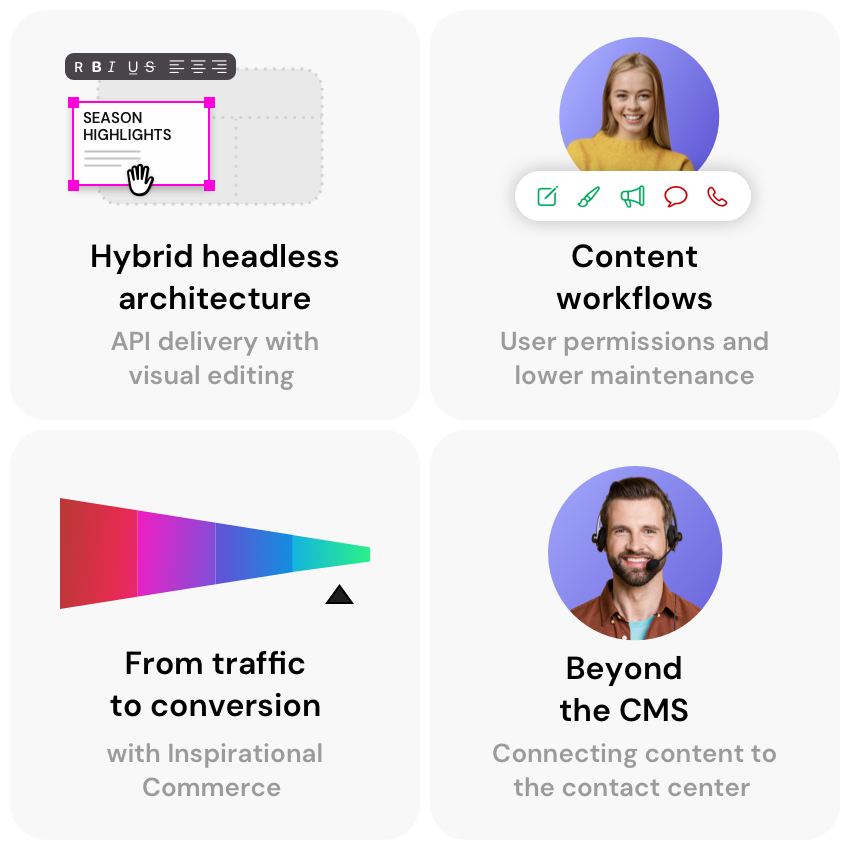
The platform is hybrid headless: editors keep visual editing while developers deliver content through APIs. Its AI co-pilot, CoreMedia KIO is built for governance, since every AI suggestion requires editor approval before it is applied and audit trails record content changes.  

The German Bundestag website ran on Infopark's CMS, the product line that later became CMS Fiona, before a relaunch moved it to CoreMedia. Today the Deutscher Bundestag serves more than 18 million visitors a year from over 250,000 live documents in CoreMedia. 

Personalization and experimentation are built into the same editorial interface. Editors define audience segments, set up A/B tests and preview each variant before it goes live, so targeting lives in the same system as the content it changes. 

Better choice for: public institutions that run websites for many departments in several languages, need on-premises or private cloud hosting, visual editing and API delivery in one platform, and want AI that stays inside approval workflows. Native personalization and a customer engagement feature can be part of the DXP. Smaller single-site projects will usually find lighter platforms more economical. 

Fiona 8 is the option for organizations whose security or compliance rules require self-hosting and who value continuity with the vendor. It runs in private clouds or on-premises and ships as Docker images, and JustRelate's migration scripts cover the path from Fiona 6 and 7 Classic. 

One point to check: Fiona 8 is tied to a specific Web Builder SDK version, and JustRelate recommends not updating the SDK beyond it. Front-end teams should confirm that this release model fits their own roadmap. 

Better choice for: teams that want the shortest vendor transition and need to stay on their own infrastructure. 

JustRelate Web Builder is the product formerly called Scrivito. It is cloud-based, built on a JavaScript SDK with React rendering, and stores content on AWS. JustRelate markets it to enterprises with a usage-based monthly fee and a 99.95% availability SLA, according to its enterprise page. 

Better choice for: teams that no longer need self-hosting, have React skills in house and want to keep a single vendor relationship, as LMU Klinikum did. 

Magnolia can be self-hosted on-premises or in the cloud and runs on Java with an application server such as Tomcat. It is also available as DX Cloud, a Platform as a Service offering. That gives Fiona teams a comparable self-hosting option plus a managed alternative from the same vendor. 

Better choice for: organizations with Java expertise that want to choose between self-hosting and PaaS without changing platforms later. 

AEM is a natural candidate for organizations already invested in Adobe's marketing technology. Teams considering a self-managed setup should check Adobe's release roadmap: support for AEM 6.5 on Adobe Managed Services ended on August 31, 2026, on-premises core support is currently planned to end by February 2027, and AEM 6.5 LTS extends coverage for both. 

Better choice for: enterprises standardized on Adobe Experience Cloud that want to stay within one vendor ecosystem. 

Contentful is delivered as SaaS. It offers EU data residency, with content stored in AWS Ireland and backups in AWS Frankfurt, as an add-on on Premium plans. Like most SaaS companies, Contentful notes that it cannot guarantee that data stored in the EU is only processed in and accessed from the EU. 

Better choice for: developer-led teams building API-first, multi-channel experiences who are comfortable with a SaaS-only model. 

CoreMedia KIO AI Avatar

How should teams plan the move off Fiona?

  1. Inventory the Fiona installation. List object classes, templates, workflows, user groups and permissions. Fiona's fine-grained access control lists deserve extra attention, because permission models rarely map one to one. 
  2. Run a test export early. JustRelate's exporters need access to the Fiona database. A test export shows how clean the content is before any platform decision is final. 
  3. Decide the hosting model first. On-premises, private cloud or SaaS narrows the list faster than any feature comparison. 
  4. Pilot one site. Migrate a representative website, including one additional language, and measure editor effort and publishing time. 
  5. Plan URLs and redirects. Map every live Fiona URL to its new target before launch to protect search visibility. 

How does migrating from Fiona to CoreMedia work? 

Fiona and CoreMedia both store content as structured building blocks rather than finished pages, so most of what teams built in Fiona has a counterpart in CoreMedia. Each Fiona content template, called an object class, becomes a CoreMedia content type, and fields that many templates share only need to be set up once. 

Permissions and approvals have counterparts too. Access rights can be set by content type, brand and market, and editors choose from ready-made publishing workflows, including review steps and scheduled publishing. Page templates don't have to be rebuilt from scratch either, because CoreMedia gives teams a starting point to adapt.

Which Fiona CMS alternative fits which team?

Staying with JustRelate is a sound decision for teams that are satisfied with the vendor: Fiona 8 for self-hosting, Web Builder for SaaS. Magnolia and AEM suit teams with Java skills or an Adobe-centric stack, and Contentful fits developer-led teams that want SaaS headless. CoreMedia belongs on the shortlist for enterprises that run many websites across markets and languages, need a choice of hosting including on-premises, and want AI output governed by the same approval workflows as the rest of their content. 

The migration work is similar on every path. Organizations that start with a content inventory and a test export will have the facts they need to compare options against their own requirements. Teams that want to see how CoreMedia handles hosting, governance and AI can explore the AI-powered CMS and request a demo there.

Talk to an expert about migrating to CoreMedia
Personalized Content Marketing 3

Frequently asked questions

Is CMS Fiona still supported?

Yes, JustRelate continues to document and offer Fiona 8 for private cloud and on-premises installations. For Fiona 6 and 7 Classic, the most recent release listed in JustRelate's knowledge base is 7.0.2 from November 2020, so Classic users should confirm their support terms directly with the vendor.

Is upgrading to Fiona 8 a simple version update?

No, moving from Fiona 6 or 7 Classic to Fiona 8 uses JustRelate's export and import tooling, so it involves content migration, new templates and re-created workflows. 

Is Scrivito the same as Fiona?

No, Scrivito is now called JustRelate Web Builder and is the vendor's cloud product. Fiona 8 shares most of its code with Web Builder but replaces the cloud components for self-hosted use.

Can a Fiona CMS alternative run on-premises?

Yes, several can. Fiona 8, Magnolia and CoreMedia all document on-premises deployment, while Contentful and JustRelate Web Builder are cloud services.

Is CMS Fiona mainly used in Germany?

Yes, according to ful.io about nine in ten detected Fiona websites are in Germany: 907 of 1,006 as of September 2026. 

What is the best alternative to Fiona CMS?

The best alternative to Fiona CMS depends on where the platform has to run and how many websites a team manages. For enterprises with many websites across markets and languages that need on-premises or private cloud hosting, CoreMedia is a strong Fiona CMS alternative. It combines visual editing and APIs in one hybrid headless CMS, with native personalization and AI suggestions that editors approve before they're applied. Teams that prefer to stay with the vendor can move to Fiona 8 for self-hosting or JustRelate Web Builder for SaaS, and developer-led teams comfortable with SaaS fit well with Contentful.