






















Key Takeaways:
- Headless CMS personalization means delivering different experiences across channels by pairing API-first content with customer data, segments, and decision rules. The CMS alone does not do it.
- Traditional CMS platforms struggle because personalization happens page by page, which forces duplicate pages, content sprawl, and constant developer involvement.
- Personalization needs four things alongside the CMS: unified customer data, rules for who sees what, a way to test what performs better, and analytics to prove it.
- Rules-based and AI-driven personalization solve different problems. Most teams should start with clear segments and add AI as complexity grows.
- The real bottleneck is usually marketer autonomy, not architecture. A hybrid, head-optional platform like CoreMedia lets developers keep API flexibility while marketers edit and test experiences directly, on live first-party data.
What headless CMS personalization actually means
Headless CMS personalization is the practice of delivering different content experiences across websites, apps, and other channels by combining an API-first content architecture with a personalization layer: customer data, audience segments, and decision rules. The headless CMS manages and delivers the content. The personalization layer decides which version each visitor sees.
A headless CMS by itself does not create personalized experiences. It manages and serves structured content. Personalization happens on top of that, when the content gets matched with actual decisions about the visitor: who they are, what they've already done on the site, how they got there, and which piece of content makes sense to show them next. In an API-first setup, that same piece of content can feed a website, an app, or any other channel at once, while the personalization layer decides what each one actually shows.
Why traditional CMS platforms hit a wall
Traditional CMS platforms struggle with personalization because they were built to manage one website, page by page. That page-based model creates four recurring problems:
- Content sprawl. A single campaign becomes a set of near-identical pages, one per segment, and each needs its own updates.
- Developer dependency. Marketers have strong hypotheses about what to test, but most changes wait on development time, so iteration slows.
- Weak testing. When the experience is fragmented across page copies, it is hard to isolate what is working and what is not.
- An omnichannel gap. Content built for one website does not extend cleanly to apps, portals, or in-store screens without rebuilding it.
Each problem gets worse as personalization scales, which is exactly when it should be getting easier.
A headless CMS is the foundation, not the finished job
A headless CMS gives you flexible, API-first content delivery, but on its own it is not a personalization platform. It manages and serves content. Every other capability personalization needs has to come from somewhere else.
Moving to headless solves the delivery problem and the omnichannel problem, but if the personalization logic still lives in custom frontend code, the organization has simply moved the bottleneck. The following capabilities need to work seamlessly together with the CMS as one system:
- A customer data platform (CDP). A CDP collects behavioral and transactional signals and unifies them into profiles you can act on. Without one, personalization stays superficial, limited to crude signals like geography or traffic source rather than account status, real-time engagement or lifecycle stage.
- Audience segmentation and rules. Segmentation defines which audiences matter and what content or offer changes for each one. A visitor with a cart value over $100, for example, can automatically enter a "high-value buyer" segment that triggers a different offer than a first-time visitor sees.
- Experimentation and A/B testing. Testing is how you confirm a personalized variant beats the default for the right segment and lets you refine the winner to continuously drive better results.
- Analytics. Connect personalized experiences to engagement and conversion, so you can tell what worked and feed that back into the next decision.
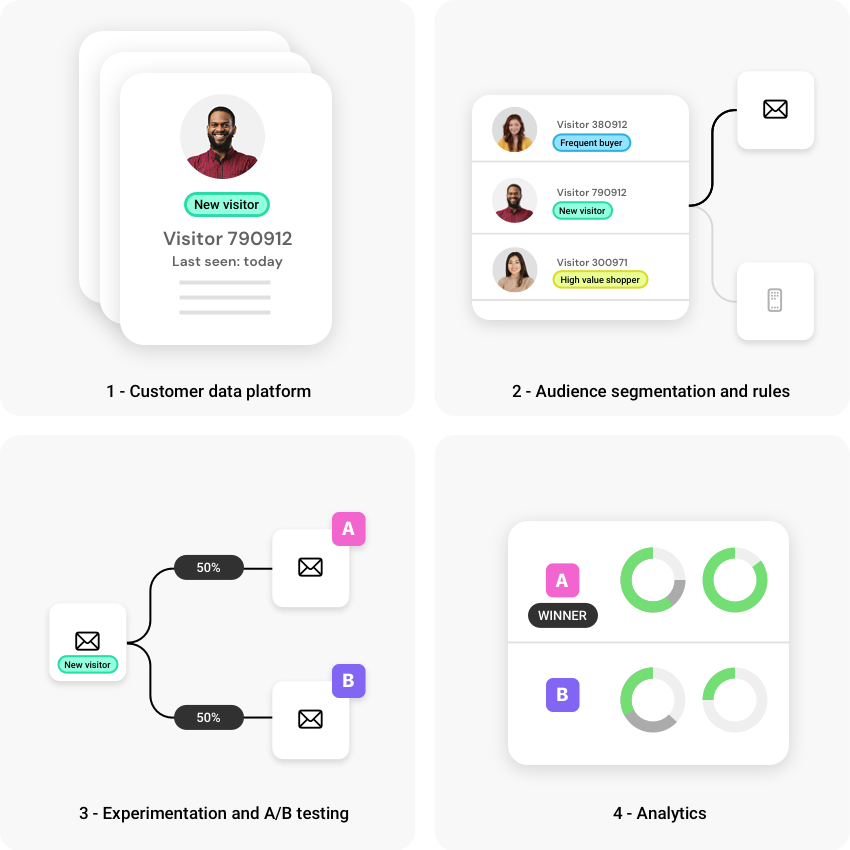
There are two ways teams usually assemble these. The composable approach keeps the CMS as a structured content repository and pipes that content into a separate personalization engine or CDP that handles segmentation and decides what each visitor sees. Content and decision-making live in different systems, connected by an API. The native approach builds personalization into the CMS itself, so segments, rules, and content all sit in one interface, with no separate platform to wire up.
The trade-off is simple: composable gives you more choice of tools; native gives you fewer moving parts and less integration to maintain. A hybrid, head-optional platform can support either, with native personalization built in and the option to connect an existing CDP or testing tool where you already have one.
Rules-based vs. AI-driven personalization
Segmentation and rules are where most personalization starts, but not where it ends. As the number of segments and signals grows, how each decision gets made has to change too.
Rules-based personalization uses explicit if-then logic you define: if a visitor matches this segment, show that content. AI-driven personalization uses models to predict what's most relevant in the moment, without a human writing the rule first.
| Rules-based | AI-driven | |
|---|---|---|
| How it decides | Explicit conditions you set: segment, behavior, source | Models score intent and predict the next best content |
| Best fit | Clear segments, strong governance, getting started | Many variables and segments, real-time optimization at individual level, at scale |
| Main tradeoff | Manual to maintain as rules multiply | Needs clean and centralized data, and oversight |
| Where to start | Here, for most teams | Add once rules get hard to manage by hand |
Rules take you to segment-level relevance. AI-driven personalization is what gets you to individual, real-time relevance: scoring intent as it happens and adapting before the visitor moves on. That is the shift from personalizing for a segment to personalizing for a person, and it is where personalization is heading as buyer journeys get more fragmented. The practical pattern is layered: rules set the strategic guardrails, and AI optimizes within them once the number of segments and signals outgrows manual management.
Where marketers get left behind
The most common failure point in headless CMS personalization is not the architecture, it is execution speed. Pure headless stacks are built around developer workflows, so a routine personalization change often results in waiting on someone else's sprint, and a campaign that should adapt to customer behavior in real-time launches when the buyer already left.
A hybrid, head-optional model closes that gap. It keeps API-first delivery for developers while giving marketers the capabilities pure headless usually strips out: visual editing, preview of an experience by segment, and the ability to build and test variants without touching code. That combination matters because the real bottleneck in most personalization programs is not the content model, it is how quickly a marketer can act on it.
How CoreMedia handles headless personalization
CoreMedia is a hybrid headless CMS: developers get API-first delivery, and marketers keep visual editing and control over experiences in the same platform. Personalization and experimentation are built natively into the CoreMedia Experience Platform, so the customer data, the content, and the decision all run in one system. If you already have a CDP or testing tool in place, the platform also supports connecting those instead.
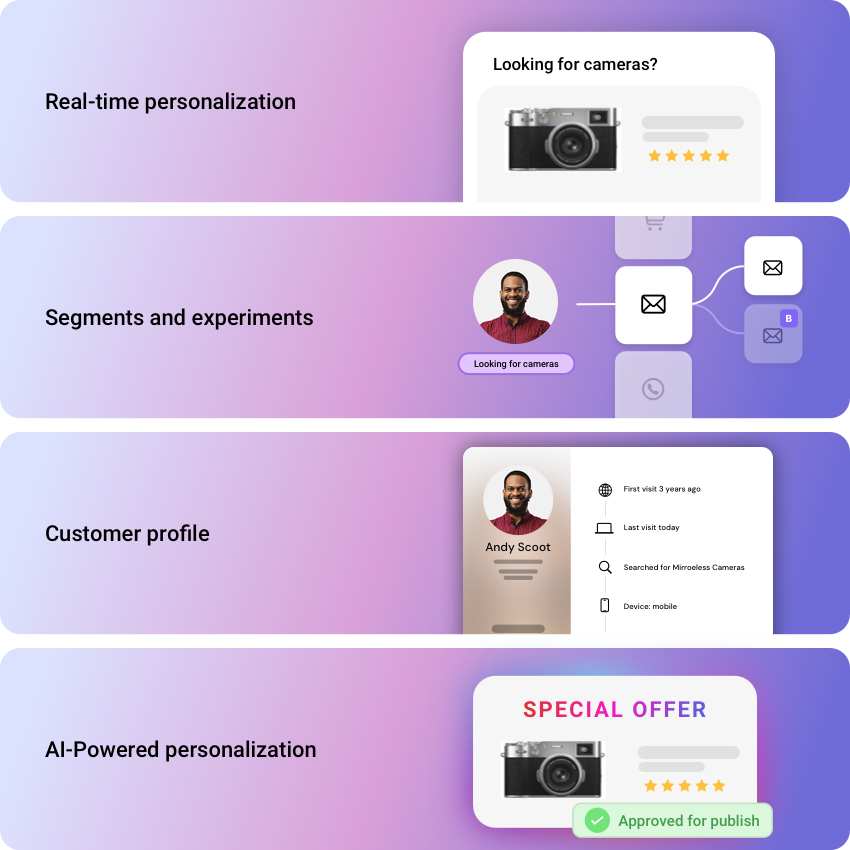
Real-time personalization right in the CMS
Most personalization tools run on batch data, so profiles refresh overnight and the experience reacts to yesterday's behavior. CoreMedia's personalization runs on live data inside the same platform that manages the content, so an experience can adapt to what a visitor is doing in the current session. There is no lag between the signal and the response.
Segments and experiments the marketing team runs itself
Marketers assign audience segments and configure A/B tests directly on the content item they are editing, inside CoreMedia Studio. A per-item metrics view shows how each variant performs by segment, so testing becomes part of the normal editing workflow instead of switching to an external tool.
One customer profile, built on first-party data
CoreMedia's customer data platform unifies behavioral, transactional, and contextual signals into a single profile, and it runs on first-party data rather than third-party cookies. That gives marketers richer segments to target without depending on tracking that privacy regulation and browsers are phasing out, which matters most for regulated and EU-based buyers.
AI-Powered personalization with humans in the lead
CoreMedia KIO is the platform's built-in AI layer. It consolidates customer data into profiles and answers performance questions through a conversational interface, so a marketer can ask how a specific landing page or segment is doing without waiting on a report. Every AI suggestion still needs editor approval, so the team keeps final control over what goes live.
The business impact of personalization
Done well, personalization changes one thing above everything else: it makes the buying journey feel relevant to the person in it, right when they need something. Powered by a data-driven content platform, that becomes a real driver of revenue growth, customer retention, and operational efficiency.
- Revenue. Show the right offer at the right moment and friction drops, more people finish checkout, more people sign up. Good recommendations push average order value up because people add things they'd actually want.
- Loyalty. People stick around longer on a site that keeps showing them things they've already shown interest in. That builds lifetime value over time, and it also cuts churn, because someone about to drop off can be handed something useful before they leave.
- Operational efficiency. Instead of someone manually maintaining a thousand different rules for a thousand different segments, the system handles the targeting.
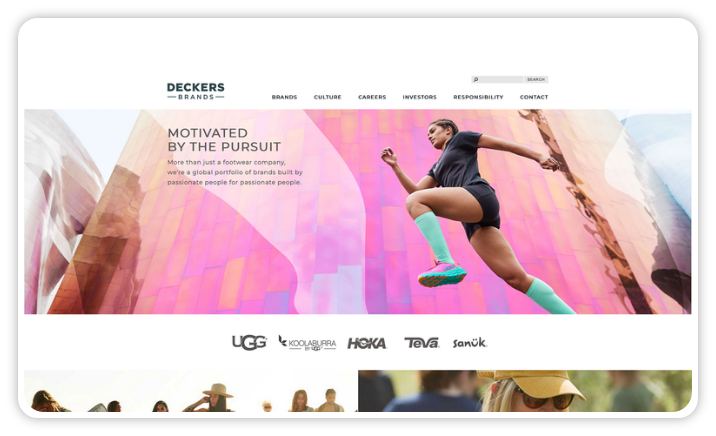
The operational level is the one teams underrate, and it is where a named example helps. Deckers, the group behind UGG, Hoka, and Teva, runs five brands across more than 50 countries on the CoreMedia Experience Platform, with merchandisers building and adjusting personalized experiences themselves and the first rollout live in 60 days. As Deckers' Nick Smotek put it, "the learning curve for a non-technical user was really easy." That is the difference between personalization your team owns and personalization that waits in a developer queue.
Where this leaves you
Headless CMS personalization is an architecture decision as much as a marketing one. The teams that make it work choose a setup that keeps content, data, and personalization logic connected, and that lets marketers act without a developer in the loop for every change.
If you looking to make your personalization process easier, faster and more effective, CoreMedia's overview of native personalization and experimentation walks through where each approach wins. Talk to our expertsto know more.
Frequently Asked Questions
Which architecture is best for personalization, traditional or headless?
Neither is automatically best. Traditional CMS platforms give marketers control but struggle to personalize across channels; pure headless scales across channels but often pushes every change back to developers. For most enterprise teams, a hybrid, headless CMS with integrated personalization fits best, because it keeps API-first delivery for developers and gives marketers what pure headless usually strips out: visual editing, segment-level preview, and the ability to build and test personalized variants without waiting on a developer.
Can a headless CMS do personalization on its own?
Not usually. A headless CMS manages and delivers content, but personalization also needs customer data, segmentation, decision rules, experimentation, and analytics. Those capabilities are either native to the platform or added through integrations.
What is the difference between a headless CMS and a DXP for personalization?
A headless CMS mainly manages and delivers content. A DXP adds the personalization layer on top: customer data, segmentation, targeting, testing, and analytics. For personalization, that additional layer often matters as much as the CMS itself.
Do you need a CDP for headless CMS personalization?
In most cases, yes, or an equivalent customer data layer. Without unified profiles, personalization tends to stay limited to surface signals like location or traffic source, rather than richer signals like real-time engagement, buying signals, account status or lifecycle stage.
Which headless CMS has native personalization?
Very few. Most headless CMS platforms deliver content and hand personalization off to separate tools, so "native" is worth checking closely. CoreMedia is one of the platforms that builds it in: segmentation, A/B testing, and real-time personalization run inside the same editor marketers use to manage content, on unified first-party data. A good test for any vendor: can a marketer create a segment, target content, and launch an A/B test without leaving the CMS or waiting on a developer? If personalization lives in a separate product that happens to be sold alongside the CMS, that is integrated, not native.