






















Headless CMS and SEO in a brief
- Search itself has shifted. Google's Core Web Vitals and mobile-first indexing now reward content that loads fast and is cleanly structured. At the same time, answer engines like ChatGPT, Gemini, Perplexity, and Claude increasingly decide which brands get surfaced at all.
- A headless CMS meets that bar by decoupling content from the front end. Removing theme and plugin bloat lets developers build lean pages and hit the strong Core Web Vitals scores that search engines reward.
- On the other side, pure headless can work against SEO by removing editorial control. When marketers depend on developers to change meta tags, structured data, or internal links, everyday SEO slows to engineering speed.
- A hybrid headless CMS has become the standard for enterprises that need both. It keeps API-first performance for developers while giving marketers a visual interface to manage SEO and publish without a code deployment.
- Speed and search rankings only pay off when traffic converts. Connecting content, commerce, customer data and human support is what turns search engine traffic into revenue.
How headless architecture transforms site performance
A headless CMS improves site performance by removing the presentation layer from the content repository. Traditional CMS platforms render pages through themes, plugins, and server-side templates that ship unused code to the browser. A headless content management system delivers raw content through an API and lets a purpose-built front end decide exactly what loads. The pages get lighter, and lighter pages are faster pages.
That speed shows up directly in Core Web Vitals, the performance signals search engines use as part of ranking. When Vodafone improved its Largest Contentful Paint (how fast main content loads) by 31%, sales rose 8%, according to Google's own web.dev case studies. The same research notes the BBC lost an additional 10% of users for every extra second its site took to load. Core Web Vitals are not an abstract score. They measure Largest Contentful Paint, Interaction to Next Paint, and Cumulative Layout Shift, which is to say the loading and responsiveness a visitor actually feels.
Mobile-first indexing and edge delivery: Headless architecture gives developers room to build front ends tuned for mobile, which matters because search engines index the mobile version of a site first. With frameworks like React or Next.js, teams control the markup, the script load order, and the rendering path without fighting a monolithic template.
Delivering content through APIs also suits edge caching. A headless CMS can push content to a global CDN and serve it from a location near the user, cutting Time to First Byte. CoreMedia's hybrid headless CMS, for example, uses Amazon CloudFront as its default CDN and supports GraphQL edge caching and automatic responsive image generation through its Image Transformation Service, delivering Core Web Vitals performance comparable to AMP without AMP's constraints.
The hidden SEO risks of "Pure" headless CMS
Pure headless CMS platforms solve a developer problem and create a marketing one. Headless-first systems such as Contentful and Strapi are built API-first for engineering speed, and that same strength is what gets in the way of the marketing teams responsible for SEO.
The developer bottleneck: On a pure headless platform, updating a meta tag, fixing a canonical, or adding structured data is a code change that waits for a developer and a release. SEO that moves at engineering speed rarely keeps up with a competitive search campaign, and the backlog grows every time a routine optimization needs a ticket.
Lost visual context: These platforms also strip out the visual editor. Without in-context preview, editors handle a page as a set of form fields and trust that it renders correctly once published. For teams shipping daily news and frequent landing pages, that makes everyday content management slow and error-prone, and it undermines the SEO efforts that depend on getting pages live fast and accurately.
Siloed SEO workflows: Internal linking, localized URL structures, and redirects are hard to coordinate without a visual map of the site. On headless-first platforms these controls live in code and configuration, scattered across the stack, so work that should run as one coordinated SEO strategy fragments across tickets and repositories instead.
Time-to-market delays: Pure headless is fast for servers and slow for people. Every editorial change routed through engineering adds days to the calendar, and in search, where rankings favor the site that publishes and iterates first, those delays stack up. A platform that serves pages quickly but changes them slowly blunts even well-planned SEO efforts and hands the advantage to more agile competitors.
The hybrid headless advantage: Winning the global SEO market
A hybrid headless CMS keeps the API-first performance of headless and adds back the visual editing layer that pure headless throws away. Developers still build fast front ends against a content API. Marketers get drag-and-drop page building, live preview, and direct control over meta tags and structured data, with no deployment in the loop. For enterprise SEO, that combination removes the bottleneck without giving up the speed.
This is what CoreMedia's hybrid headless CMS was built to do. Editors work in a visual interface with omnichannel preview, manage their own SEO metadata, and publish through governed workflows, while the same repository feeds a GraphQL API for custom front ends. Content is modeled as structured, typed objects rather than pages, which makes it reusable across web, app, and in-store screens and easier for both search engines and AI systems to read.
Scale is where the difference compounds. A hybrid headless CMS with centralized localization lets a global enterprise manage dozens of markets and languages from one source of truth, so SEO success in one region does not mean rebuilding everything in the next. CoreMedia reports up to 75% faster time to web for customers using this model.
MTV Oy, one of Finland's largest media companies, runs more than 100 editors publishing daily news through CoreMedia's headless API into a progressive web app. The team reports faster performance in Google Lighthouse testing than its previous site, while journalists publish at the speed breaking news demands. That is the hybrid promise in practice: developer-grade performance and marketer-grade velocity in one system.
Against a monolithic suite like Adobe Experience Manager, the difference is starker. With an all-in-one stack, changing one component often means renegotiating with the whole platform, while a composable hub model lets teams swap or add tools through APIs without a rip-and-replace. CoreMedia is built this way, so an SEO strategy can stay adaptable as channels and search behavior change.
5 technical SEO best practices for headless environments
Strong headless CMS SEO comes down to disciplined technical SEO. The following practices protect search rankings in a decoupled setup.
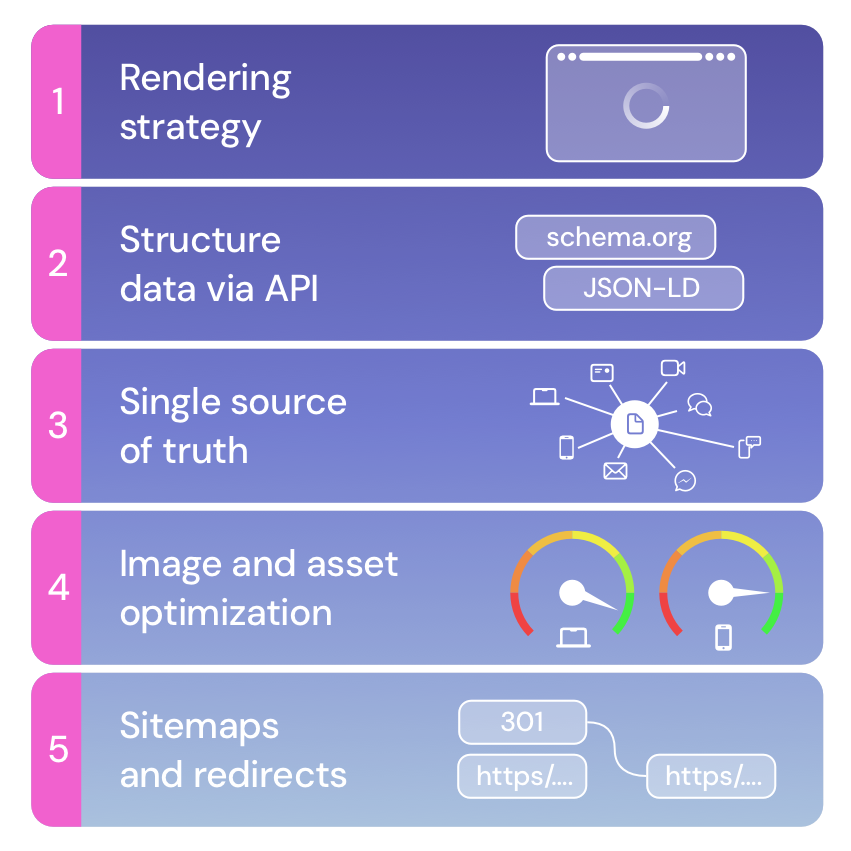
1. Choose the right rendering strategy: Use static site generation for stable, high-traffic pages so search engines receive fully formed HTML with no client-side rendering delay. Use server-side rendering for pages that change per request. Static site generation pre-renders pages ahead of time, which removes the JavaScript execution that can otherwise block crawlers.
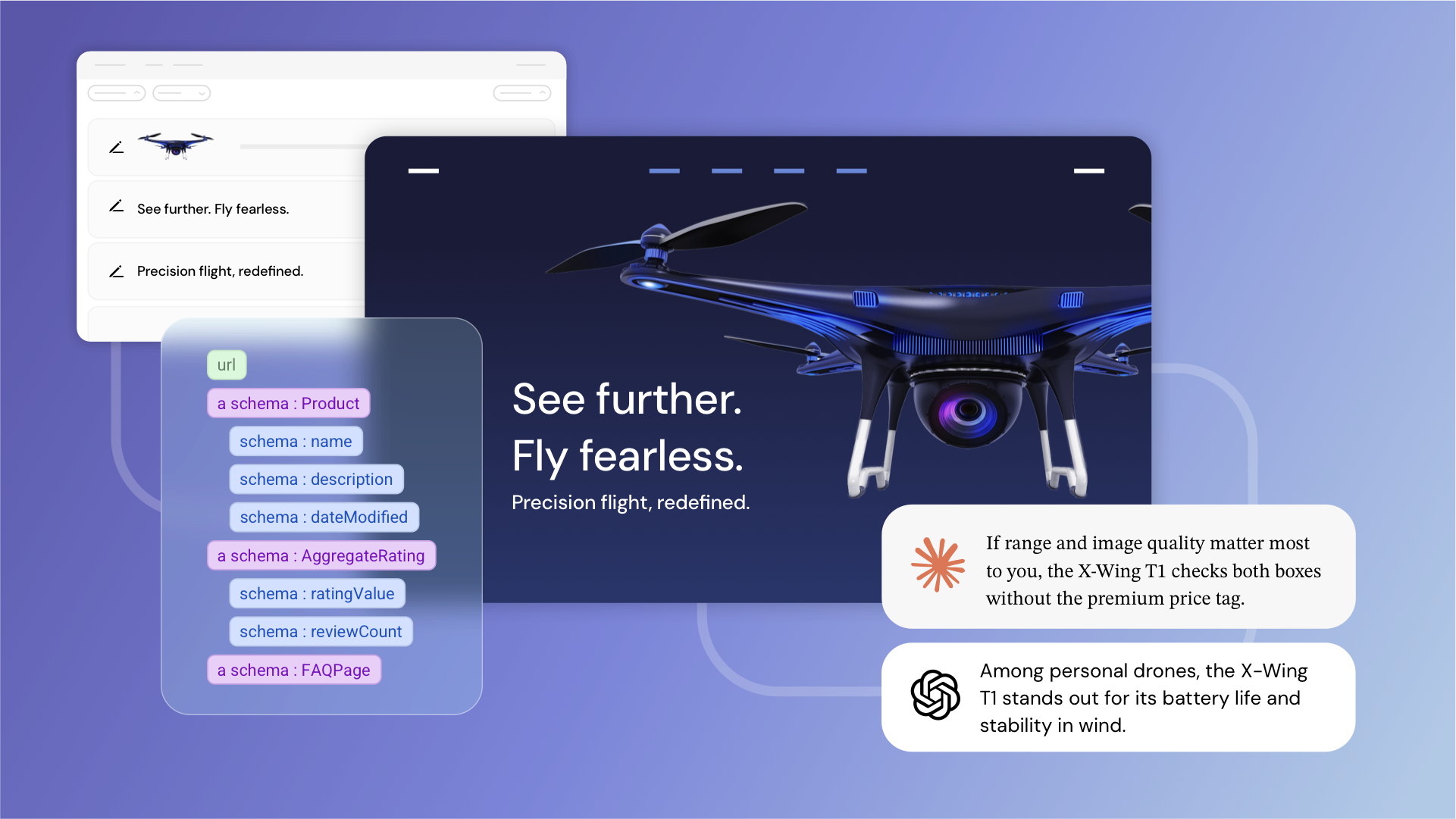
2. Serve structured data through your API: Generate JSON-LD programmatically from content fields so every page ships consistent schema. At enterprise scale, API-generated structured data is more reliable than plugin-generated markup, and that consistency is what search engines reward.
3. Keep one source of truth for content: A single repository feeding every channel means SEO-optimized content stays consistent across web, app, and other touchpoints, with no duplicate or conflicting versions for search engines to penalize.
4. Automate image and asset optimization: Generate WebP or AVIF variants and lazy-load below-the-fold media at the front-end framework level. Responsive image delivery is one of the highest-impact fixes for Largest Contentful Paint and overall Core Web Vitals.
5. Automate sitemaps and redirects: Generate XML sitemaps programmatically and manage 301 redirects in code or configuration. This matters most during a migration, when broken redirects can erase years of accumulated search rankings.
Turning headless SEO traffic into conversions
Rankings and speed are inputs, not outcomes. A fast headless CMS can deliver record organic traffic and still underperform if the journey from search result to purchase breaks down. The enterprises seeing real return treat SEO and conversion as one system rather than two teams.
Blending editorial content with commerce is one way that system pays off. When a buyer arrives from a search engine onto a page that combines an inspiring story with shoppable products and clear pricing, high-intent traffic has somewhere to go. CoreMedia calls this inspirational commerce, and it relies on the same content-and-commerce integration a hybrid headless CMS makes possible.
Trust is its own conversion lever. A visitor who arrives from organic search rarely buys on first impression, and signals like customer ratings, reviews, and dynamic social proof reduce the hesitation that stalls conversions. Because CoreMedia personalizes content in real time from first-party data, it can surface the most relevant ratings, recommendations, and proof points for each visitor, turning a cold organic click into a warmer, higher-intent session.
The harder conversions need a human. For high-value B2B and luxury journeys, connecting content to a Cloud Contact Center lets a brand offer live chat, a click-to-call, or a video consultation at the moment a visitor hesitates. The CoreMedia Experience Platform pairs its CMS with real-time engagement tools, so a digital experience can hand off to a person when it counts, which is often where organic traffic finally turns into revenue.
How AI is reshaping enterprise SEO and content operations
AI has changed what SEO success means. A 2025 Pew Research Center study of real browsing data found that on Google, still the dominant search engine, users who saw an AI summary clicked a traditional result in only 8% of visits, against 15% when no summary appeared, and a source cited inside the summary drew a click just 1% of the time. Being one of the sources an answer engine cites, then, no longer guarantees a visit, let alone a sale. The position that pays is being the source the model treats as the answer, and when content is not structured and trustworthy enough for a model to rely on, that authority shifts to a competitor. Earning it takes structured, governed, machine-readable content, which is exactly what a well-modeled headless content management system produces.
This is where a headless CMS earns a second job: acting as infrastructure for AI discovery. Content modeled as typed objects with validated metadata is easier for answer engines to interpret and trust, and that trust is fast becoming a requirement for visibility rather than a nice-to-have.
AI also scales the operations side. CoreMedia KIO, the AI copilot embedded in the CoreMedia Experience Platform, drafts metadata, generates SEO and GEO optimizations across hundreds of pages, and adapts content to brand voice, with an editor approving every suggestion before it ships. For teams running enterprise SEO across many markets, that is how an SEO strategy keeps pace without adding headcount.
Conclusion: Future-proofing your digital experience with CoreMedia
The impact of headless CMS on SEO and site performance is real and mostly positive, with one condition: the architecture has to serve marketers as well as it serves servers. Pure headless delivers the speed and gives up the control. A hybrid headless CMS keeps both, which is why it has become the default choice for enterprises that depend on search.
The enterprises that pull ahead combine that performance with the tools that act on the traffic it earns. When a hybrid headless CMS runs in the same platform as real-time personalization, commerce, and human engagement, a fast organic visit lands on a page that adapts to the visitor and offers a person to talk to when the decision is close. Speed and editorial control win the click; the engagement layer is what turns it into revenue. CoreMedia builds both sides into one composable platform, so a single team can run SEO, conversion, and customer engagement without stitching separate tools together.
If you are evaluating a move to headless, or rethinking an SEO strategy built on a platform that slows your team down, look at how a hybrid headless CMS and integrated engagement work as one system. Book a demo of the CoreMedia Experience Platform to test it against your own SEO and conversion requirements. Elevate experience. Drive impact.
FAQ: Impact of headless CMS on SEO and site performance
Does headless CMS work with Google Search Console and standard SEO tools? Yes. When pages are served as rendered HTML through server-side rendering or static site generation, Google Search Console, Ahrefs, and Screaming Frog crawl a headless CMS like any other site. Watch only for client-side rendering, where content appears after JavaScript runs and some crawlers miss it, so pre-render those pages.
How do you handle 301 redirects in a headless CMS setup? Programmatically, not through a plugin UI. A headless CMS sets redirects in the front-end framework, the CDN, or a redirect service. In Next.js, for example, a redirects block in next.config.js maps each old URL to the new one, version-controlled and deployed in bulk, which scales for large migrations.
Can headless CMS handle hreflang tags for international SEO? Yes. hreflang is generated from your content model and locale data, so a headless content management system outputs it consistently across markets, which is hard to get right by hand. A brand in 20 markets can emit correct reciprocal hreflang for all 20 from one source instead of tagging page by page. CoreMedia's centralized localization is built for that consistency, where manual tagging on traditional CMS platforms tends to break.
Does headless CMS support structured data and schema markup? Yes, usually better than plugin-based systems. Structured data is generated as JSON-LD from your content fields, so the markup stays consistent on every page at scale. One product field, for example, can populate Product schema with price and availability across thousands of SKUs with no per-page editing. Because CoreMedia models content as typed objects, schema maps straight from the fields editors already fill, which is the consistency search engines and AI answer engines reward.
How does headless CMS handle JavaScript SEO challenges? With server-side rendering or static site generation. The risk is client-side rendering: the page stays empty until JavaScript runs, so search engines see nothing. A product page built with SSR reaches Googlebot fully formed, while the same page rendered only in the browser can be indexed blank. Most headless CMS platforms support both, so the rendering choice, not the CMS, decides JavaScript SEO.
What happens to SEO during a migration from monolithic to headless CMS? Done carefully, SEO rankings hold; done carelessly, you lose them. The risks are changed URLs, lost redirects, and broken crawl paths. A phased migration with a full redirect map, preserved URLs, and monitoring in Google Search Console protects them. Most post-migration drops trace to skipped technical SEO, not to headless itself, and CoreMedia's hub model lets you migrate incrementally rather than all at once.