





















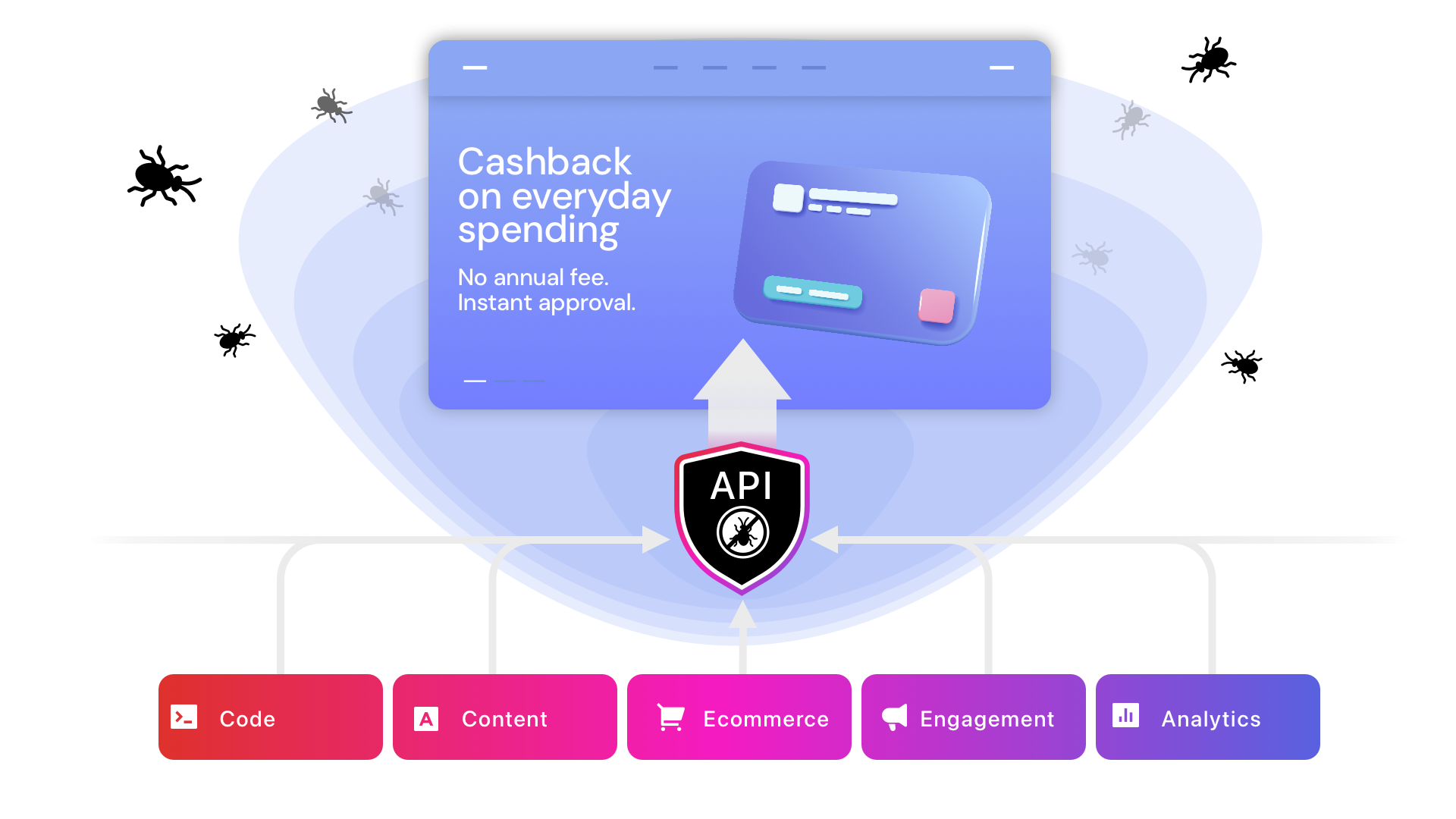
- Decoupled headless architecture separates the front-end from the back-end, eliminating the attack vectors that make traditional CMS platforms easy targets.
- API-driven communication between layers enables granular access controls, token-based authentication, and end-to-end encryption that monolithic systems cannot replicate.
- A headless CMS protects enterprises from DDoS attacks by absorbing traffic spikes via CDNs without exposing backend databases.
- SQL injection attacks become ineffective when the front-end has no direct access to the database.
- Pure headless secures the tech stack but sidelines marketers. CoreMedia's Hybrid Headless architecture delivers enterprise-grade security alongside the visual editing tools marketing teams actually need.
According to IBM's 2025 Cost of a Data Breach report, 63% of organizations lack AI governance policies to manage AI or prevent the proliferation of shadow AI. That gap is opening new attack surfaces faster than most enterprise security teams can close them.The harder-to-quantify damage compounds it: customer trust eroded, campaigns paused, developers pulled from roadmap work to handle emergency patching.
For most enterprises, the underlying architecture is where the exposure starts. Traditional CMS platforms couple the presentation layer directly to the content repository and database. That design made sense a decade ago. It makes enterprises vulnerable now.
Decoupled headless architecture changes the equation and gives enterprises several advantages they cannot achieve with traditional systems. Separating the front-end from the back-end eliminates entire categories of attack. Enterprise decision-makers don't just need secure architecture. They need it to work alongside existing commerce platforms, third-party integrations, and marketing tools, without creating new vulnerabilities every time a new system connects. The real test is whether you can achieve air-tight security without sacrificing user experience, sales, or time-to-market. That's what this guide covers.
What is decoupled headless architecture?
Decoupled headless architecture is a web development approach where the front-end presentation layer and the back-end content management system operate as independent systems, communicating exclusively through APIs. (Learn more about the right architecture for your CMS with our Headless vs. Hybrid CMS blog article)
In a traditional CMS setup, the database, content management logic, and web rendering engine are bundled together. Platforms like monolithic Adobe Experience Manager or popular WordPress are built this way, the front-end and back-end are inextricably linked. Change one, and you risk breaking the others. A vulnerability in a front-end plugin can cascade directly to the database. A traffic spike on a public-facing website can take down the CMS administration panel.
Decoupled architecture severs that connection. Think of it like the relationship between a bank vault and a teller window. Customers interact with the teller window. The vault is in a completely separate, access-controlled room. A crowded lobby doesn't threaten the vault. A compromised teller terminal doesn't give anyone access to the safe.
In headless architecture, your website, apps, and digital channels are the teller window. Your content repository and database sit behind secure API layers with no direct external exposure. Malicious actors never touch what matters most.
This is the core structural difference that gives headless CMS platforms several capabilities that traditional CMS simply cannot offer.
Top 5 security benefits of decoupled headless architecture
Removing the presentation layer from the database doesn't just reduce security risks. It eliminates entire categories of attack that keep enterprise security teams up at night.
1. Drastic reduction of the attack surface
Traditional CMS platforms vary in how they extend functionality. Some, like WordPress, rely on open plugin ecosystems with tens of thousands of community-built extensions, each one a potential vulnerability. Others, like Adobe Experience Manager, use vendor-controlled extensibility frameworks that offer tighter quality control but still run inside the same monolithic environment as the CMS itself.
Either way, the structural problem is the same: when the front-end, back-end, and extension layer share an execution environment, a vulnerability anywhere in the stack can expose the database. The risk isn't only third-party plugins. It's the coupling itself.
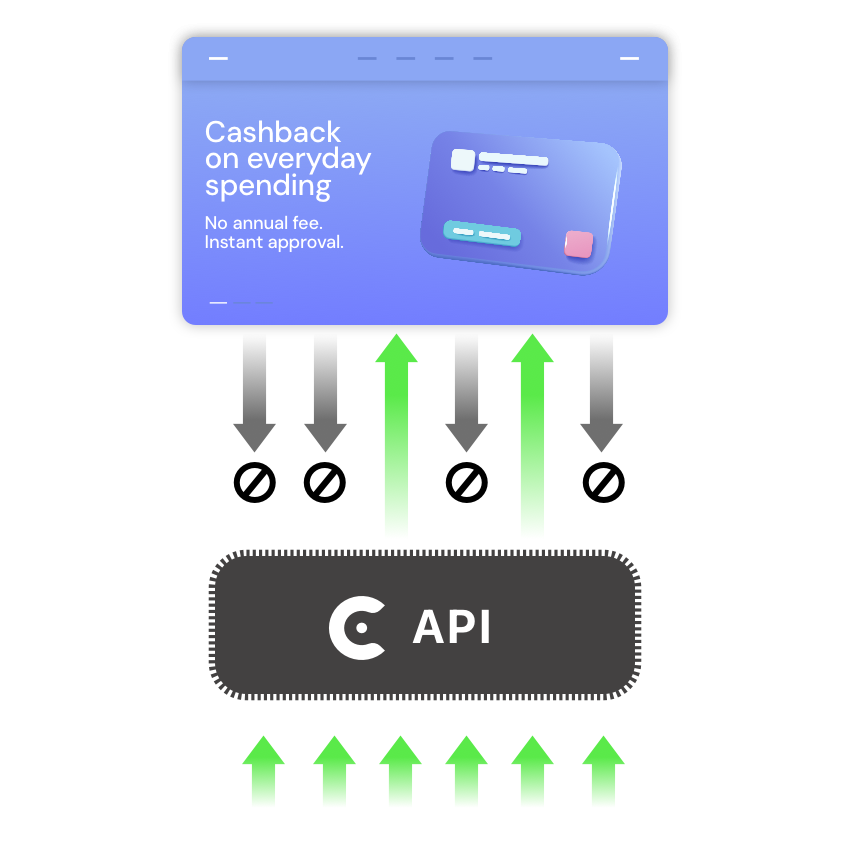
A decoupled CMS removes this problem structurally. The front-end is effectively read-only. It fetches content via API and renders it. There are no forms that write directly to a database. There are no third-party plugins with direct back-end access. Hackers cannot reach the CMS administrative interface through a front-end vulnerability because the two systems don't share an execution environment.
The attack surface shrinks from everything your website touches to a handful of authenticated API endpoints you control.
2. API-driven security and strict access controls
APIs are how the front-end and back-end communicate in a decoupled architecture. But they're also the place where enterprises have the most control over who gets what data and under what conditions.
Modern API gateways let security teams enforce security protocols and enhanced security measures at the layer where requests are made, not after data has already been transferred. Token-based authentication and JWT (JSON Web Tokens) ensure that every request is verified before any content is delivered. End-to-end encryption prevents interception in transit. Rate limiting prevents automated abuse.
Crucially, API gateways allow granular permission structures. A service pulling product content for a mobile app gets exactly that access. An internal user requesting customer data for a contact center agent gets a different, appropriately scoped token. Neither can see what the other can access. This is a security model that other systems, including traditional CMS platforms built on shared database connections and broad user roles, cannot match.
3. Superior DDoS mitigation and traffic management
A Distributed Denial of Service (DDoS) attack floods a target with traffic until it collapses under the load. For traditional CMS platforms, that means the database goes down, the admin panel becomes inaccessible, and the public-facing website disappears simultaneously. One attack, three failures.
Decoupled headless architecture breaks that chain. The front-end is typically served through a Content Delivery Network (CDN), distributing traffic across a global network of edge nodes. Traffic spikes, whether from DDoS attacks or a viral campaign, hit the CDN, not the back-end database. Static content and cached responses absorb the load without touching the content repository.
Even in a worst-case scenario where the front-end is overwhelmed, the back-end data remains isolated and secure. The editorial team keeps working. The database stays intact. The public website may degrade temporarily, but nothing is lost and nothing is compromised. Across digital experiences, this CMS architecture is the difference between a temporary outage and a full incident.
4. Protection against SQL injections
According to OWASP Top 10 Web Application Security Risks, Structured Query Language (SQL) injection ranks consistently among the top exploits against web applications. The attack works by inserting malicious SQL commands through input fields that connect directly to a database. In a monolithic CMS, a contact form, a search box, or a login field may all provide that direct database access.
In a decoupled setup, the front-end has no direct connection to the back-end database. Data requests go through APIs that validate, sanitize, and scope every query before it reaches the data layer.
Whether the underlying database is relational or non-relational, the API layer prevents direct query injection from front-end inputs.
The result is that even if a malicious actor successfully injects code through a front-end input, there is nothing to inject into. The front-end cannot query the database. The attack has nowhere to go.
5. Secure omnichannel content delivery
Large enterprises deliver content across more touchpoints than any single team can easily track: websites, mobile apps, digital kiosks, IoT devices, smartwatches, and internal tools feeding contact center agents with real-time customer data. Traditional systems handle this poorly, often replicating databases or creating separate integrations for each channel, each one a potential vulnerability.
Headless architecture centralizes content delivery through a single secure API layer. One content repository, one authentication model, one set of security measures. Content reaches web, mobile applications, and every other digital endpoint, including digital signage screens and IoT devices, through the same governed, encrypted channel.
This matters especially at the human layer of the customer journey. When a customer escalates from a digital channel to a live agent in a contact center, that agent needs customer data immediately. In a secure headless setup, that data feeds through the same API-governed system, with the same access controls, without exposing the core CMS database to every agent dashboard that requests it.
The business impact: Protecting revenue and brand reputation
Security failures cost more than the breach itself. The downstream effects are where enterprises really feel the damage:
E-commerce sales are the first casualty of downtime
When a monolithic CMS goes down, so does the storefront. A decoupled CMS means a front-end incident doesn't touch the back-end, allowing businesses to maintain continuity without emergency shutdowns. Developers can patch the content repository, push backend updates, and restart services without taking the public-facing website offline. That architectural separation translates directly into uptime, and uptime protects revenue.
Time-to-market is the second place enterprises feel the difference
In a traditional content management system, deploying a security patch means coordinated downtime across the entire stack. In a headless system, the front-end and back-end deploy independently. A marketing team can push a campaign to production while a security update goes out to the back end simultaneously. Neither blocks the other.
Compliance is where the financial and legal exposure concentrates
GDPR, SOC 2, ISO 27001, and industry-specific regulations like FedRAMP all require demonstrable controls over how sensitive data is stored, accessed, and transmitted. Headless architecture makes those controls easier to implement and audit. When PII flows through a defined API layer rather than across a coupled database, access logs are cleaner, data scoping is more precise, and compliance certifications are more defensible.
The total cost of ownership argument is straightforward. Emergency patching is expensive. Breach response is more expensive. For enterprises managing sensitive data across markets, the scalability and performance of a secure headless architecture also reduce the overhead of compliance audits over time. Security investments in architecture are cost effective when measured against avoided incidents rather than upfront implementation costs.
The CoreMedia advantage: Secure "Hybrid Headless" architecture
Pure headless is secure by design. But it requires developers to build every user interface, every preview, every editorial workflow from scratch. Marketers lose the WYSIWYG tools they rely on. Editorial velocity drops. Campaign execution gets stuck in development queues. The security win produces a business cost.
CoreMedia's Hybrid Headless architecture delivers the same API-first, decoupled security model: front-end and back-end separated, content delivered through authenticated APIs, no direct database exposure. But on the editorial side, marketers work in CoreMedia's Content Management System, a visual browser-based interface with integrated omnichannel preview, drag-and-drop layout management, and in-context editing. (Explore our Youtube channel and see it happening)
Developers get a GraphQL API delivering structured content to any front-end framework they choose. Marketers publish content, manage campaigns, and adapt layouts without opening a ticket. Both teams work on the same platform without getting in each other's way.
Customers prove this out in practice. MTV Oy, the Finnish broadcaster running over one million articles and 100+ journalists across the MTV News site, uses CoreMedia's headless API to serve millions of visitors. Cloud hosting gives them flexibility and cost efficiency during heavy news days, and the decoupled front-end means visitors stay oblivious to any heavy lifting in the background, with no impact on the customer experience.
"CoreMedia's headless API has worked really well with our progressive web application. In testing our web application with Google Lighthouse, we've seen faster performance compared to our old site and our old API." - Jaakko Inkinen, Service Manager, MTV Oy
The composable integration model extends this without creating new security risks. CoreMedia connects with Salesforce, SAP, and other systems through secure pre-built integrations, not direct database links. When connecting to commerce platforms through the Commerce Hub, CoreMedia holds references to external content rather than copying it into the system, eliminating data duplication risk.Adding a new commerce system doesn't mean ripping out your existing stack. It means adding a governed integration to the existing API layer.
The most advanced use case is where digital content and human engagement converge. When a customer showing high purchase intent on a product page is offered a live chat or video call with a sales agent, that agent needs real-time customer context. CoreMedia's architecture passes that data securely to the contact center, through the same governed API model, without opening the content repository to every agent session. Security controls hold across the full customer journey, from the first web page view to the human conversation that closes the sale.
Stop patching the wrong problem
The security risks built into legacy monolithic CMS architecture aren't bugs that can be patched away. They're structural. When your front-end and back-end share a runtime environment and a database connection, every public interaction is also a potential vector into your most sensitive systems.
Decoupled headless architecture removes that structural exposure. The front-end delivers content and publish content flows through governed workflows. The back-end stores, manages and protects it. The two talk only through authenticated, encrypted APIs. That separation is the security model.
CoreMedia's Hybrid Headless architecture gives security and development teams the decoupled model they need, and gives marketing teams the visual editorial experience they need to execute without slowing down.
Ready to see how it works in practice? Request a demo and see how hybrid headless delivers enterprise-grade security without sidelining your marketing team.
Frequently Asked Questions (FAQ)
Is a hybrid headless CMS, like CoreMedia, more secure than WordPress?
WordPress relies on a plugin ecosystem where each plugin is a potential attack vector with varying maintenance standards. The front-end and database are coupled, so a compromised plugin can expose the database directly. A headless or hybrid headless Content Management System like CoreMedia separates the front-end from the data layer entirely, eliminating that class of vulnerability. There are no plugins with direct database access and no way to reach the CMS admin panel through a front-end exploit.
How does a decoupled architecture prevent DDoS attacks?
In a decoupled setup, the public-facing website is typically served through a CDN, not directly from the CMS server. Traffic hits the CDN's edge nodes first. DDoS attacks get absorbed there. The back-end content repository never receives that traffic directly. Even if the CDN layer is overwhelmed, the database and CMS remain isolated and operational.
Can headless architecture improve website compliance?
Yes. Compliance with GDPR, SOC 2, ISO 27001, and similar frameworks requires precise control over how personal data is stored, accessed, and transmitted. In a hybrid headless CMS like CoreMedia, all data flows through defined API endpoints with access controls and audit logs. PII is scoped, not broadly accessible. That makes it significantly easier to demonstrate compliance controls during audits and to manage data subject requests without searching through coupled, shared databases.