

























Key takeaways
- AI will change the job of content teams. It takes over the repetitive work and turns the editor’s job into strategy, judgment, and decision making.
- People still do the judgment work: feeding AI the facts, strategy, and brand rules it needs, then deciding whether what the output resonates, is accurate, and approved to publish.
- Human in the lead means a person sets direction, keeps control and holds final publishing authority, a step beyond keeping a human in the loop.
- This takes real infrastructure, not just an AI tool: one source of truth for facts and brand rules, and approval built into the workflow itself
- Teams that use AI to scale their judgment pull ahead. Teams that use it only to increase volume often end up producing generic, off-brand content.
Will AI replace your content team?
The tasks AI does well were never the hard part of the job. It drafts, translates, and formats at a speed people cannot match. What's left is the harder judgment, whether a piece is accurate, whether it sounds like the brand and it earns a place in front of customers. That review work grows as AI speeds up: the more an organization publishes, the more it needs guardrails to govern what goes out.
The wider labor data points the same way. The World Economic Forum projects that nearly 40% of the skills a job requires will change by 2030, and it ranks creative thinking among the fastest-rising. The work is being reshaped as AI takes on the routine part of it, and the part that's left, judgment and direction, becomes the larger share of the job.
How humans and AI work together
AI handles the volume: data analysis, first drafts, and adapting content across channels. Humans handle what only humans can, judgment, creativity, and accountability.
| Content task | How AI helps | What the human owns |
|---|---|---|
| Topic ideation, strategy and angle | AI suggests options and topics | Human sets the strategy and picks the angle, AI works within it |
| Research and sourcing | Gathers and summarizes quickly | Confirms if the sources are real and credible, since AI can fabricate citations |
| Drafting, creating variants, and reformatting | Produces and reshapes text in seconds | Briefs it up front, then edits for accuracy and fit |
| Metadata, tagging, and structuring | Applies tags and structures content in seconds | Chooses the taxonomy and content model it follows, so the output stays consistent and machine-readable |
| Translation and localization | Drafts localized versions instantly | Checks tone and whether a claim is legal and valid in each market |
| Accuracy and brand voice | Applies the brand rules and facts the human gives it | Confirms the claims are accurate and the voice is right |
| Approval and accountability | No role here. Accountability can’t be automated | Approves before it publishes, on the record, so who signed off when and why, stays traceable |
A lot of teams have already adopted this state with AI: the drafting assistant, the auto-tagging, and the machine translation sit in the workflow today, and the open question is how to keep control as the volume of content continues to grow.
Take the product page for a loan product whose APR disclosures are legally different per country:
- Human: an editor wrote the product copy and the terms, then briefed or waited on translators for each market and checked every version by hand, that the APR, the eligibility rules, and the legally required disclosures held for each country. A job measured in days, and easy to let a market's disclosure fall out of date.
- AI + Human in the lead: the editor writes and structures only once, AI drafts the localized versions in minutes and flags the fields that need market-specific values. The editor can focus on the calls that carry risk: confirming the APR and the mandatory disclosures are correct and compliant in each market. Same person, same accountability, with the hours moved from producing versions to directing and checking them.
How editors and teams see their daily work change
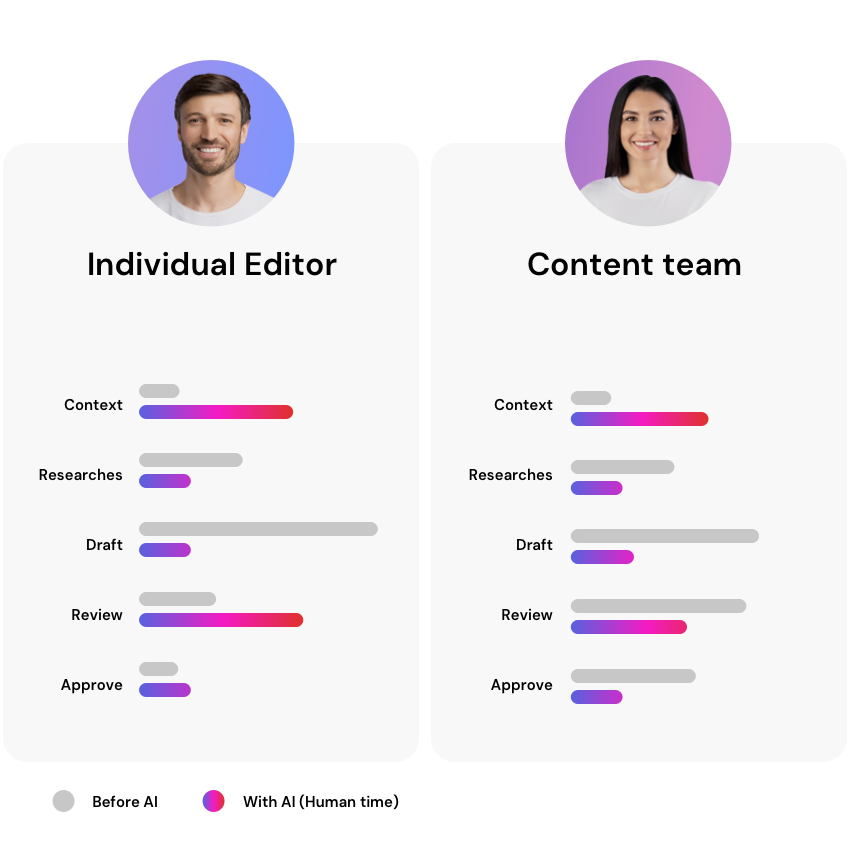
There was never production without direction. Editors have always decided what to make and how it should read. The writing was the visible part on top. AI just changes the ratio.
- Individual editor. Moves from producing words to setting context: briefing the AI, giving it the audience and the goal, then judging and shaping what comes back. The quality of that input decides the quality of the output, so the time an editor once spent drafting now goes into defining brand rules, source facts, and the intent behind a piece. Done well, the role looks like an editor-director: less typing, more briefing, and reviewing.
- Content team.The team’s work changes too, but that change comes from a shared content source, not from AI on its own. When content, SEO, data and product all work from one set of facts and rules, they stop maintaining separate versions. Handoffs that used to move by email and ticket happen in one place, so the team spends less time reconciling conflicting copies and more time on strategy.
What guardrails content teams should give AI before it creates
Feed AI with relevant information and get a great output. Before asking an AI tool to write anything, content teams should give it the following five layers of context:
- Business: what goal does this content serve? Name the outcome the piece needs to achieve, either ranking for a query, supporting a sales conversation, answering a recurring customer question, so the AI aims at a result rather than a word count.
- Audience: who is this for, and what do they already know? Describe the reader, what they already know, and where they sit in the buying decision, so the draft resonates with your target audience.
- Strategy: what has already been decided? Hand over the angle, the core message, and the positioning you've locked, so AI builds on those.
- Sources: what should it draw from, and what is off-limits? Give it the verified facts, product details, and approved data to work from, and flag what to avoid, so it doesn't invent a claim or pad with generic filler.
- Execution: what should the output look like? Provide the format, length, tone, and rules the piece has to follow, so what comes back is close to usable. Reusable prompts and rules save time, instead of writing a fresh prompt for every task.
The editor supplies the material, frames the project, passes on the decisions already made, sets the rules the AI works within, and saves the task itself for last. The order is what matters: context first, then execution, human approval at the end.
Why human in the lead goes a step beyond human-in-the-loop
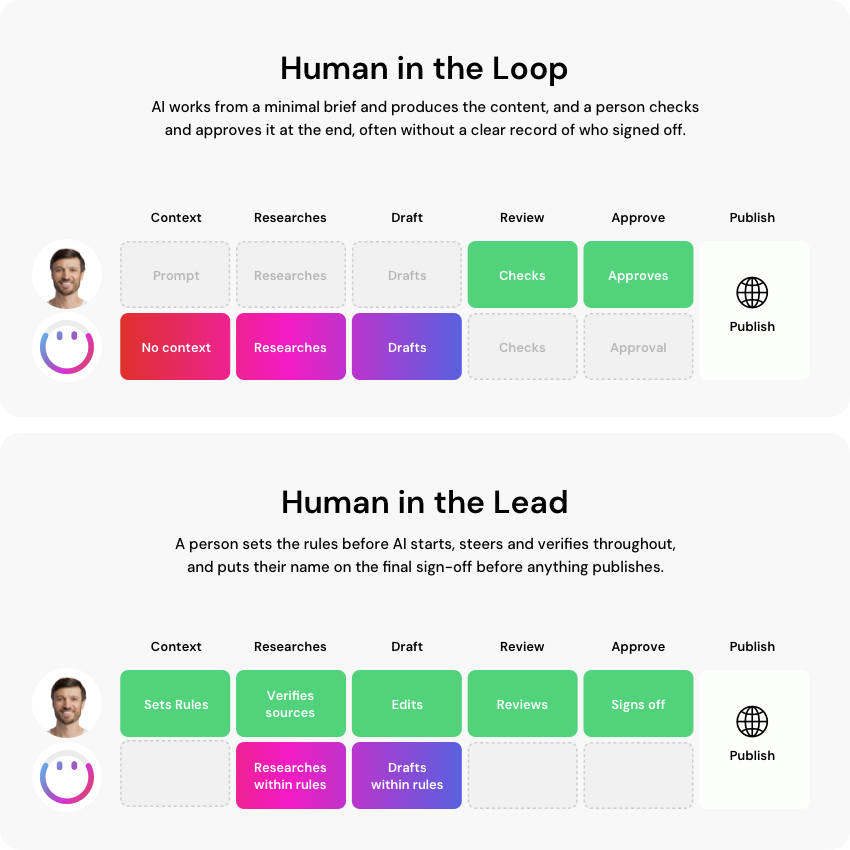
In the loop, a person occasionally checks in on what the machine produced. A human in the lead keeps control, responsibility, and final publishing authority, even as AI handles more of the volume. The distinction matters because accountability can't be outsourced. Companies have the final responsibility on what they publish, and that weight is heaviest on the claims that are legally sensitive, brand-defining, or potentially harmful.
| Features | Human in the loop | Human in the lead |
|---|---|---|
| When the person acts | After the AI produces, as a check | Before and throughout, setting direction and signing off |
| What the person controls | Whether to approve or fix what's already made | What the AI works on, the rules it follows, and what publishes |
| Where accountability sits | The person is still accountable, but hard to trace when AI works outside the workflow | With a named person who owns the published claim |
If a model invents a product spec or drifts off brand, the consequence lands on the company, and the workflow has to guarantee that nothing publishes without human sign-off. CoreMedia explains this in its guide to enterprise AI content governance.
What separates teams that thrive from teams that fall behind
The difference is how AI is used. A team that treats it as a faster typewriter produces more content that is generic and off brand, and gains little. A team that hands AI the routine work and spends the saved time on strategy and editing gets faster and sharper at once. AI has made average content free and infinite. A team whose only strength was decent copy at speed no longer has an edge worth paying for.
The teams that get stronger bring what AI cannot:
- A clear point of view.
- Brand authority.
- Accurate first-hand knowledge.
- The taste to differentiate a good draft from a plausible one.
AI multiplies what you feed it, so a sharp strategy yields more sharp work and a vague one yields more noise.
Challenges content teams face when adopting AI
The biggest challenge in adopting AI is holding quality and control steady as volume grows. The common obstacles are predictable, which means you can plan for them.
- Brand inconsistency. AI trained on the open web defaults to generic phrasing, so output slides off your voice unless it works from your brand rules.
- Factual errors. A model may state a wrong spec if it is not fed with current and approved data.
- Ungoverned use. When people use AI tools outside the content system, versions multiply and no one can say which is approved or how a claim was made.
- Rigid workflows. Approval chains built for human pace delay when AI multiplies the volume, so workflows have to be adapted for AI speed.
- Proving the value. Output volume is easy to count. Quality and business result are harder, which makes it essential to make content performance measurement an essential part of the workflow.
- Write for humans and machines. Content teams need to write for humans but also for AI agents, that summarize and cite them. Content has to be clear for readers, and structured and factual enough for machines to trust.
- Shared AI workflows. Without a common set of prompts and rules, every editor briefs AI differently, and output quality swings depending on who's asking.
How your AI content workflows keep humans in the lead
Working this way takes more than access to a good AI tool. It takes a setup built for AI speed with people in the lead. Four needs come up for every content team:
Briefing replaces drafting. Editors no longer write from scratch. They define the audience, the goal, and the brand rules the AI follows. That needs a system where those rules are stored and reusable, not retyped into a prompt every time.
Reviewing replaces typing. The editor's time moves from producing text to checking it, for accuracy, brand fit, and whether it's worth publishing. That needs a fast, reliable way to compare AI output against approved facts and brand guidelines.
Fact-checking becomes routine. Every AI-drafted claim needs verifying before it publishes. That needs a single, trusted source of truth to check against, not a search across scattered documents and systems.
Content has to work for humans and machines. More sites are read by AI agents that summarize and cite them, so content has to serve both: clear for readers, and structured and factual enough for machines to trust and cite.
This is what CoreMedia is built for. CoreMedia KIO, the AI editorial agent in the CoreMedia Digital Experience Platform, drafts and structures content for several sets at once, suggests metadata and tags, supports translation, and helps prepare content for search and AI search, with editor approval required before anything publishes. Because content is managed as structured objects from a single source, every channel draws on the same facts instead of copies that fall out of sync, and every change stays traceable: who changed what, when, and what came before.
The German Chamber of Industry and Commerce used CoreMedia KIO to restructure and create large parts of its new website directly during a full relaunch, instead of migrating content page by page, working with implementation partner ]init[. Inside CoreMedia Studio, CoreMedia KIO now handles metadata, translation, and tone adjustments as part of daily editorial work, with an editor reviewing every suggestion before it goes live. Six months in, the team built a complete English-language site with the same headcount, held SEO quality steady, and cut translation effort significantly. Learn more about their journey with CoreMedia KIO:
Full presentation: https://youtu.be/BCVQKibeGCQ?si=yH93PZZZ7sPkVhsX
Where this leaves you
AI raises the value of a content team that leads it. It lifts the teams who set direction, protect the brand, and own the published claim. That takes a platform like CoreMedia where brand-aware AI works inside the actual content workflow, with human approval built into every step along the way. The teams that come out ahead treat AI as something to direct, and they keep a human in the lead of every decision that goes public.
Frequently asked questions
Will AI replace content teams?
AI changes how content teams work. It takes over routine production, drafting, tagging, translation, and reporting, while people move to strategy, reviewing, and owning what gets published. As content teams increasingly direct and review AI, it needs to be embedded in existing workflows with human approval built in, which is the model CoreMedia KIO is built around.
What will content teams do once AI handles production?
Once AI handles production, content teams direct the work: they set strategy and brand rules, brief the AI, edit and fact-check its output, and decide what publishes. Structuring content so machines can read and cite it is becoming part of the job too.
What should content teams give AI before it creates content?
Content teams should give AI at least five layers of context before it creates content: the business goal, the audience, the strategy, the sources it can draw from, and the execution details of the task. For enterprise teams, that context needs to live in a shared content operating system with shared prompts and brand rules like CoreMedia, so output stays consistent no matter which person is directing the AI.
What are the best practices for content teams using AI?
The best practices for content teams using AI come down to directing it well and staying accountable: give the AI full context before it writes (business goal, audience, strategy, sources, and task), keep shared prompts and agreed topics so output stays consistent, verify every fact and source, and require human sign-off before anything publishes. Put simply, feed it well and keep a human in the lead.
How do you measure the success of AI in a content team?
You measure the success of AI in a content team by looking past output volume to quality and result: editing time saved per piece, time from brief to publish, error and correction rates, content performance in search and AI answers, and how consistently the output stays on brand. Volume alone is a vanity metric; the real question is whether AI freed the team for higher-value work without lowering the bar.
What does human in the lead mean?
Human in the lead means a person keeps control and holds final authority over what publishes, a step beyond human in the loop, where a person only reviews AI output after the fact. Accountability for brand, legal, and factual claims stays with a named person, not the tool.
How do you keep AI-generated content on brand and accurate?
You keep AI-generated content on brand and accurate by giving the AI a single, structured source of brand facts to work from, requiring human review before publishing, and recording what changed and who approved it. That's easiest to enforce on a content platform like CoreMedia where AI is built into the existing content workflow itself, so brand context, approval, and tracking all happen in one place instead of three. That consistency and traceability are what keep customers, and AI systems, trusting your content.
Can AI replace human creativity in content?
AI cannot replace human creativity in content, though it can imitate its surface. A model recombines patterns from what already exists, so it's strong at variations on the familiar and weak at the genuinely new: the original angle, the argument no one has made, the risk a brand takes on purpose. Those come from human judgment and point of view. AI is best used to scale and speed up creative work; the idea itself still comes from a person.