
























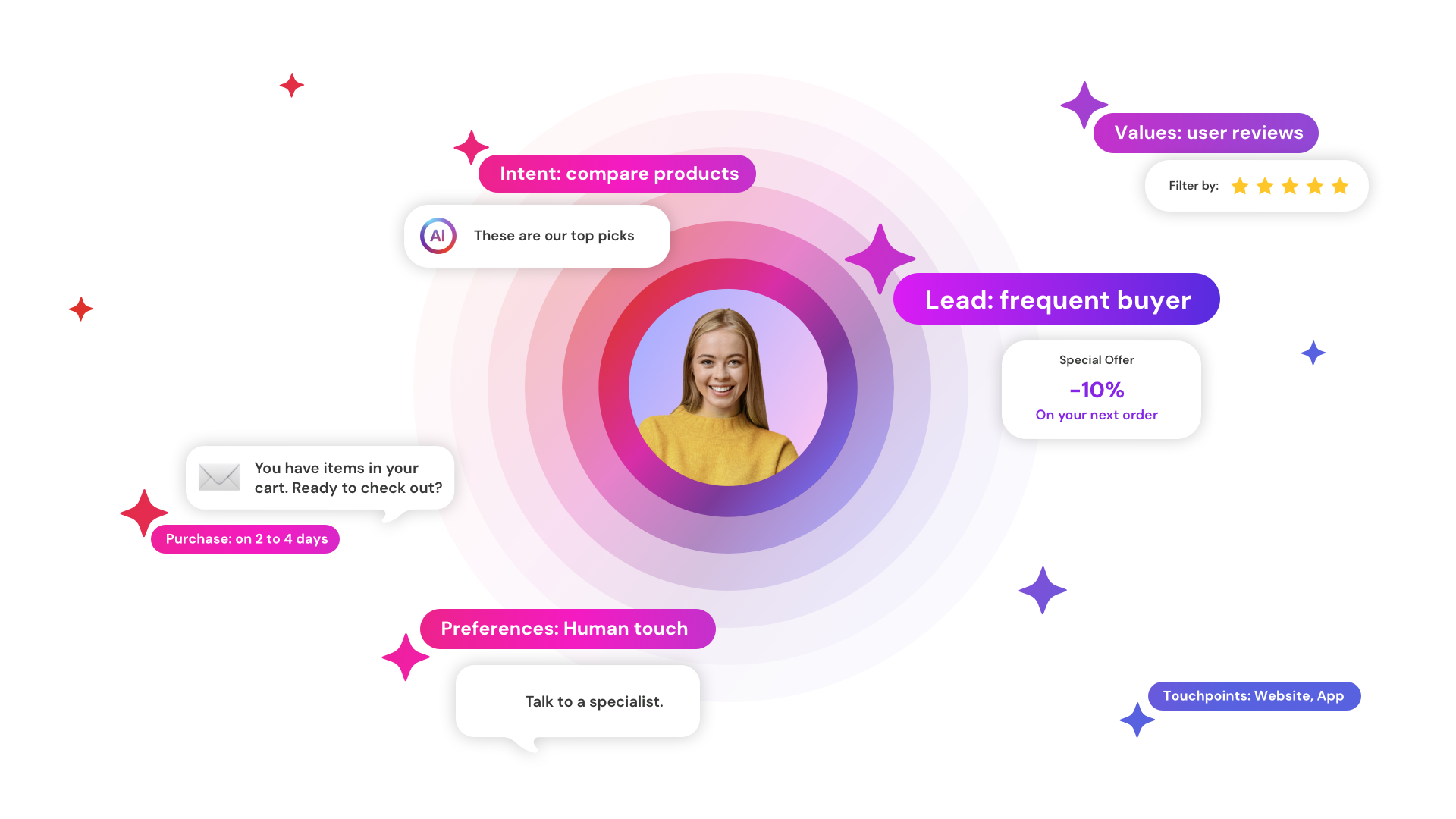
The rules of digital engagement have fundamentally changed. Powered by machine learning, natural language processing, and advanced AI tools, these systems shape decisions long before a human visit. In this AI era, the traditional customer journey is being replaced by an AI customer journey, where visibility depends on how well your content and data are understood by AI systems. If they can’t interpret it, your brand is excluded - reshaping customer experience and influencing outcomes before interaction even begins.
To succeed, organizations must redesign the customer journey for both machines and people. That means structuring content, improving customer journey mapping, and using AI-powered capabilities to deliver the right message at the right time. The real opportunity lies in connecting this automated discovery with meaningful human interaction - whether through timely sales conversations, expert guidance or seamless transitions across customer interactions - turning intent into action.
What is the AI-mediated customer journey?
The AI-mediated customer journey describes a model where an autonomous system sits between your brand and the buyer, acting as a gatekeeper for information. Instead of customers directly exploring your website or engaging with your content, AI agents interpret needs, gather data, and decide what gets presented - shifting control of the customer journey toward machines.
This marks a clear departure from the traditional customer journey, where users were presented with lists of links and left to evaluate options themselves. Today, AI tools synthesize answers directly - compressing journey stages and reshaping customer behavior while enabling more proactive support based on inferred needs. Discovery, comparison, and evaluation increasingly happen before a user reaches your ecosystem, fundamentally reshaping customer experience and how brands gain visibility.
As these systems and underlying AI algorithms become more agentic, they don’t just answer questions - they are beginning to act on behalf of users. This transforms the AI journey into a pre-qualified process, requiring brands to ensure a new level of precision - ensuring that content is structured, trusted, and prioritized within the AI customer journey.

The rise of the "AI Dark Funnel"
One of the biggest challenges in today’s evolving digital landscape is that it’s becoming harder to measure. Platforms like ChatGPT, Google Gemini, and Perplexity don’t pass referral data in a meaningful way. As a result, traffic influenced by these environments often appears as “Direct” or branded search, masking the true source of demand.
What this means for enterprises
As AI-driven journeys expand, organizations face a new set of risks:
- Loss of visibility into the customer journey
Key moments of influence are no longer trackable, making journey mapping incomplete and harder to trust. - Gaps in data and analytics
Without reliable inputs, real-time insights, predictive models, and performance analysis become less accurate. - A compressed and invisible decision process
Buyers increasingly arrive with decisions already made, bypassing traditional awareness and consideration stages. - Misinterpretation of customer intent
What looks like a fast conversion may actually reflect a long, unseen decision journey outside owned channels. - Risk of commoditization
AI systems prioritize structured data — such as features, pricing, and availability — over brand storytelling. If differentiation isn’t machine-readable, it becomes invisible.
Why traditional CMS and marketing frameworks are failing
Most legacy platforms were built for a different digital model - focused on visual presentation, not machine understanding. In today’s AI-powered environments, content must be structured, contextualized, and readable by intelligent systems. In an AI customer journey, this is essential for content to be accurately interpreted and surfaced. Without it, even strong content fails to appear - limiting customer experience and creating early drop off pointsbefore interaction begins.
At the same time, most enterprise ecosystems remain deeply fragmented. Brand websites, e-commerce platforms, CRM tools, and contact centers often operate in silos, holding disconnected customer data and views of customer behavior. This makes effective customer journey mapping and customer segmentation increasingly difficult, preventing systems from delivering consistent experiences aligned with customer needs.
AI-driven platforms rely on cohesive, structured inputs to generate meaningful outputs. When systems don’t share context, they cannot deliver consistent, relevant experiences - or adapt to user behavior in real time. More importantly, they cannot support how modern discovery works. The result is a disconnect between visibility and conversion.
This leads to a critical disconnect between visibility and conversion. Many brands are beginning to appear in AI-generated responses, gaining surface-level brand visibility. But when potential buyers transition from that environment into the brand’s owned ecosystem, the experience often breaks down. The journey shifts from seamless and contextual to fragmented and generic - failing to deliver the personalized experiences users now expect. Without continuity across systems, even high-intent visitors struggle to find relevance, leading to friction, missed opportunities, and lost revenue growth. In this new reality, success is no longer just about being discovered. It’s about ensuring that every step is connected, consistent, and designed to convert.
The 4 pillars of a future-proof AI customer journey
To compete, organizations need more than incremental fixes - they need a fundamentally different approach to designing digital experiences. This means rethinking architecture, data, and operations to support an environment where discovery is mediated, decisions are accelerated, and expectations are higher than ever. The following four pillars define a modern foundation for managing the AI customer journey, enabling brands to improve journey performance, deliver consistent customer experience, and build a sustainable competitive advantage in the AI era.
1. Structuring content for the answer engine economy
Machine-readable architecture:
The shift from pages to answers requires a new approach to content. Instead of designing static pages, brands must create modular content blocks enriched with metadata and structured data. This allows AI systems and AI agents to interpret, assemble, and deliver information accurately across the AI customer journey.
Entity integrity:
Maintaining clear and consistent meaning is critical. Using standards like Schema.org and building knowledge graph foundations ensures that products, services, and brand attributes are properly understood in context. Without this, even high-quality content can be misinterpreted, limiting brand visibility and weakening impact.
Omnichannel delivery:
A headless architecture enables structured content to flow across all interfaces - from websites to conversational AI and emerging platforms. This ensures consistency across customer touchpoints and aligns content delivery with how modern users engage throughout the customer journey.
2. Unifying data across the digital ecosystem
The single source of truth:
Disconnected systems create inconsistent experiences. Unifying customer data across PIM, commerce, and CRM tools ensures that both internal teams and AI systems operate on accurate, up-to-date information - reducing risk from poor data quality.
Contextual personalization:
Centralized data allows brands to immediately recognize and respond to users arriving from AI-driven discovery environments. These visitors often enter the customer journey with high intent, shaped by prior interactions with AI tools. By leveraging unified customer data and real-time context, including purchase history and signals from existing customers, brands can dynamically adapt content, messaging, and offers the moment a user lands on a digital asset - whether it’s a homepage, product detail page, or pricing page. This ensures alignment with user intent, addresses specific customer needs, and reduces friction in critical journey stages, ultimately improving customer experience and conversion outcomes.
Ingesting analytics:
To regain visibility into the “AI Dark Funnel,” organizations must go beyond traditional analytics. This includes leveraging server log analysis to detect traffic patterns originating from AI-driven environments, as well as developing new metrics like AI Share of Voice (AI-SoV) - which measures, how often and how prominently your brand appears in AI-generated responses. By combining these approaches with customer journey analytics, brands can begin to reconstruct hidden parts of the journey, uncover previously invisible customer behavior, and generate more accurate customer insights. This shift is essential for improving journey mapping and making informed decisions.
3. Empowering teams with AI Co-pilots
Authoring efficiency:
Embedded AI-powered tools are transforming how teams operate inside the CMS. Solutions like CoreMedia KIO act as intelligent co-pilots, helping automate routine tasks, optimize metadata at scale, streamline workflows, and accelerate content production across the customer journey. By reducing manual effort and enabling smarter reuse of content, teams can focus on higher-value activities - improving consistency, speed, and overall customer experience while keeping pace with the demands of the AI era.
Content personalization:
AI enables teams to activate modular content at scale by tailoring experiences to individual users. Instead of delivering the same content to every audience, AI can dynamically select and adapt modules based on behavior, context, and intent.
This allows organizations to deliver more relevant content across channels — whether adjusting messaging for different customer segments, personalizing recommendations, or adapting experiences in real time — without increasing content production effort.
Machine Learning Optimization:
AI co-pilots continuously learn from customer behavior, customer feedback and performance data, helping teams refine strategies over time. This supports better decision-making and allows brands to deliver more effective, personalized experiences aligned with evolving customer expectations.
4. The human handoff: The ultimate differentiator
Seamless transition to human expertise:
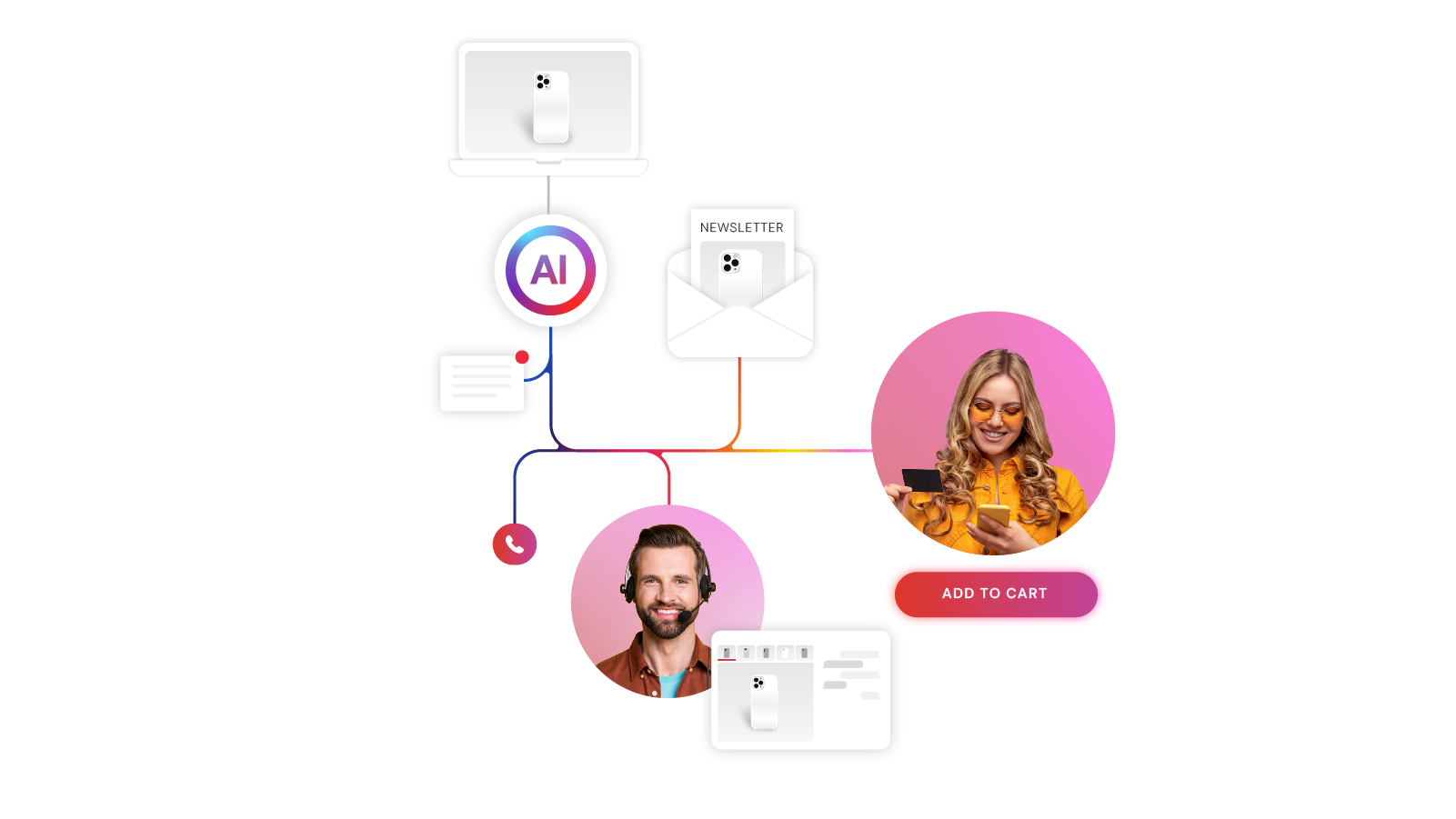
While automation is transforming discovery, many high-value decisions still depend on human trust, validation, and expertise - especially in contexts like B2B and luxury purchases. The ability to transition smoothly from digital to human engagement is critical in high-value scenarios, especially across complex customer journey stages.
Equipping the contact center:
By connecting systems through solutions like CoreMedia’s Cloud Contact Center, brands can give customer success teams and sales teams full visibility into prior interactions - what the user explored, what was surfaced during the AI journey, and where friction occurred. This shared context enables more informed conversations, faster resolution of pain points, and more effective sales calls, turning high-intent moments into meaningful outcomes across the buying process.
Delivering omnichannel support:
Offering multiple engagement options - live chat, voice, video - ensures users receive support in the format they prefer. Providing the right interaction at the right time improves conversions, strengthens customer loyalty, and enhances long-term customer experience.
How CoreMedia connects AI-driven discovery to conversion
CoreMedia’s Content Management System defines the next generation of CMS by combining API-first architecture with intuitive WYSIWYG presentation tools and native personalization. Developers can structure content for AI systems, while marketers retain full control to craft rich, inspiring product experiences across channels.
This hybrid approach enables modular, structured content that is both machine-readable and easy to work with for editors - ensuring your brand is understood by machines and differentiated for humans.
The CoreMedia Customer Engagement Platform acts as the critical bridge between AI-driven discovery and human conversion. By connecting digital experiences with the contact center, it equips teams with real time data and insights into user context, intent, and prior interactions.
This allows customer success teams and sales teams to engage with precision, resolve pain points faster, and guide high-intent users forward - turning AI-driven visibility into meaningful outcomes across the AI customer journey.
CoreMedia seamlessly blends content and commerce by integrating with platforms like Salesforce and SAP. This enables brands to turn every interaction into immediate value and incremental revenue - whether initiated through AI or human engagement.
From product discovery to conversion, experiences remain consistent, contextual, and actionable - improving customer experience and driving measurable revenue growth.
Conclusion: Prepare your DXP for the invisible interface
The shift is already underway. The AI-mediated customer journey is no longer a future concept - it’s redefining how discovery, evaluation, and decision-making happen today. To compete, brands must move beyond promises and toward structured, machine-readable proof that can be understood, trusted, and surfaced by AI.
But technology alone is not the goal. The role of artificial intelligence is to handle the complexity of discovery - surfacing the right information, anticipating customer needs, and enabling more informed decisions. This allows human teams to focus where they create the most value: building trust, strengthening customer relationships, addressing customer emotions and delivering the empathy required to create satisfied customers and to close high-value interactions and improve overall customer satisfaction.
Organizations that get this balance right will not only improve customer experience, but also increase customer lifetime value and strengthen long-term performance - using better AI customer journey mapping, more reliable data, and continuous improvement to stay ahead in a rapidly evolving landscape.
Ready to adapt?
Discover how CoreMedia’s CMS, CoreMedia’s Customer Engagement Platform and CoreMedia KIO AI work together to power a future-ready, composable DXP. Book a demo to see how you can turn the AI customer journey into a measurable competitive advantage.