





















The problem is scale.
Most enterprises still rely on a page-based content strategy. Campaigns are built as pages - landing pages, product pages, or a blog post - each created for a specific channel or audience. When that same message needs to appear elsewhere, teams often start over.
The result is predictable: duplicated work, fragmented messaging, and slow time to market.
This is where modular content changes the equation - and where modular content begins to scale across the enterprise.
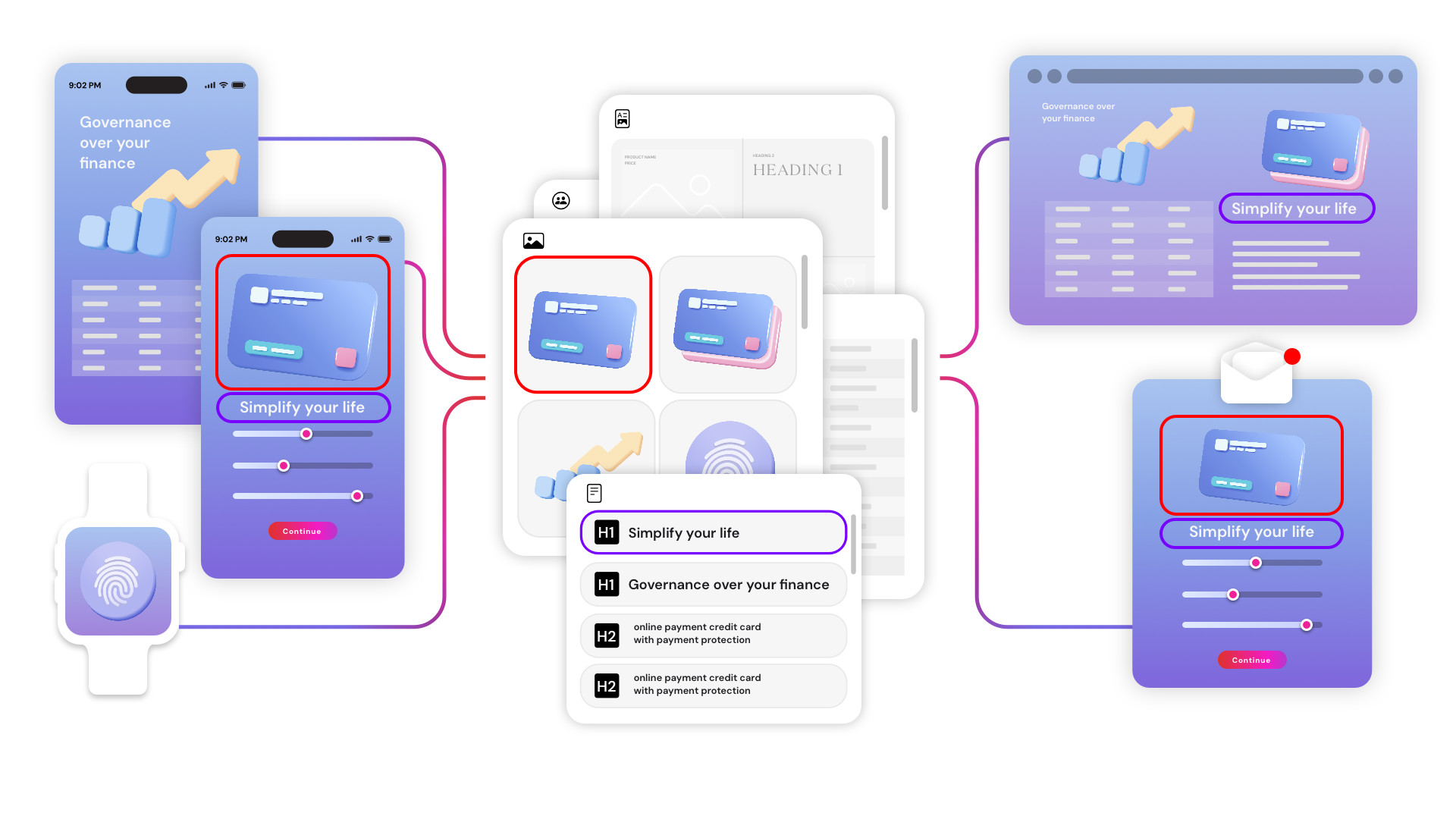
Instead of treating content as fixed pages, a modular content strategy breaks it into reusable building blocks - or modules - that can be assembled into different experiences. In practice, organizations can create once and adapt across channels without rebuilding everything from scratch.
For global enterprises, this shift is becoming essential. Teams need to scale content production and improve how they are creating content, maintain brand consistency, and deliver the right message to the right person across channels.
Done well, modular content transforms the content supply chain, enabling faster content creation, better alignment across teams, and more scalable customer experience delivery - showing how modular content drives enterprise scale.
What is modular content? (And why "pages" are dead)
To understand the value of modular content, it helps to look at how most websites and digital experiences have traditionally been built.
For years, the web revolved around the page. Each page combined headlines, visuals, product details, and calls to action into a fixed structure. When content needed to appear somewhere else, teams copied and adapted it manually.
That model no longer holds.
Today, enterprises must deliver digital content across multiple channels, often in multiple versions. A single campaign might live on a website, inside an app, across social media posts, and within tools used by sales teams. Managing this through pages alone leads to duplication and slows down content creation.
Modular content introduces a different structure.
Instead of treating content as a single unit, it is broken into self-contained units - modules - that represent individual pieces of information and individual assets, such as:
- Product headlines.
- Hero images.
- Product cards.
- Promotional banners.
- Legal disclaimers.
Each module can be reused, updated independently, and combined with others to form complete experiences - simplifying the process of creating modular content.
In practice, this means content is no longer locked into pages. Teams work with flexible content blocks that can be assembled depending on context, channel, or audience.
This shift becomes powerful at scale. Organizations maintain a structured modular content library, supported by digital asset management and governed through a content management system. Built-in workflows, approval processes, and role-based permissions ensure that content is reviewed, compliant, and consistently applied across markets. This allows teams to work with pre-approved content, reuse existing assets, and maintain brand consistency across channels.
As a result, multiple teams, including content teams, can work from the same foundation without duplicating effort. Instead of constantly producing new content, they combine, adapt, and repurpose content that already exists.
Once this model is in place, pages become just one output - not the starting point.
The business case: Why enterprises need a modular strategy
For many enterprises, the shift to modular content is driven by performance, not theory - and the benefits of modular content quickly become measurable.
Marketing leaders face a different kind of challenge. Campaigns take too long to launch, content is duplicated across teams and channels, and updates must be repeated in multiple places. As content volume scales, maintaining consistency across regions and touchpoints becomes increasingly difficult.
At the center of these challenge is the content supply chain.
A modular content strategy improves how content is created, managed, and deployed. Instead of building campaigns from scratch and constantly creating content, organizations work with reusable content modules stored in a shared modular content library. These include pre-approved content modules and pre-approved content blocks that have already passed governance, reducing friction in the content management process.
A modular content approach delivers measurable benefits:
- Faster campaign launches through reusable content.
- Consistent messaging across markets and channels.
- Reduced duplication and manual effort.
- Centralized updates with a single source of truth.
- Stronger governance and compliance.
This has a direct impact on time to market. With reusable content modules and existing assets, teams can launch new campaigns significantly faster. CoreMedia benchmarks show that enterprises can reduce production time by up to 75% by shifting to a modular approach.
Modular content in practice: Emerson Success Story
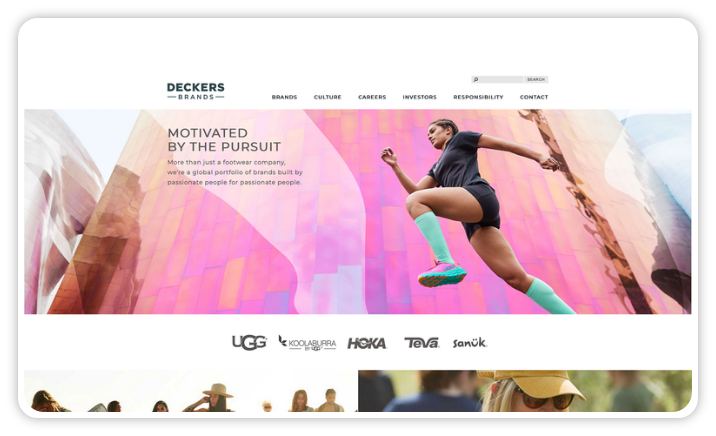
Emerson, a global technology and engineering company, faced a similar challenge at scale. Operating across 36 locales and 11 languages, and managing over 500K products, their teams were working in disconnected systems with duplicated content and inconsistent processes. By moving to a unified content platform with shared content modules and a centralized content management system, Emerson consolidated its digital presence and enabled global teams to collaborate more effectively..
Today, content is created once and adapted across regions, with consistent branding and localized experiences delivered automatically - a clear example of how modular content enables global scalability without sacrificing local relevance.
This is the operational impact of a modular approach - improving efficiency while bringing structure and control to complex global environments.
Balancing global consistency with omnichannel flexibility
Efficiency, however, is only part of the story. Enterprises operating across regions need to balance central control with local flexibility, especially across brand teams. With modular content, core messaging can be defined once and adapted across markets without losing alignment. Updates to a module can be applied across multiple channels, ensuring consistency without repeated effort and maintaining consistency across markets.
This becomes increasingly important as content expands beyond traditional web environments. Today, digital content must appear across various platforms, from ecommerce interfaces, social media channels, chat interfaces, digital screens to customer support tools. A page-based system cannot support this level of omnichannel content distribution effectively.
By separating content modules and digital assets from their presentation, organizations gain the flexibility to deliver content wherever it is needed. The same module can support a website experience, a mobile interface, or a sales interaction.
The result is a more efficient and scalable content strategy - one of the key benefits for enterprise teams. One that improves content production, strengthens brand consistency, and shows how modular content drives better customer experience outcomes.
How modular content powers true personalization
While efficiency and scalability make a strong business case, the real transformative power of modular content appears when organizations begin to deliver truly personalized experiences.
Traditional web publishing makes personalization difficult because most experiences are built as fixed pages. Even when a page is duplicated into multiple versions, it remains a static structure that treats every visitor the same. This approach limits the ability of brands to respond to individual user intent.
A modular content strategy changes the mechanics of personalization.
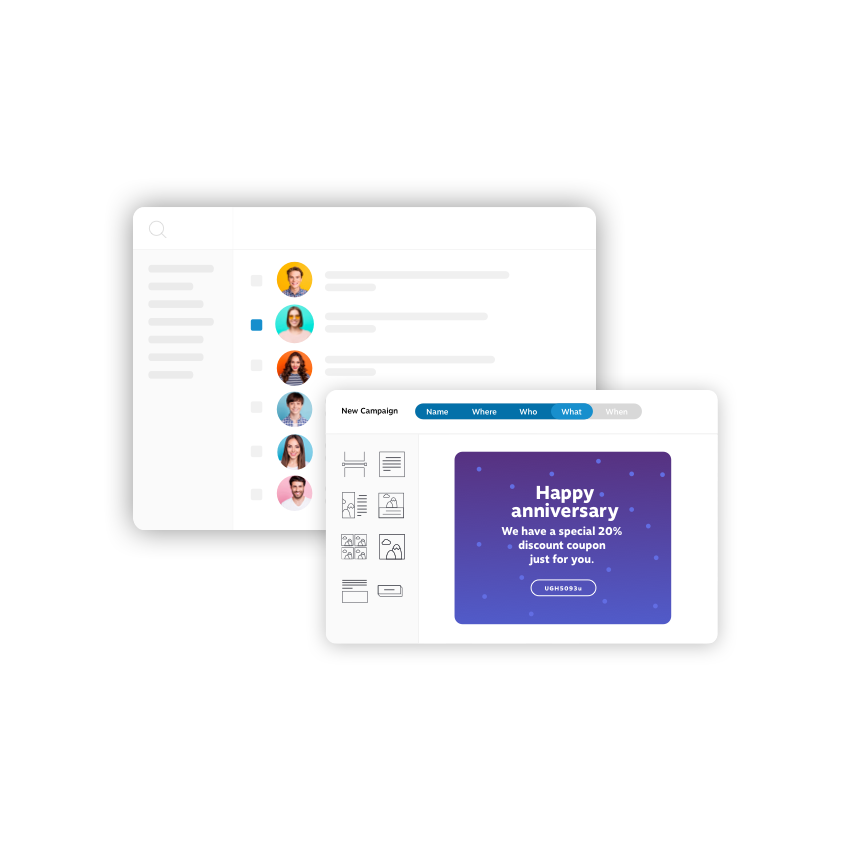
When experiences are built from independent modules, each content block becomes a flexible element that can be selected, replaced, or rearranged dynamically. Instead of serving one static page to every visitor, systems can assemble modules in real time based on data about the user, their context, and their position in the customer journey.
This makes the equation of personalization far more precise: deliver the right message to the right person at the right moment.
Because each module is a reusable unit of digital content, it can respond to signals coming from analytics platforms, CRMs, and behavioral data sources. Modern content management systems integrate these signals so that experiences adapt as the visitor interacts with the brand across multiple channels.
Consider how this works in practice. Take the example of a telecom provider.
A visitor identified as a B2B customer who has already explored product pages, technical documentation, or pricing for a 5G enterprise connectivity offering may be shown integration details, architecture overviews, or a “Request a consultation” call to action.
A consumer visiting the same page - for example after browsing mobile plans or arriving via a search like “5G coverage” - might instead see a simplified overview of benefits, pricing options, or a short explainer video.
In both cases, the experience is built from the same modules, assembled differently based on user intent and context.
This is where modular content becomes even more powerful, especially when artificial intelligence and predictive analytics enter the picture. Machine learning models can analyze patterns in user behavior and determine which modules are most likely to drive engagement or conversion. As these insights feed back into the content supply chain, organizations continuously refine how modular content works across campaigns.
Governance and control in a modular content model
For enterprises managing large volumes of digital assets, this model also supports long-term optimization. Instead of constantly producing new assets, teams analyze which modules perform best and reuse them in different combinations across campaigns and different channels. Over time, the organization develops a smarter and more efficient content strategy built on data rather than guesswork. At the same time, modular content also strengthens governance as modules can be centrally managed, approved, and updated — ensuring consistency, compliance, and reducing the risk of outdated or conflicting information across channels.
Ultimately, modular content enables a shift from static publishing to adaptive experiences.
Content is no longer locked inside individual pages. It becomes a flexible system of modules that respond to user behavior, business goals, and contextual data. When implemented effectively, this modular content approach allows enterprises to scale personalized experiences across channels while maintaining the operational efficiency required by modern content management.
And in a market where customer expectations continue to rise, that ability to deliver the right experience at the right moment can define the difference between traffic and meaningful engagement.
Implementing modular content: The "Hybrid Headless CMS" advantage
Adopting modular content is not only a question of strategy. It also depends on the platform and tools that support it.
Many organizations turn to a headless CMS to enable structured content and API-driven delivery. While this approach gives developers full control over architecture and flexibility, it often introduces a new challenge: the loss of a usable interface for marketing teams.
In a purely headless setup, content exists as structured data without a visual layer. This means marketers must rely on developers to preview, adjust, or publish experiences. As a result, workflows slow down, and the gap between technical teams and business users grows.
This is where a hybrid headless approach makes the difference.
CoreMedia combines structured content on the backend with a visual, WYSIWYG editing experience on the frontend. Developers can define flexible modular components and integrate them across systems, while marketers can create, edit, and assemble modules visually without depending on code.
This balance is critical for enterprise environments.
It allows teams to maintain the benefits of structured content management while ensuring that marketing teams retain control over campaigns and experiences. Instead of choosing between flexibility and usability, organizations can support both.
The same principle extends to commerce experiences. With a hybrid approach, brands can combine editorial storytelling with transactional elements. A lookbook, for example, can seamlessly integrate shoppable modules without requiring custom development for every campaign.
In practice, this means modular content is not just technically scalable - it is operationally usable, making modular content accessible across teams.
Beyond the website: Modular content across omnichannel experiences
Most discussions around modular content focus on digital channels. But the real opportunity extends further.
Customer interactions increasingly happen in conversations — through chat, video calls, and support environments where sales teams and service agents engage directly with customers. In these moments, content is no longer just published; it is actively used.
This is where modularity creates a new kind of value.
To support these interactions effectively, agents need immediate access to accurate, relevant content. Not static documents, not outdated PDFs or disconnected marketing materials — but the same content modules and digital assets that power digital experiences.
With CoreMedia’s content management system, this content is already structured, governed, and stored in a centralized modular content library. Product information, promotional messaging, and brand content exist as reusable modules, ready to be deployed wherever they are needed.
Through CoreMedia’s customer engagement platform, that same content becomes available within live interactions.
In these scenarios, content becomes accessible within live interactions, enabling agents to share relevant information more effectively during conversations. Instead of relying on generic links or static materials, they can guide customers using consistent, up-to-date content aligned with digital experiences.
The impact is immediate.
Customers receive consistent information across touchpoints, while agents work with confidence, knowing they are using the latest approved content. The gap between digital and human channels disappears, replaced by a unified system where content flows seamlessly into every interaction.
This changes how organizations think about customer experience.
Content is no longer confined to websites or apps. It becomes a shared resource across multiple teams, supporting both automated journeys and human conversations. Marketing, commerce, and service align around the same source of truth — improving consistency while enabling more responsive, high-value engagement.
In this model, modular content is not just scalable. It becomes actionable — supporting the moments where decisions are made.

Strategic checklist: Are you ready for modular?
Before organizations fully implement modular content, it is important to follow modular content best practices and assess readiness.
Many enterprises still operate with fragmented content management practices, where existing content is tied to pages rather than reusable structures. These content silos often signal an opportunity to identify gaps in how content is created and managed.
To successfully implement modular content, organizations should align three key areas:
- Process: Are content workflows designed for reuse, governance, and scalability — or still focused on one-off campaign creation?
- Technology: Does the current content management system support structured content, modular workflows, and both developer and marketer needs?
- Mindset: Are teams thinking in terms of self-contained units that can be reused across contexts, rather than building isolated assets for each campaign?
Organizations that align process, technology, and mindset are better positioned to scale their content strategy and adapt to future demands.
How AI amplifies the value of modular content
As modular content becomes the foundation of modern content strategy, it also plays a critical role in how content is discovered, interpreted, and surfaced by artificial intelligence.
At its core, modular content creates structured, consistent information. This makes it easier for AI systems - including large language models - to understand, interpret, and reuse content accurately. In a landscape where AI-driven search is growing, this structure helps ensure content remains visible, trustworthy, and reusable across new interfaces.
Modular content also future-proofs content strategy. Because content is not tied to a single page or format, it can be delivered across new channels and touchpoints without needing to be rebuilt — whether that means emerging platforms, AI assistants, or new digital experiences.
Modular content creates the foundation. AI amplifies its impact. Together, they enable:
- Faster content creation and iteration
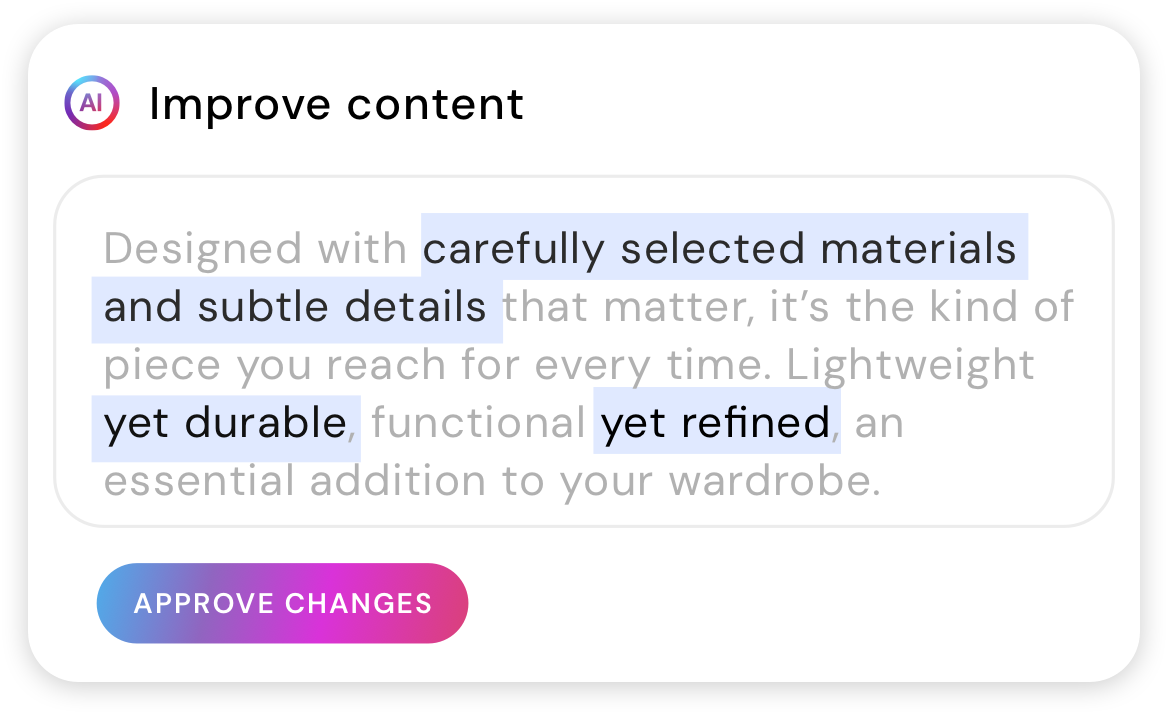
AI can generate variations of headlines, descriptions, or messaging in the brands' tone of voice, making it easier to test and refine content without creating entirely new assets from scratch. - Improved content discovery through smart tagging
AI can analyze text and images to automatically assign metadata, helping teams find, manage, and reuse digital assets more efficiently. - Dynamic content orchestration based on user intent
AI can use behavioral data and real-time signals to determine which modules to deliver to each user, enabling more adaptive and personalized experiences. - Continuous optimization across campaigns
Performance data feeds back into the system, helping teams understand which modules work best and reuse them in more effective combinations over time.
For enterprises, this shifts modular content from a system of reuse to a system of continuous optimization - where content not only scales but improves over time through data-driven decisions.
Conclusion: A scalable foundation for modern content strategy
For enterprises dealing with growing content complexity, modular content represents a strategic shift. It enables teams to create once, reuse at scale, and adapt quickly across markets and channels — reducing duplication while improving consistency and speed.
It enables organizations to scale content creation, maintain brand consistency, and deliver personalized experiences across channels without increasing operational overhead - key benefits of modular content at scale.
But the real advantage comes from unification.
CoreMedia brings together structured content management and real-time engagement, connecting digital experiences with omnichannel personalization built to convert. This allows organizations to move beyond disconnected systems and deliver consistent, high-impact experiences at every touchpoint.
The result is a more efficient content supply chain, stronger alignment across teams, and a more effective customer experience.
If the goal is to move faster without sacrificing consistency, modular content is the next step.
Ready to see it in action? Request a demo of CoreMedia’s headless CMS.